
Workshop leader with lots of batches to bake
Wants participants to keep baking without delays, so compares usable shelf levels, tray size and the trays included—not just the oven’s capacity in litres.


For a workshop at a different venue each time, a freestanding fan oven is an obvious choice. In a permanent kitchen, a built-in oven with clearly specified shelf levels may be better suited to several batches baking at once. Don’t just look at the capacity: check how many compatible baking trays are included, how much space and what type of connection you’ll need, and which oven setting the recipe calls for.
Wants participants to keep baking without delays, so compares usable shelf levels, tray size and the trays included—not just the oven’s capacity in litres.
May not have a permanent built-in space available and needs to be able to position and connect a freestanding oven, then put it away after the workshop.
Wants to keep a close eye on the oven setting and baking time across repeated batches, and knows that a recipe temperature for conventional top and bottom heat won’t necessarily be the same as for a fan oven.
Best suited to when: you’re baking somewhere without a suitable built-in space, or want to move the oven after the workshop.
Bear in mind: you’ll need enough worktop space and a suitable electrical connection. The capacity won’t tell you how many full-sized baking trays you can use at once.
Best suited to when: you have a permanent kitchen with a suitable oven space and want to use several trays at once. Bosch specifies 3D Hotair for up to three shelf levels in the HBA534BB3; AEG specifies baking on three levels for the NBU5A40SK.
Bear in mind: the installation space and accessories included. Both models mentioned come with one baking tray or roasting pan, so having several shelf levels doesn’t automatically mean all the trays you need are included.
| What to consider | What should you look for? | Who is this important for? |
|---|---|---|
| Baking capacity | Check the number of supported shelf levels, the usable tray sizes and how many trays are included. | If I want to limit the number of batches during a workshop, I look at what the model and compatible trays can actually handle. Around 36% of consumers with this need prioritise baking capacity. |
| Venue and positioning | Compare the available space with the appliance or oven-space dimensions, and check the connection and installation requirements. | At a workshop venue that changes from time to time, I want to know whether there’s a suitable space and connection, without relying on a permanent oven space. Positioning is the deciding factor for around 29% of consumers. |
| Recipe and oven setting | Check which settings are available and how to set the time and temperature; test the recipe beforehand. | If I’m using the same gingerbread biscuit recipe for several batches, I want to be able to repeat the settings and keep checking the results. Around 21% of consumers say recipe control is their top priority. |
| Accessories and care | Compare the trays and racks included with each model, and check the care instructions. | I want to know in advance whether I’ll need extra compatible trays as well as the accessories included, and how to care for the oven after use. Around 14% of consumers prioritise accessories and aftercare. |
The Bosch and AEG built-in models reviewed are both specified for baking on up to three levels, but each lists just one baking tray or roasting pan.
Count how many trays you’ll need for your planned batches and check that they’re compatible with the exact model.
Positioning, supported shelf levels and included accessories vary by model. The capacity in litres doesn’t tell you how many biscuits will fit at once.
Start with the space available and the trays you actually want to use, then compare capacity.
Voedingscentrum distinguishes between conventional heat and fan cooking. A brand’s general description won’t tell you which settings are available on the exact model.
Check the manual and, if necessary, bake a test batch of your chosen recipe first.
The freestanding OV607B is an option for a workshop venue without a built-in oven space.
The HBA534BB3 built-in oven is an option if you want to use several shelf levels in a permanent kitchen.
The NBU5A40SK built-in oven is specified for baking on three levels.
Electrolux specifically says the KOEBH09H built-in oven can bake biscuits or cakes on three trays at once.
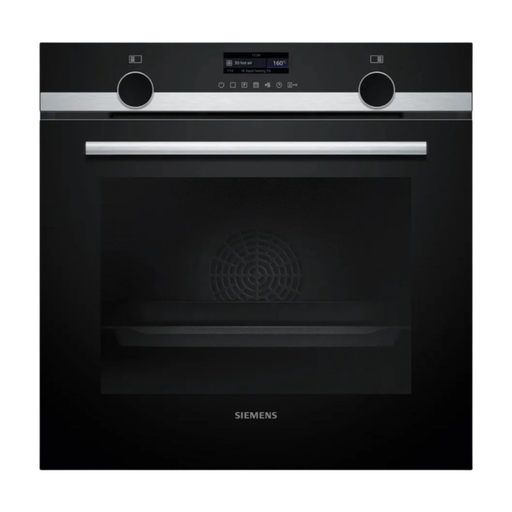
Siemens describes 3D hot air as a setting for cooking dry dishes on several levels.
This selection includes built-in ovens for a permanent kitchen and a compact worktop oven. Choose according to the space available, how many batches you want to bake and which accessories you need.
 No image available
A built-in option for a permanent kitchen; the product information specifies baking on up to three levels.
The product name lists 71 L and 3D Hot Air. Check that the available oven space and installation requirements are suitable for your kitchen.
 No image available
A built-in oven for a permanent kitchen; the product information specifies 3D hot air on up to three levels.
The product name lists 71 L, 3D HotAir and EcoClean Direct. Check the built-in dimensions and whether you’ll need extra compatible baking trays.
 No image available
An electric built-in oven for a permanent kitchen; the product information specifies 3D hot air on up to three levels.
The product name lists 71 L, Steam Cooking and Pyrolytic Self-Cleaning. Check the built-in dimensions and which settings suit your recipe.
 No image available
A compact worktop oven with fan cooking and conventional top and bottom heat, according to the product information.
Place the appliance on a stable, heat-resistant surface with plenty of ventilation. The accessible surfaces get hot during use.
 No image available
A built-in oven for a permanent kitchen; the product information specifies convection cooking.
The product name lists 71 L. Check the oven-space dimensions and whether the available settings suit your recipe.
Not without first checking which oven setting the recipe was written for. When converting a recipe from a conventional oven to a fan oven, Voedingscentrum recommends starting with a temperature around 10% lower. Check the colour and whether the biscuits are cooked through towards the end of the baking time; the right setting also depends on the recipe and the oven.
Check the colour of the biscuits at the end of each batch and make sure the edges don’t burn. The gingerbread biscuit recipe mentioned suggests letting the biscuits cool after baking; follow the manual for your chosen model when cleaning the oven.
No. For a consumer purchase, the manufacturer’s warranty is in addition to your statutory rights. According to the Government of the Netherlands, there’s no fixed statutory guarantee period in the Netherlands, and the seller must provide a solution if a product is faulty. If you’re buying as a business, check separately which terms apply to that purchase.
Not all ovens fall within the energy labelling rules for domestic ovens. The European Commission says that small and portable ovens are excluded from these rules. So check the label requirements for the actual product type; a portable oven without a label isn’t, in itself, proof of a breach.
According to the NVWA, you must follow food safety rules when selling to consumers. If you sell on several occasions each year, the NVWA also specifies that you must register and have a food safety plan or hygiene code. Businesses offering non-prepacked food must tell consumers about any allergens present. The requirements that apply to your workshop depend on how and how often you offer the biscuits.