
Cooking for a crowd
Want to bake several portions at once? Start by checking the interior dimensions and making sure your largest oven dish will fit. Consumentenbond recommends comparing your dish with the oven space.


First, measure your oven dish and compare its external dimensions with the usable interior space; the stated capacity in litres alone won’t tell you whether the dish will fit. Then choose between a suitable built-in oven or freestanding oven if baking is your main priority, or a combination microwave if you also want to reheat or defrost food regularly. Check the available oven settings and installation instructions for each model.
Want to bake several portions at once? Start by checking the interior dimensions and making sure your largest oven dish will fit. Consumentenbond recommends comparing your dish with the oven space.
You can choose between a built-in appliance and a freestanding oven, which will take up space on your worktop or another suitable spot. Check the model’s installation requirements first.
Want to reheat or defrost food regularly as well as bake? Compare combination microwaves by checking their separate oven settings and whether there’s enough room for your dish.
First choose the type of appliance that suits your kitchen and how you’ll use it. Then measure your dish and check the oven settings on the exact model.
Suitable for: mainly baking, if you have a suitable built-in space.
Keep in mind: check the space, interior dimensions and oven settings; a built-in model needs a suitable space and installation.
Suitable for: baking without installing a built-in oven, if you have a suitable spot.
Keep in mind: the appliance takes up space, and its stated capacity won’t tell you whether your dish will fit.
Suitable for: if you often want to reheat or defrost food as well as bake.
Keep in mind: check whether your dish will fit in the oven space and whether the oven setting you want is available.
Suitable for: if you’re looking for a compact appliance and have confirmed that your dish will fit inside.
Keep in mind: a low stated capacity makes this a less obvious choice for a large dish.
| What to consider | What should you check? | Who is this important for? |
|---|---|---|
| Room for your dish | Measure your dish, including any protruding edges, and compare its dimensions with the usable interior space and the position of the racks or turntable. | If I’m cooking for several guests, I want to know whether my dish will really fit. Around 36% of consumers say space for the dish is their main consideration. |
| Oven settings | Check whether the model has convection, top and bottom heat, and, if needed, a separate grill setting. | If baking and getting the browning I want are top priorities, I want to be able to choose the right settings. Around 29% of consumers put baking functions first. |
| Reheating and defrosting | Compare the separate oven and microwave functions, and check that there’s enough room for your dish. | If I want to use one appliance regularly for reheating or defrosting too, I look at those extra functions. Around 21% of consumers prioritise versatility. |
| Installation | Compare the external dimensions and follow the installation, ventilation and connection instructions for the exact model. | If my kitchen has limited free space, I want to know in advance where the appliance can be placed or built in. Around 14% of consumers focus mainly on compact installation. |
The stated capacity doesn’t guarantee that your oven dish will fit in the usable space. Racks or a turntable can affect how much room you actually have.
Measure your largest dish and compare it with the interior dimensions of the exact model.
If the dish doesn’t fit, you may need to use a different one.
The balance between microwave and oven functions varies from one appliance to another. A combination microwave may have different oven settings or shelf positions from an oven designed mainly for baking.
Check the separate oven settings and the space for your dish before relying on the word ‘combination’ in the name.
Consumentenbond points out that a larger oven can use more electricity than a smaller one, even if it has a better energy rating. The European Commission describes exceptions to the applicable oven regulations, including small ovens and appliances with microwave heating.
Compare appliances that suit the way you’ll use them, and check the energy consumption per cycle where available. Don’t assume that the same oven label applies to every type of appliance.
Worth considering if you’re looking for a built-in convection oven. Bosch lists 3D Hotair, top and bottom heat, and a grill among the features of model HBA534BB3.
The product information reviewed covers a freestanding convection oven, OV607B, and a freestanding combination microwave, MN305C.
The TO 2068 is an example of a compact freestanding mini oven with convection.
A brand to compare for built-in convection ovens; Consumentenbond describes model KOFGH40BK as a convection oven without a steam function.
Joybuy picks for convection baking, from freestanding and built-in ovens to combination microwaves.
 No image available
An option if you want to use microwave and grill functions as well as bake; check that your dish will fit on the turntable.
The product description lists a capacity of 25 litres, a 270 mm turntable and a baking tray as an accessory. The oven space measures 340 × 220 × 344 mm.
 No image available
A freestanding combination appliance to consider if you want to grill or reheat food as well as bake.
The product description lists a 20-litre capacity, a 270 mm turntable, and convection, grill and microwave functions. If you place it in a cupboard, make sure there’s enough ventilation.
 No image available
A freestanding oven to consider if you’re looking for a larger cooking space and have a suitable spot; measure your dish before you choose.
The product description lists six cooking functions, five shelf positions and a temperature range of 50–250 °C. Keep the ventilation openings clear and don’t place the appliance outdoors or in a damp environment.
 No image available
A built-in option if you’re mainly looking for an oven for baking and have a suitable space.
The product description lists a 66-litre capacity, five cooking programmes and a temperature range of 50–275 °C. Follow the installation instructions in the manual.
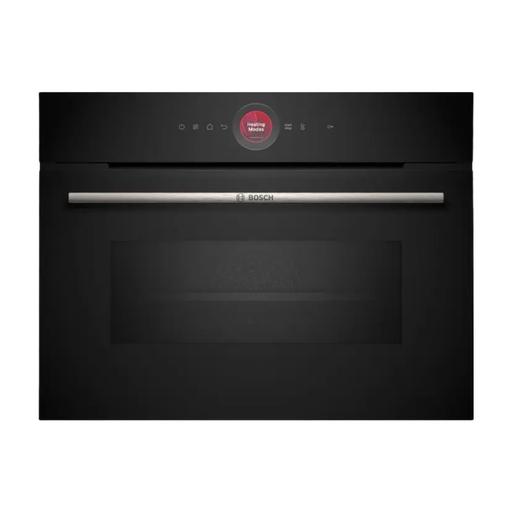 No image available
A built-in combination oven to consider if you want microwave cooking as well as baking; check the space and make sure there’s room for your dish.
The product description lists convection, grill and microwave cooking, a maximum temperature of 230 °C and a microwave output of 900 W. The stated recess height, width and depth are 45,5 × 56 × 55 cm.
You can’t tell from the capacity in litres alone. Measure the external dimensions of your dish and compare them with the usable interior dimensions and the position of the racks or any turntable.
To bake, use the oven or convection function on an oven or combination microwave. Consumentenbond recommends using the microwave function for reheating and the oven or convection function for baking; you can use a grill to brown the top.
For a built-in oven, check the required recess and ventilation space. For a freestanding appliance, check the installation instructions, connection and cord length for the exact model; Consumentenbond recommends these checks for combination appliances too.
Voedingscentrum recommends cooling leftovers quickly, storing them in a sealed container and not leaving them out of the fridge for more than 2 hours. When reheating leftovers, heat them all the way through until piping hot; a browned top alone doesn’t tell you the temperature inside.
When you buy remotely from a business, you’ll usually have a 14-day cooling-off period, according to Rijksoverheid. The seller must also provide a solution if there’s a problem with the product; these statutory rights are separate from the cooling-off period.