
Family baker with a large cake tin
You want to know whether your tin will fit and which oven setting the recipe calls for. The Consumers’ Association recommends checking the internal dimensions.


Choose an oven that fits your cake tin and has the setting specified in your recipe. If the recipe calls for conventional heat, that’s a sensible place to start. A freestanding oven can be practical if you don’t have a suitable space for a built-in model. For a built-in oven, check the dimensions of the housing space, as well as the installation and ventilation requirements. If you also need a microwave function, compare a combination oven and a combination microwave by looking at their available oven settings and shelf positions.
You want to know whether your tin will fit and which oven setting the recipe calls for. The Consumers’ Association recommends checking the internal dimensions.
You want to bake other treats as well as coffee cake, so you’re looking at usable space, baking trays and the option to bake on multiple levels.
You’re looking for a freestanding oven that will fit in the space available. Check the positioning and ventilation instructions; the Fire Service highlights heat dissipation around electrical appliances as something to consider.
Start with the oven setting specified in your recipe and the dimensions of your largest cake tin. Then choose between a built-in and freestanding model, and only compare extra features if they’re relevant to how you’ll use the oven.
| What to consider | What should you check? | Who should prioritise this? |
|---|---|---|
| Oven setting and recipe | Check that the oven has the setting and temperature specified in the recipe. Heel Holland Bakt recommends using the setting in the recipe as your starting point. | If I want to follow the recipe as closely as possible, I first check whether the oven has conventional heat or a fan setting, as specified in the recipe. Around 33% of consumers give the recommended oven setting top priority. |
| Tin and oven space | Measure your largest cake tin and compare it with the oven’s internal dimensions and shelf space. Also check which baking trays will fit if you plan to make more treats. | If I also want to prepare other treats for a celebration, I look at the space for the tin and the number of available shelf positions. Around 27% of consumers put space and capacity first. |
| Positioning and connection | For a built-in model, check the housing dimensions and installation instructions. For a freestanding oven, measure the space and follow the required ventilation and connection instructions. | When the space available in my kitchen determines which type of oven will fit, I start by choosing between a built-in and freestanding model. Around 20% of consumers give positioning top priority. |
| Energy use, cleaning and service | For applicable models, compare the energy use per cycle and check the model’s cleaning method. Also read the warranty terms. | Once I’ve made the basic choice, if energy use, cleaning and service are my main concerns, I compare those details for each model. Around 20% of consumers prioritise these practical considerations. |
The capacity in litres doesn’t tell you whether your cake tin will fit between the oven walls and shelves.
Measure your largest tin and compare its dimensions with the oven’s internal measurements and shelf positions.
If your tin or baking tray doesn’t fit, you may need to buy different bakeware.
A combination oven and a combination microwave may differ in their oven settings and shelf positions. The Consumers’ Association warns that some combination microwaves don’t have a bottom-heat setting.
Check each model’s available oven settings and shelf positions, and make sure there’s room for your cake tin.
The Dutch government states that there is no fixed statutory warranty period in the Netherlands. Your statutory rights are separate from any additional manufacturer’s or seller’s warranty.
Check what the additional warranty covers. If a product is faulty, remember that the seller is your point of contact.
Worth considering if you’re looking for a built-in oven with conventional heat and a fan setting.
A brand to consider if you’re looking for a freestanding oven rather than a built-in model.
Worth comparing if you’re considering a built-in oven with telescopic rails and a choice of oven settings.
Useful for comparing basic built-in oven models with options that have extra features.
This selection includes built-in and freestanding ovens for anyone who wants to follow a recipe’s recommended setting or use a cake tin that fits the space available.
 No image available
A built-in option if your recipe calls for a specific oven setting and you’d also like to use a fan setting.
71 l; conventional heat; 3D Hotair. Bosch says 3D Hotair is designed for baking on up to three levels.
 No image available
A built-in option if you’re looking for an oven that will fit in a suitable housing space.
66 l; 5 oven programmes; ecoClean cleaning.
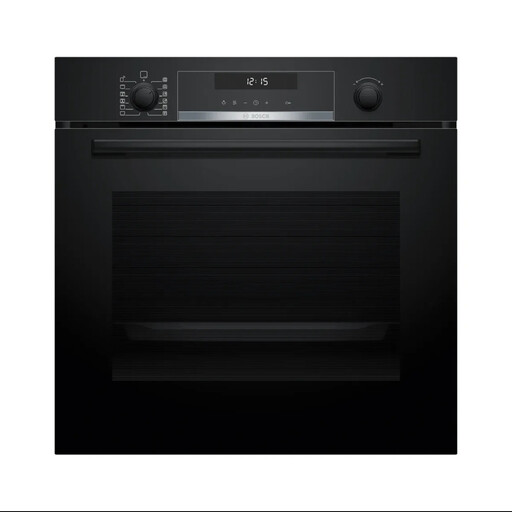 No image available
A built-in option if you’d like to compare extra features as well as the oven function.
71 l; Air Fry function; Home Connect; pyrolytic cleaning.
 No image available
A freestanding option if you don’t want to use a built-in housing space. Follow the instructions to place it on a stable, heat-resistant surface with adequate ventilation.
4-in-1; 1200 W; baking, toasting and grilling functions.
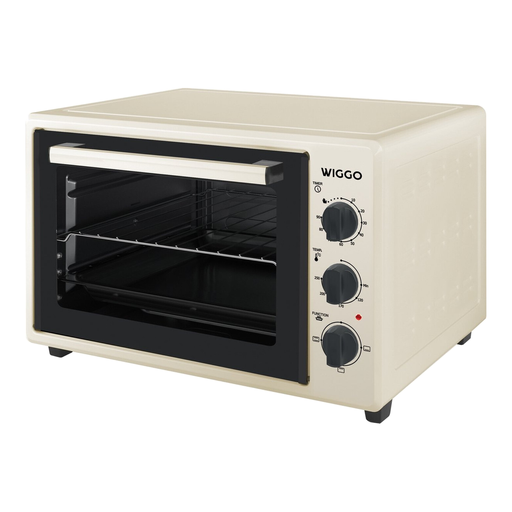 No image available
A freestanding option if you don’t want a built-in oven. The instructions require a stable, heat-resistant surface with at least 10 cm of clear space around it for ventilation.
35 l; 1800 W; cream.
Start with the setting specified in the recipe. Conventional heat and a fan setting aren’t automatically interchangeable. If you use a different setting, follow the recipe’s guidance and check the result as it bakes.
You can’t tell from the capacity in litres alone. Measure your tin and compare it with the oven’s internal dimensions and shelf space. Also follow the instruction manual.
Follow the installation instructions for your chosen model and make sure the oven can release heat. The Fire Service highlights ventilation around electrical appliances, including ovens, as something to consider.
For ovens covered by EU energy labelling, you can compare the stated energy use in kWh per conventional or fan-assisted cycle. The Dutch government states that there is no fixed statutory warranty period in the Netherlands; if a product is faulty, contact the seller. The manufacturer’s warranty is additional.