
Bakers preparing large quantities
You want to prepare plenty of florets in planned batches before the sale. So compare the usable tray space and shelf positions, not just the capacity in litres.


First, choose an oven that lets you spread the florets across suitable baking trays for the number of batches you’re planning. A built-in fan oven is a good fit if you have a suitable housing unit; a freestanding model avoids the need for built-in installation, while a commercial oven with multiple trays is most relevant if you can make use of its capacity and meet its installation requirements. The stated capacity in litres alone won’t tell you how much cauliflower will fit on the trays.
You want to prepare plenty of florets in planned batches before the sale. So compare the usable tray space and shelf positions, not just the capacity in litres.
You’re looking for an oven that will fit in the available housing unit or on your worktop. Check the installation requirements and baking tray dimensions before comparing features.
You’re making small quantities or want to run an extra batch. A compact oven may be suitable if its smaller tray space is enough.
Start with the amount you want to prepare in each batch, then check that the oven will fit in the intended space and suit the way you roast.
| What to consider | What should you check? | Who is this important for? |
|---|---|---|
| Tray space per batch | Compare the internal dimensions, compatible tray sizes and usable shelf positions with the amount you want to spread across each tray. | If I’m preparing lots of florets for a sale, I want enough tray space for each batch. Around 36% of consumers in this oven-buying scenario say tray space and throughput are their main priorities. |
| Suitable cooking settings | Check that fan-assisted cooking and the temperature required by your recipe can be selected, and see what the manufacturer says about using multiple shelves. | I want to be able to spread the florets out appropriately and use the right oven setting for my chosen recipe. Around 29% of consumers prioritise the cooking method and the results. |
| Positioning and connection | For a built-in oven, measure the housing unit according to the installation instructions. For a freestanding model, check its external dimensions, where it will stand and the connection required. | If the oven needs to fit in my kitchen, I check the housing unit or worktop space and the connection first. Around 21% of consumers prioritise positioning and connection. |
| Cleaning and running costs | Check the cleaning instructions, the trays included and the stated energy consumption on a like-for-like basis. | After several batches, I want to know how much extra cleaning and how many running costs to expect. Around 14% of consumers put cleaning and running costs first. |
The stated capacity isn’t the same as the usable space. Consumentenbond notes that the usable space may be smaller than the stated oven capacity.
Measure your baking tray and compare the internal dimensions and shelf positions of the exact model.
Unox positions the oven range in question for bakery products. The stated tray capacity doesn’t prove that cauliflower will roast evenly on multiple shelves with your way of working, or that the connection is suitable.
Choose a model to suit the quantities you’re planning, and check the accessories and installation requirements for each one.
The NVWA emphasises that food sold at markets and events must be prepared, sold and stored safely and hygienically. This is separate from your choice of oven.
Plan transport, storage, serving and allergen information separately from the baking.
Built-in domestic ovens for anyone with a suitable housing unit who wants to compare ovens with multiple shelf positions.
Freestanding domestic ovens for anyone who isn’t looking for a built-in model.
Commercial convection ovens for anyone considering larger or regular production batches.
Compact tabletop ovens for small quantities or an extra batch.
Built-in ovens with additional features for anyone who wants to compare functions beyond fan-assisted cooking.
Browse these Joybuy ovens if you’re looking for a compact fan oven, a freestanding model or a domestic built-in oven for planned batches.
 No image available
A compact fan oven with a four-tier baking rack may suit you if you want to use multiple levels; check how much tray space each level offers.
The product name lists a capacity of 35 litres and a thermometer.
 No image available
A freestanding model may suit you if you don’t want to use a built-in housing unit; check the external dimensions and the space available on your worktop.
The product description lists a capacity of 65 litres, a turbo fan and four rack positions.
 No image available
This built-in oven may suit you if you have a suitable housing unit and want to compare multiple shelf levels; check the housing unit dimensions and baking trays for the exact model.
The product description lists 3D hot air for up to three levels and a capacity of 71 litres.
 No image available
A compact oven may suit small portions or separate batches; check whether the baking tray is large enough for the way you want to spread out the florets.
The product description lists fan-assisted cooking and an adjustable temperature range of 100–230 °C.
 No image available
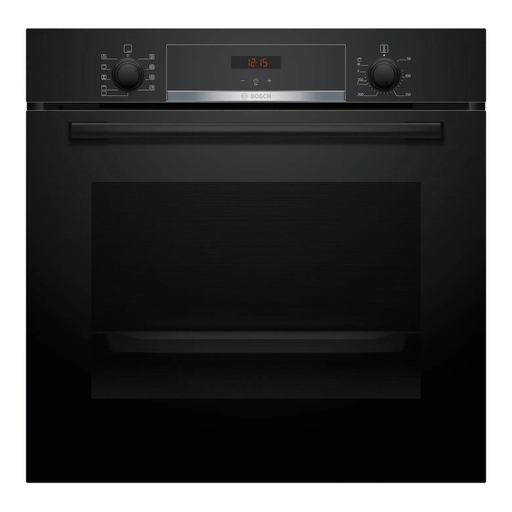
A built-in oven may suit you if you have a suitable housing unit; check the installation dimensions and compatible baking trays before choosing your oven.
The product description lists a capacity of 71 litres and convection heating.
Measure the compatible baking tray and check the internal dimensions and permitted shelf positions of the exact model. Consumentenbond notes that the usable space may be smaller than the stated oven capacity. Try out your preferred arrangement before the sale.
No. Also check the required housing unit dimensions and installation instructions for the exact model. The appliance dimensions and the required housing unit dimensions are separate measurements.
Plan preparation, transport and serving as well as choosing your oven. The NVWA requires food sold at markets and events to be stored safely and at the right temperature. Voedingscentrum advises consumers to keep perishable products at 4 °C and throw them away if they’ve been left out of the fridge for more than two hours. Make sure your procedures suit the ingredients and the relevant rules for selling food.
According to the NVWA’s step-by-step guide, you need to register if you sell food several times a year; you don’t need to register if you sell it once a year. The same guide states that a food safety plan or hygiene code is required if you sell food several times a year. Even for a one-off sale, it’s important to work safely and hygienically.
The NVWA requires customers to be told about allergens present at the place where the products are offered for sale. You may provide this information verbally under the NVWA’s conditions, which include making it immediately available to customers before they buy, as well as to staff and inspectors. Check the ingredients in batter, seasoning mixes and dips.