
Cooking for a crowd
If you’re making one fish pie in a single dish for several people, check that your oven dish will fit in the oven. The Consumers’ Association advises comparing the oven’s internal dimensions with the dish you want to use.


Start by checking the dimensions of your oven dish and the space available: a capacity in litres won’t tell you whether the dish will actually fit. Then choose an oven with a setting that suits your recipe. A freestanding model needs a suitable spot on your worktop, while with a built-in oven you’ll need to check the housing space and installation requirements. Consider a microwave oven with grill and convection only if its oven function and interior space suit what you want to cook.
If you’re making one fish pie in a single dish for several people, check that your oven dish will fit in the oven. The Consumers’ Association advises comparing the oven’s internal dimensions with the dish you want to use.
A freestanding oven could be right for you if you don’t want to use a built-in housing space. Weigh up the worktop space available against the room you need for both the oven and your oven dish.
If you’re following a recipe, check which oven setting it requires and what functions the model offers. Also compare energy use with the relevant setting, rather than looking only at capacity or the energy label.
A good fit if: you don’t want a built-in housing space and have room on your worktop.
Bear in mind: the worktop space required and the oven’s internal dimensions; the stated capacity in litres doesn’t prove that your dish will fit.
A good fit if: you have a suitable housing space and the oven can be installed there in line with the installation requirements.
Bear in mind: the dimensions of both the housing space and your oven dish, as well as any installation costs.
A good fit if: you also need a microwave and the specific oven setting and interior space suit your recipe and dish.
Bear in mind: according to the Consumers’ Association, microwave ovens with grill and convection often have fewer oven settings or shelf positions than combination ovens. Don’t assume they offer the same options as every conventional oven.
| What to consider | What to look for | Who is this important for? |
|---|---|---|
| Space for the dish | Measure the dish and compare its dimensions with the usable internal width and depth. Also check how the shelves affect the available space. | If I want to use one wide dish to feed several people, I want to know in advance whether it will fit between the oven walls and shelves. Around 36% of consumers make sure the dish will fit their top priority. |
| Where it will go in the kitchen | Choose between freestanding and built-in based on the available worktop space or housing space; compare the appliance and installation dimensions. | When kitchen space is limited, I want to know first which type of installation will actually fit. Around 29% of consumers prioritise the space available. |
| Oven settings you need | Check that the model has the setting your recipe requires, such as fan cooking or conventional heat from above and below. | If I want to make my fish pie to a recipe, I need to be able to select the oven setting it requires. Around 21% of consumers prioritise oven settings. |
| Energy use | Where available, compare energy use in kWh per cycle for similar oven settings. Energielabel.nl states that small and portable ovens don’t have an oven energy label. | If I use the oven regularly, I want to be able to take the energy use of a relevant setting into account. Around 14% of consumers rank energy use above their other buying considerations. |
An oven may have plenty of capacity but still be too narrow or shallow for your oven dish.
Measure the dish and compare its dimensions with the oven’s usable internal measurements.
The number of oven settings and shelf positions can vary, which matters if you need a specific setting.
Check the functions and interior space of the model you’re considering against your recipe and oven dish.
An energy label doesn’t compare energy use with the oven setting you’ve chosen. According to Energielabel.nl, small and portable ovens don’t have an oven energy label.
Where the information is available, compare energy use in kWh per cycle using similar oven settings.
A freestanding option if you don’t want a built-in housing space. The OV607B is one specific model to consider.
A built-in option with fan cooking, including the BBIE12100XD.
Built-in models with a range of oven functions; check the specifications of the exact variant.
This selection includes freestanding ovens, a microwave oven with grill and convection, and built-in ovens. For each model, check whether your dish will fit, which oven settings are available and what installation requirements apply.
 No image available
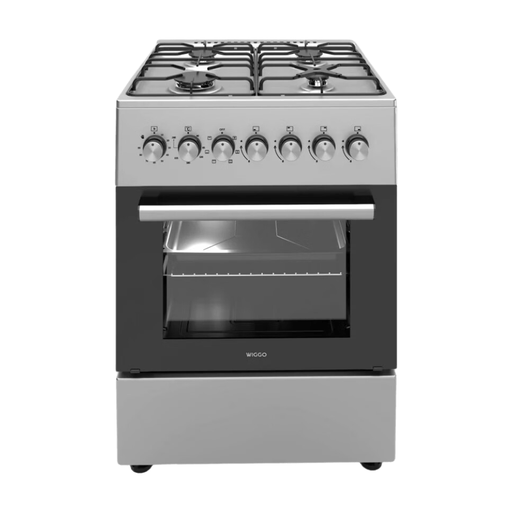
Only worth considering if you specifically want a freestanding gas oven; bear in mind that it needs to be connected to the gas supply by a qualified professional.
The product description lists a 66-litre oven capacity, six cooking programmes, a grill function and a timer.
 No image available
A freestanding model to consider if you’re looking for an oven with several cooking functions; compare its dimensions with the space you have available.
The product description lists a 65-litre capacity, six cooking functions, a turbo fan and four shelf positions.
Place the oven on a flat surface with at least 10 cm of clear space around it and 30 cm above it; don’t block the ventilation openings.
 No image available
A combination appliance to compare if you’re looking for a microwave as well as an oven function; check that the interior will fit your dish.
The product description lists fan cooking, a grill, seven automatic programmes and a glass turntable.
If you’re placing it in a cabinet, it needs adequate ventilation.
 No image available
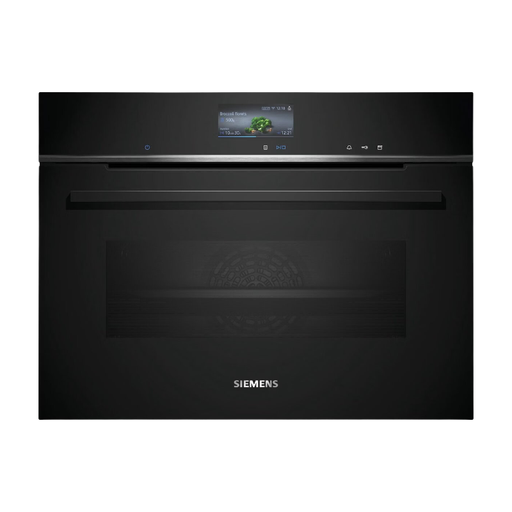
A built-in model to consider if you’re weighing up 4D fan cooking and a range of automatic cooking programmes.
The product title lists 47L, 4D Hot Air, Pyrolytic Self-Cleaning and Home Connect. The product description mentions automatic baking and roasting programmes.
According to the product description, the electrical installation must be carried out by a qualified electrician.
 No image available
A built-in oven to compare if you’re looking for a model with 3D fan cooking; check first that your housing space is suitable.
The product description lists a 71-litre capacity, baking on up to three levels and a cleaning aid.
A suitable housing space is needed for installation; the product description states that installation should be carried out by a professional.
No. The recipes and buying information reviewed don’t say that a steam function is essential. Choose the oven settings your recipe calls for; a steam function may be useful for other types of cooking.
Follow the cooking instructions in your recipe and check that any raw fish is cooked through in the middle. A browned top alone doesn’t tell you whether the fish inside is cooked. When reheating leftovers, make sure they’re heated through too.
Compare the appliance’s dimensions and internal measurements with the space available and your oven dish. Follow the manual for your chosen model when installing and cleaning it; hydrolysis cleaning and steam cleaning are different functions.
No. The Dutch government states that there is no fixed legal guarantee period in the Netherlands: you’re entitled to a product that works properly, and you can contact the seller if something is wrong. Any manufacturer’s guarantee is in addition to this.
An electric oven covered by the Dutch Commodities Act Decree on Electrical Equipment must meet safety requirements and carry the CE mark. Check the details of the specific appliance; a statement made at the point of sale doesn’t, by itself, prove that the requirements have been met.