
Baking several tins
You’re making Dutch butter cake for a group and want to weigh up whether you can bake your tins at the same time or should plan several batches. The tins you use, the available oven levels and enough cooling time all matter.


Choose based on the size of your baking tin and the usable space inside the oven, rather than litres alone. A built-in oven with an explicitly stated multi-level function could suit you if you want to bake several tins at once and have a suitable housing unit. If you don’t, a freestanding model with successive batches may be enough. Follow the oven setting specified in the recipe, and allow plenty of time for the Dutch butter cake to cool before cutting it.
You’re making Dutch butter cake for a group and want to weigh up whether you can bake your tins at the same time or should plan several batches. The tins you use, the available oven levels and enough cooling time all matter.
You’re looking for an oven to sit on your worktop. The space available and the size of your baking tin matter more than the stated capacity in litres alone.
You prefer to bake one tin at a time and want to be able to choose the oven setting that suits your recipe.
Choose this option if: you often want to bake several tins at once and have a suitable housing unit.
Bear in mind: the housing unit, internal dimensions and supplied trays. Multiple levels don’t guarantee that every tin or recipe will bake well at the same time.
Choose this option if: you don’t want a built-in oven and have enough safe space on your worktop.
Bear in mind: both the space it takes up and its usable internal dimensions. Capacity in litres or a fan function won’t confirm that two tins will fit at once.
Choose this option if: you need a microwave function as well as an oven.
Bear in mind: the oven settings and shelf positions on the exact model. According to the Consumentenbond, a microwave combination oven may have fewer shelf positions and lack bottom heat.
| What to consider | What to check before buying | Who it matters to |
|---|---|---|
| Number of batches | The tins you need, internal dimensions, stated oven levels and supplied trays. | If I need to bake several tins for the neighbourhood, I want to know whether they’ll fit at once and how many batches I’ll need; around 33% of consumers prioritise reducing the number of batches. |
| Fit and placement | Measure your baking tin and the usable oven space. Also check the housing unit or worktop space, as well as the ventilation instructions. | If my kitchen has limited space, I want to know in advance whether the oven can be positioned safely and whether my tin will fit; around 25% of consumers prioritise fit and placement. |
| Oven setting | Check which settings the model offers and which setting your recipe specifies. | If I’m following a trusted recipe, I want to be able to use the specified oven setting; around 25% of consumers prioritise having that choice. |
| Use and aftercare | Where applicable, compare energy use per cycle using the same setting, cleaning options and service terms. | If I’ll use the oven regularly after the get-together, I’ll consider energy use, cleaning and service; around 17% of consumers prioritise these points. |
The usable internal space may be smaller than you expect, and the capacity in litres doesn’t tell you whether your tin will fit.
Measure your baking tin and compare its dimensions with the internal space. Also check how many suitable trays and levels are available.
If your tin doesn’t fit, you may need a different baking tin or have to plan extra batches.
These settings aren’t necessarily equivalent; the right choice also depends on what your recipe specifies.
Check the setting specified in the recipe and keep an eye on how it bakes, especially if you use a different setting or several levels.
The Joybuy listing for the Severin TO 2073 states 18 litres and 2000 W in the title, but 60 litres and 2200 W in the product description. Severin states 60 litres and 2200 W.
Before buying, check which version and specifications apply to the listing.
Built-in options for those with a suitable housing unit who are looking for an explicitly stated multi-level baking function.
Freestanding oven options for those who aren’t looking for a built-in model.
A built-in option with several cooking functions for those with a suitable housing unit.
A freestanding alternative for those weighing up the available space and oven capacity.
A built-in option for those looking for other cooking functions as well as conventional baking.
This selection includes a freestanding fan oven and several built-in ovens. First decide whether you have a suitable spot on your worktop or a suitable built-in housing unit.
 No image available
A freestanding option to consider for baking on several trays, provided the rack and your tins fit.
Capacity: 35 litres. The product description mentions a four-level rack.
 No image available
A built-in option to consider if you want to use several levels and have a suitable housing unit.
Capacity: 71 litres. The product description mentions 3D Hotair for baking on up to three levels.
Built-in model; follow the installation instructions and check the housing dimensions.
 No image available
A built-in option to consider if you want to use several levels and have a suitable housing unit.
Capacity: 71 litres. The product description mentions 3D Hotair for baking on up to three levels.
Built-in model; follow the installation instructions and check the housing dimensions.
 No image available
A built-in option to consider if you want a choice of oven settings and have a suitable housing unit.
Capacity: 66 litres. The product description mentions five heating methods, baking on three levels, and conventional heat.
Stated temperature range: 50–275 °C. Follow the installation instructions and check the housing dimensions.
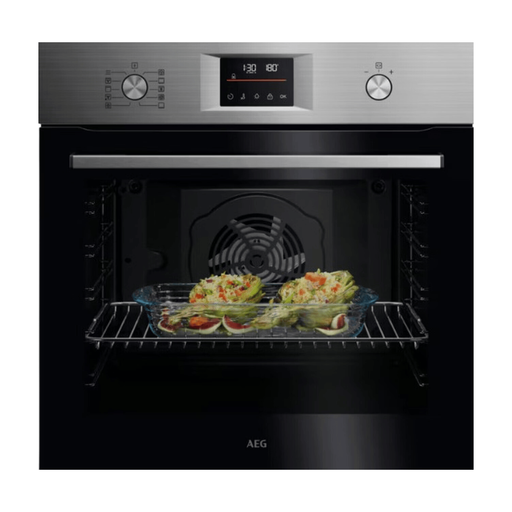 No image available
A built-in option to consider if you’re looking for a spacious oven with convection and have a suitable housing unit.
Capacity: 72 litres. The product description mentions convection, 45 cooking programmes and five shelf positions.
Built-in model; follow the installation instructions and check the housing dimensions.
Start with the size of your baking tin, not a set capacity in litres. In a recipe from Rutger Bakt, updated on 24 March 2026, a 20 × 20 cm square tin is used and one cake is said to make around 40–50 small squares. Measure your tin, including any parts that stick out, and compare it with the usable internal dimensions.
Only if the oven supports several levels and both tins fit with enough room around them. Bosch states that the HBA534BS3 can bake on up to three levels using 3D Hotair; Electrolux states that the KOPCX01H can bake on three levels. These are model specifications, not a guarantee that two Dutch butter cakes will bake identically. Check your recipe and the results too.
Follow the cooling instructions in your recipe. For the recipe in question, Rutger Bakt recommends leaving the cake to cool in the tin for at least six hours before cutting it. Make sure you allow for this when planning.
Follow the installation instructions for your chosen model and make sure the oven can release heat. The fire service advises connecting high-power appliances directly to a socket wherever possible, rather than using a cable reel or extension lead. Check the electrical rating and your existing installation too, before using several appliances at the same time.
Where applicable, compare energy use in kWh per cycle using the same oven setting. Milieu Centraal recommends comparing ovens by their energy use per use or per year. For the Netherlands, the Dutch Government states that there is no fixed statutory guarantee period. If there’s a fault, ask about your statutory rights and the seller’s terms and conditions.