
Vandaag of morgen in huis

Kwaliteit gegarandeerd

Welkomstaanbiedingen ontgrendelen: GRATIS bezorging | Tot 80% korting | Gratis 30 dagen JoyPlus-proefperiode
Download de app
An oven dish that cracks when temperatures change, a lid that leaks in your bike bag or food storage containers that cannot go in the microwave: when it comes to oven dishes and food storage containers, the key differences are often not visible at first glance. Home bakers, families and meal preppers in particular sometimes pay for features that turn out to be less useful in practice than expected.
Before buying, watch out for these three common pitfalls:
A glass oven dish is useful when you want to bake a dish and then store it straight away. Borosilicate glass is used in various food storage containers and oven dishes because, according to the product description, it is suitable for both cold and hot applications. Even so, always check the stated temperature range and usage instructions. Avoid sudden temperature changes, such as placing a hot dish on a cold or wet worktop.
Ceramic ramekins are suitable for individual portions, such as crème brûlée, soufflé, pudding or small quiches. Ceramic is fragile, however, so handle hot dishes carefully when moving them.
A stainless steel dish is less vulnerable to drops than glass or ceramic. The Maxcook dishes are made from 304 stainless steel and are described in the product information as rust- and corrosion-resistant. They are suitable for use in the oven, steam oven and on an induction hob. Wear oven gloves when heating them and do not heat an empty dish.
Plastic is particularly practical for food storage containers and meal prep. Pay attention to the combination of materials: a plastic container may be microwave-safe, while the lid must be removed separately.
Before buying, create a simple usage checklist:
The Secret de Gourmet glass dishes are listed as suitable for use in the oven up to 300 degrees, microwave, dishwasher and freezer. According to the product information for the 5five Keepeat Oval, the dish is oven-safe up to a maximum of 400 degrees, while the lid must not be used in the oven or microwave or placed in the dishwasher.
For a family, dishes of around 2 to 4 litres are practical for oven dishes, lasagne or a large quiche. For individual meals, meal prep containers of 500 to 1,000 ml are often sufficient. Larger food storage containers from 1,500 ml to 3,200 ml are useful for leftovers, salads or several portions.
An airtight food storage container helps keep smells and moisture contained, but also look at the design of the seal. A removable silicone ring can be cleaned more thoroughly. For soup, sauces and dressings, leakproof containers are more important than a stackable design alone.
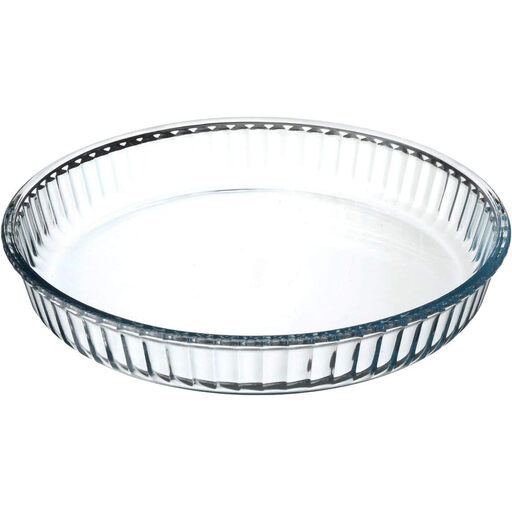
Why it suits this profile: A round 32 cm glass dish is practical for pies, oven dishes and quiches without having to buy a complete set straight away.
The product information explicitly lists the oven, microwave, dishwasher and freezer as suitable for use. There is no lid that could accidentally be heated.
Round glass design, a capacity of 1.6 litres and stated suitability for oven use up to 300 degrees.
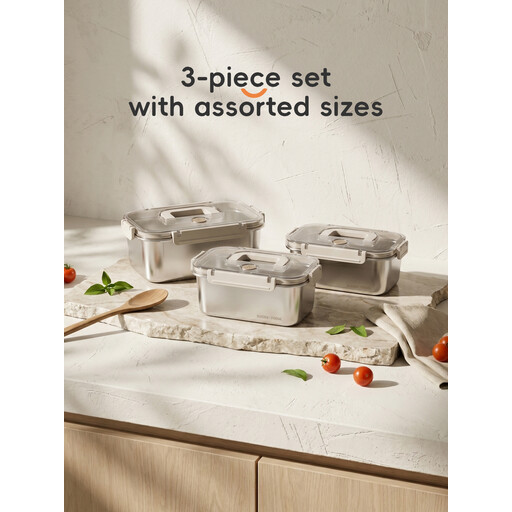
Why it suits this profile: This is a sensible choice for anyone looking for one set to use for storing, transporting and organising multiple portions.
The three sizes of 1,700, 2,100 and 3,200 ml make it easier to match the contents to the container. The lid must be removed before using the container in the oven or microwave.
304 stainless steel containers, a silicone sealing ring, four locking clips and product information confirming dishwasher suitability.
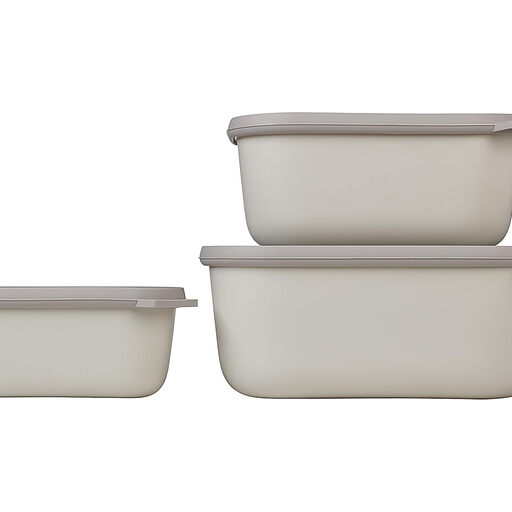
Why it suits this profile: For anyone who regularly freezes, reheats and transports meals, this set offers three sizes: 750, 1,500 and 3,000 ml.
The product information describes the containers as airtight and leakproof. The lid must be removed when using them in the microwave, keeping the intended use clear.
Suitable for the fridge, freezer, microwave without the lid and dishwasher; the transparent lid rim makes the contents visible.
We have put together a complete, up-to-date list of products that fully meet these strict selection criteria and the applicable European safety regulations.
Not without checking first. With many models, only the dish itself is oven-safe and the plastic lid must be removed. Also check the maximum temperature. A lid that is suitable for the fridge or freezer is not automatically suitable for the oven or microwave.
Choose microwave-safe containers with a clearly stated capacity, a sturdy closure and preferably an airtight seal. Leakproof containers are important for soup and sauces. If you freeze meals, you will also need fridge- and freezer-safe containers. Sets with several capacities are practical for portions of different sizes.
That depends on how you use it. Glass is suitable for many oven and microwave applications, but it is heavier and can break. Plastic food storage containers are lighter and often more convenient to take with you. Do not just consider the material: also check dishwasher suitability, lid quality, temperature limits and how you expect to use the product.
