
Home baker with a large cake tin
You want to bake a custard tart with a pastry base and need an oven that can fit your tin and has the specified cooking setting. The capacity in litres alone won’t tell you whether your tin will fit on the rack.


Start with the recipe, then measure your baking tin and the space where the oven can sit safely. For a larger custard tart, a freestanding oven with suitable usable capacity and the specified cooking setting could be a good choice; pastéis de nata may need a much higher temperature. A built-in oven needs a suitable permanent space, while an air fryer is only suitable if the tin and recipe work with it.
You want to bake a custard tart with a pastry base and need an oven that can fit your tin and has the specified cooking setting. The capacity in litres alone won’t tell you whether your tin will fit on the rack.
You share the worktop and possibly the plug sockets too. So think about more than just the oven’s external dimensions: check the recommended clearance around it and where it can sit safely while in use.
Pastéis de nata may need a different temperature range from a larger custard tart. Choose an oven to suit the specific recipe.
A good fit if: you want your own oven on the shared worktop and your baking tin fits in the usable interior.
Bear in mind: allow for the oven’s external dimensions, ventilation space and power connection. The capacity in litres doesn’t prove that a tin will fit.
A good fit if: the shared kitchen already has a suitable built-in space and you’re looking for a permanent oven.
Bear in mind: check the exact model’s installation dimensions and requirements. This isn’t a portable worktop oven.
A good fit if: a suitable tin fits in the appliance and you use an appropriate recipe or carefully adapt the cooking method.
Bear in mind: a tin that fits doesn’t mean the cooking time and temperature will stay the same. Philips mentions quiches in traditional springform tins as an option, not every custard tart or air fryer setting.
Choose your oven based on the recipe first, then check the tin and the space available. Laura’s Bakery specifies top and bottom heat at 180 °C for the base of its rhubarb and custard tart; for his pastéis de nata, Rutger Bakt recommends an oven that can reach over 250 °C, ideally around 280 °C.
| What to consider | What to check before buying | Relevant consumers |
|---|---|---|
| Cooking setting and temperature | Compare the specified cooking setting and temperature with the details for the exact model. | If I want to bake both a tart with a pastry base and small pastéis de nata, the oven needs to suit the recipe I choose. Around 36% of consumers prioritise recipe compatibility. |
| Fit of tin and oven | Measure the tin, including handles, and compare it with the usable interior dimensions and rack position. | If my baking tin doesn’t sit securely in the oven, a compact appliance won’t help. Around 29% of consumers prioritise a physical fit. |
| Safe position and power connection | Follow the model’s placement instructions and check where the oven can stand with enough ventilation space. | When I share a worktop and power connection with others, I want to know in advance where I can use the oven safely. Around 21% of consumers prioritise shared space and power access. |
| Cleaning and user information | Check which parts the manufacturer says are dishwasher-safe, and only compare energy consumption on a like-for-like basis where relevant. | When several people use the kitchen, I want to know how to clean the oven after baking and what usage information is available. Around 14% of consumers prioritise maintenance and running costs. |
The Fire Service recommends plugging high-power appliances directly into a wall socket rather than using a cable reel or multi-socket adaptor. Also follow the specific appliance’s instructions for placement and ventilation.
A capacity of, say, 20 or 30 litres doesn’t tell you whether your cake tin will fit on the rack.
Measure the tin and compare its dimensions with the usable interior of the exact model. Also allow for the space needed to position the oven safely.
If the tin doesn’t fit, you may need a different baking tin or have to bake the tart in smaller batches.
Recipes can call for different cooking settings and temperatures. Rutger Bakt recommends an oven that can reach over 250 °C for his pastéis de nata, ideally around 280 °C.
Choose the exact recipe before selecting an oven, then compare the required setting and temperature with the model’s specifications.
The European Commission excludes small and portable ovens from the scope of the EU rules on oven energy labels covered by its research. So a missing label is not, by itself, proof of a particular level of energy consumption. ACM ConsuWijzer also makes clear that your statutory guarantee exists alongside a manufacturer’s or seller’s guarantee.
Where possible, compare relevant energy consumption figures on a like-for-like basis. Read the guarantee terms, but consider your statutory rights separately.
Freestanding ovens such as the 30-litre OV307B may be suitable if your baking tin and available space are a good fit.
The freestanding OV-3650 mini oven is a compact option to consider if your tin and the available worktop space are a good fit.
The freestanding 30-litre TO 2056 could be a good option if its usable interior is suitable for your tin.
A compact built-in oven such as the CBG7341B1 is worth considering if the shared kitchen already has a suitable permanent built-in space.
An air fryer could be an alternative for small batches if the tin and recipe suit the specific appliance.
This selection includes freestanding and built-in ovens for baking in a shared kitchen. Check that each model’s capacity, cooking setting and available space suit your recipe and kitchen.
 No image available
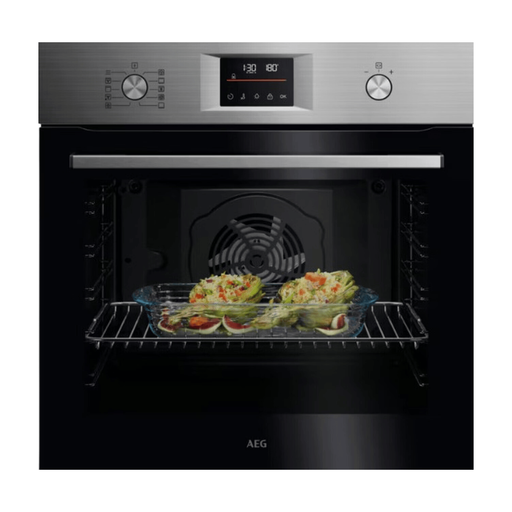
A built-in oven to consider if the shared kitchen has a suitable permanent built-in space.
The product name lists 72 litres, pyrolytic cleaning, energy class A++, 45 programmes and black/stainless steel. The product information mentions convection cooking and a maximum temperature of 300 °C. Check the installation dimensions and requirements.
 No image available
A freestanding oven to consider if your worktop has enough space and your cake tin fits inside.
The product name lists 2000 W and white. The product information mentions four oven levels, a 90-minute timer, and top and bottom heat that can be used separately or together. Follow the placement instructions for a flat surface and adequate ventilation space.
 No image available
A permanent built-in oven to consider if your kitchen has a suitable built-in space and its specifications suit your recipe.
The product name lists 60 cm, 71 litres, 3D fan-assisted cooking, EcoClean Direct and energy class A+. The product information mentions top and bottom heat and a maximum temperature of 275 °C. For Rutger Bakt’s pastéis de nata recipe, this is below his preferred temperature of around 280 °C.
This model needs a suitable built-in space and correct installation.
 No image available
A freestanding model to consider for recipes that need a temperature within the oven’s range.
The product name lists 1200 W. The product information mentions 30 litres, top and bottom heat, convection and a temperature range of 100–230 °C. Follow the placement instructions for a stable, heat-resistant surface and adequate ventilation. For Rutger Bakt’s pastéis de nata recipe, 230 °C is below the higher temperature recommended.
 No image available
A freestanding oven to consider if you have suitable worktop space and a baking tin that fits.
The product name lists 1800 W and stainless steel. The product information mentions 35 litres, top and bottom heat, three heating functions, a baking tray, a rack and a maximum temperature of 250 °C. For Rutger Bakt’s pastéis de nata recipe, this is below the recommended temperature of over 250 °C. Follow the placement instructions for ventilation space and a flat surface.
It depends on the recipe. Laura’s Bakery specifies top and bottom heat at 180 °C for the base of its rhubarb and custard tart. Rutger Bakt, on the other hand, recommends an oven that can reach over 250 °C for his pastéis de nata, ideally around 280 °C. So choose based on the specific recipe, not just the name custard tart.
Follow the placement and ventilation instructions for the exact model, and agree where the appliance can sit while in use. The Fire Service recommends plugging high-power appliances directly into a wall socket rather than using a cable reel or multi-socket adaptor.
Follow your model’s manual and let hot parts cool down safely first. For the Inventum OV307B, the manufacturer recommends using a soft, damp cloth with a little washing-up liquid on the inside, and says the accessories are dishwasher-safe. Don’t automatically apply these model-specific instructions to other ovens.
According to the European Commission, small and portable ovens are outside the scope of the EU rules on oven energy labels covered by its research. A missing label is not, by itself, proof of a particular level of energy consumption; compare relevant consumption figures where possible.
No. ACM ConsuWijzer explains that your statutory guarantee exists alongside a guarantee from the manufacturer or seller. The seller is your point of contact if the product doesn’t meet what you could reasonably expect during normal use.