Who is this buying guide for?

Bakers preparing for a big birthday

You want enough portions for everyone and may want to bake more than one dish. Measure your tin and compare it with the usable interior space and the available shelf levels. The portion and tin suggestions are based on the Albert Heijn Allerhande recipe; Consumentenbond recommends checking the oven’s internal dimensions.

Bakers making delicate desserts

You want to choose the right setting for a single clafoutis and are weighing up fan oven versus top and bottom heat. Bosch lists top and bottom heat as a possible setting for delicate bakes.

Bakers with limited kitchen space

You’re looking for an oven that fits a smaller housing unit or a freestanding model. Check the available space as well as the usable internal dimensions: capacity in litres alone won’t tell you whether your tin will fit. Consumentenbond also stresses the importance of checking the internal dimensions.

What should you look for when choosing?

Standard built-in oven

Suitable for: a suitable built-in housing unit and the flexibility to use a large tin or bake several dishes.

Trade-off: Milieu Centraal reports that a large oven uses around 20% more energy per use than a medium-sized oven.

Compact freestanding oven

Suitable for: a kitchen without a suitable built-in housing unit, as long as your tin fits inside the oven.

Trade-off: You’ll need a suitable place to put it; follow the positioning and operating instructions for the specific model.

Compact built-in oven with microwave function

Suitable for: a suitable 45 cm housing unit and a need for both an oven and a microwave function. The ETNA CM450ZT is one example.

Trade-off: A microwave function doesn’t automatically make an oven equivalent to a larger baking oven; check the usable space for your tin.

What to consider What should you check? Who is this important for?
Tin and portions First, choose the recipe and number of portions. Then measure your tin and check there’s enough room to put it in and take it out of the oven. When I’m baking for a group, I want to know whether my tin will fit before I plan the portions. Around 33% of consumers prioritise tin size and portions when choosing an oven.
Oven setting and results Check the settings on the exact model, and follow the chosen recipe and the manual for temperature and cooking time. Don’t assume a setting will work the same across different oven modes. When I’m baking a single delicate clafoutis, I want to be able to match the setting in my recipe carefully to the oven. Around 27% of consumers place the greatest importance on baking results and oven settings.
Where it will go in your kitchen For a built-in oven, check the housing dimensions and installation instructions. For any type of oven, compare the interior space with your own baking tin. With limited space, I want to know in advance whether the oven will fit in the space available. Around 20% of consumers prioritise where the oven will go in the kitchen.
Energy and running costs Where applicable, compare energy use in kWh per cycle for the same oven setting. Also consider the capacity you need and the cleaning features. If I’ll use the oven regularly after the party, I want to factor in its energy use for the way I usually cook. Around 20% of consumers prioritise running costs.

Common buying mistakes

  • Going by capacity in litres alone

    The stated capacity isn’t the same as the space you can actually use. Consumentenbond recommends checking the internal dimensions.

    Measure your baking tin and compare it with the internal dimensions, shelf position and access to the oven.

  • Assuming a recipe temperature is right for a fan oven without checking

    The Albert Heijn Allerhande recipe for blackberry clafoutis gives a temperature, but doesn’t specify a fan setting. A recipe setting won’t necessarily work for every oven mode.

    Check the recipe alongside the model’s manual, and judge whether it’s cooked according to the recipe rather than treating the temperature as a universal fan oven setting.

  • Comparing energy label ratings directly across different types of oven

    EU energy labelling rules don’t apply to every appliance type in the same way. The European Commission gives small ovens and appliances with microwave heating as examples of products that aren’t necessarily covered by the oven rules mentioned.

    First check whether the labelling rules apply to that type of appliance. Where they do, compare energy use per cycle for the same oven setting and consider whether the oven suits the portions you usually cook.

  • Confusing paid-for extra cover with your legal guarantee

    In the Netherlands, legal guarantees don’t have a fixed statutory duration. The Dutch government describes them separately from paid-for additional cover.

    Check exactly what extra rights a paid-for plan provides. If you have a complaint about a faulty product, contact the retailer.

    Additional cover comes at an extra cost, so check what extra protection it provides before you buy.

Brands and models to compare

Bosch

Built-in baking ovens with separate fan and top and bottom heat settings.

  • Bosch lists a capacity of 71 litres and 3D Hotair for the HBA4720B3. According to Bosch, this model supports baking on up to three shelf levels using that setting.
  • These specifications don’t guarantee a particular clafoutis result. Check the housing dimensions and whether your tin will fit in the oven.

Severin

Freestanding mini ovens, including the TO 2058, with fan cooking and separately usable top and bottom heat.

  • Severin lists a capacity of 42 litres and four shelf positions for the TO 2058.
  • The capacity alone doesn’t show whether every baking tin will fit. Check the internal dimensions and the manual.

ETNA

Built-in ovens with a microwave function, including the CM450ZT for a 45 cm housing unit.

  • ETNA lists a capacity of around 50 litres, five shelf levels and no turntable for the CM450ZT.
  • Those features don’t tell you by themselves whether a particular tin will fit; compare the actual interior space.

AEG

Built-in fan ovens, including the BP7200B with top and bottom heat.

  • AEG lists a capacity of 71 litres and pyrolytic cleaning for the BP7200B.
  • Claims about automatic guidance or baking results don’t prove an advantage for clafoutis. Compare the installation requirements and the features you need.

Siemens

Built-in baking ovens with features including fan cooking and top and bottom heat.

  • Siemens lists a capacity of 71 litres and 3D Hotair for the HB457G0B3F.
  • The specifications don’t show that it will bake better than other ovens. Measure the housing unit and check whether your tin will fit.

Ovens at Joybuy

This selection includes built-in fan ovens and freestanding ovens for baking. Check the features listed for each model and make sure there’s room for your baking tin.

Comfee electric built-in oven, 60 cm, 70 L

Comfee electric built-in oven, 60 cm, 70 L

A built-in option to compare if you’re looking for fan cooking and baking on multiple levels; check whether your tin will fit inside.

70 L, 60 cm and 3 kW. Listed features include fan-assisted baking, a grill and a pizza function.

View at Joybuy

Wiggo WMO-E657(B) freestanding oven, 65 L

Wiggo WMO-E657(B) freestanding oven, 65 L

A freestanding option if you don’t want a built-in oven; check that you have a suitable place for it and enough interior space for your baking tin.

65 L, 2000 W, turbo fan and six cooking functions, including baking.

View at Joybuy

Bosch HBF133BR0 built-in oven, 66 L

Bosch HBF133BR0 built-in oven, 66 L

A built-in option with both 3D Hotair and top and bottom heat, so you can compare its settings with those in your recipe.

66 L; the model specifications list baking on up to three levels and a temperature range of 50 °C to 275 °C.

View at Joybuy
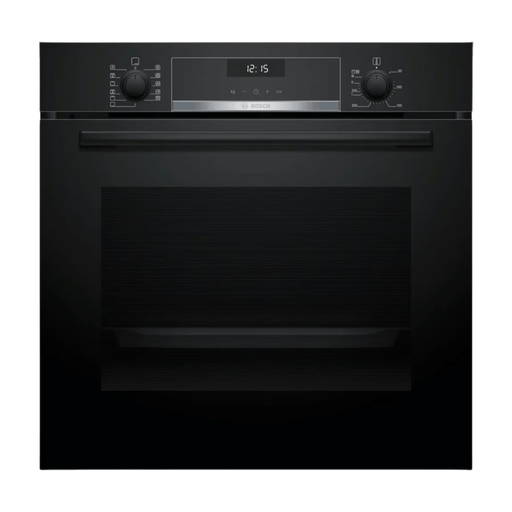
Bosch HBG537EB4 Serie 6 built-in oven, 71 L

Bosch HBG537EB4 Serie 6 built-in oven, 71 L

A built-in option to consider if you want to compare 3D Hotair with top and bottom heat for your baking needs.

71 L; the model specifications list baking on up to three levels and eight heating modes, including Air Fry.

View at Joybuy

Wiggo WMO-E456(W) mini oven, 45 L

Wiggo WMO-E456(W) mini oven, 45 L

A freestanding mini oven to consider if you want to choose separate baking settings; check the positioning instructions and make sure there’s room for your tin.

45 L and 2000 W; features include convection, top heat, bottom heat and a grill.

View at Joybuy

Frequently asked questions

Which oven setting should you use for a single berry clafoutis?

Start with the oven setting and temperature given in your chosen recipe, and check whether it’s cooked according to the recipe. Separate top and bottom heat may be a suitable option for a single delicate bake. The Albert Heijn Allerhande blackberry clafoutis recipe gives a temperature of 175 °C and a cooking time of around 45 minutes, but doesn’t specify a fan setting. Don’t assume that setting will work for fan cooking.

How can you tell whether an oven is big enough for a birthday party?

First choose the recipe, number of portions and baking tin, then measure the oven’s interior. The Albert Heijn Allerhande recipe for 12 portions uses a shallow Ø 28 cm dish; other recipes may call for a different tin. Consumentenbond recommends checking the internal dimensions, as the stated oven capacity alone doesn’t show how much usable space there is.

How do you compare an oven’s energy label and legal guarantee?

First check whether EU energy labelling rules apply to that type of oven. For domestic ovens covered by these rules, the label gives details including capacity and energy use per cycle for conventional and fan cooking. The European Commission gives small ovens and appliances with microwave heating as examples of products that aren’t necessarily covered by the oven rules mentioned. In the Netherlands, legal guarantees don’t have a fixed statutory duration; if a product is faulty, contact the retailer.

How should you store a clafoutis baked before the party?

If your clafoutis contains perishable ingredients, remember to keep it chilled. Voedingscentrum advises not leaving highly perishable food out of the fridge for more than 2 hours and setting the fridge to 4 °C. Check the Storage Guide for how long to keep your dish; this advice is about food storage, not choosing an oven.
