
Cooking for a larger group
You want to make the cauliflower bake for the bring-and-share in as few batches as possible. So measure your dish and compare it with the usable oven space; the capacity in litres alone won’t tell you whether it will fit.


First, measure your oven dish and compare it with the usable oven space; the capacity in litres alone won’t confirm whether the dish will fit. Then choose an oven with the setting your recipe calls for, and make sure there’s a safe spot for it in the shared kitchen. A larger model may take up more room and use more energy.
You want to make the cauliflower bake for the bring-and-share in as few batches as possible. So measure your dish and compare it with the usable oven space; the capacity in litres alone won’t tell you whether it will fit.
You’re looking for a permanent spot for the oven that won’t get in the way of the shared workspace or the specified ventilation clearance. Follow the model’s positioning and connection instructions.
You’re comparing the required grill, conventional heat or fan oven setting with the oven’s features. Your recipe will tell you which setting you need.
| What to consider | What should you check? | Who is this important for? |
|---|---|---|
| Fit and number of batches | Measure the dish, including its handles, and compare it with the usable interior space and door opening. | If you’re cooking for a group, you’ll want to know whether your dish fits and how many batches you’ll need. Around 36% of consumers prioritise cooking for a group. |
| Location and connection | Compare the external dimensions with the available space, and follow the positioning, ventilation and connection instructions. | In a shared kitchen, you’ll want a suitable location and connection that won’t put the workspace at risk. Around 29% of consumers give safe positioning top priority. |
| Required oven setting | Check which setting your recipe calls for, such as grill, conventional heat or fan oven. | If you’re following a recipe, you’ll want an oven with the specified heating setting. Around 21% of consumers choose mainly on the basis of the setting required by their recipe. |
| Energy use | Compare the energy used per cooking session on a like-for-like basis; don’t infer it directly from the rated power. | If you’ll use the oven after the bring-and-share too, consider its energy use alongside the portion sizes you usually cook. Around 14% of consumers prioritise the combined purchase and running costs. |
The capacity in litres doesn’t directly tell you the usable width, depth or door opening. This means a dish with handles may still not fit.
Measure your dish, including its handles, and check the usable space in the exact model before you choose.
An oven that’s too small may mean you need a different dish or have to plan for several batches.
Available settings vary by model, while your recipe may call for grill or conventional heat, for example.
Check the full model designation and specifications to make sure it has the setting your recipe calls for.
The rated power doesn’t tell you how much electricity one cooking session uses. Milieu Centraal recommends comparing energy use per session or per year and choosing a size that suits your usual portions.
Compare energy use on the same basis and don’t infer consumption directly from the wattage.
The OV207B is a compact option to compare if you want both fan oven and conventional heat in a 20-litre model.
The OV-3620 is a compact option to compare if conventional heat is all you need.
The TO 2058 is a larger freestanding model to compare, with fan oven and conventional heat.
The 112754 is a larger freestanding model to compare if fitting one bigger dish is your priority.
This selection includes freestanding ovens and an oven-air fryer combination with features described for baking or grilling. Compare the capacity and settings with your dish, recipe and available space.
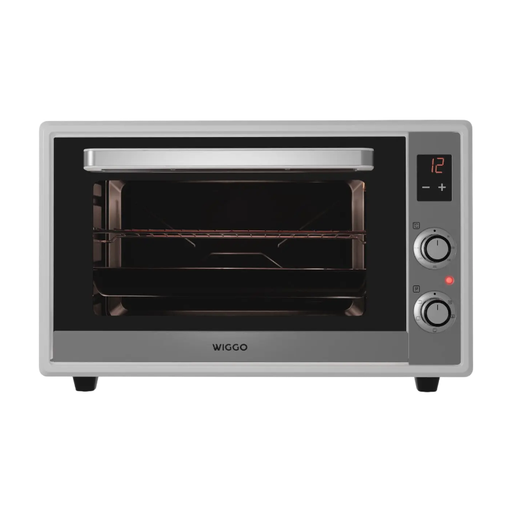 No image available
The stated 65-litre capacity may be useful for a larger dish; check that it will fit and that you have enough space on the shared worktop.
The product description lists six cooking functions, baking and grilling. The turbo fan is listed as an optional feature.
External dimensions: 60 × 49 × 40 cm.
 No image available
The description lists baking, grilling and fan oven functions; check that these suit the cooking steps in your recipe.
Capacity: 30 litres. The description also lists two hotplates and dimensions of 50 × 42 × 35 cm. Allow for the required worktop space and ventilation.
 No image available
The stated 45-litre capacity may suit a larger dish, but it doesn’t confirm that your dish will fit in the oven.
The description lists six functions, including convection and grill, as well as conventional heat. Check the usable space and positioning instructions.
 No image available
The description states that baking tins up to 25 cm in diameter can be used, giving you a specific measurement to compare with a round dish.
Capacity: 22 litres. The listed settings include conventional heat and hot air. The timer is stated as 60 minutes.
 No image available
The product description lists baking and broiling programmes; check that the programmes described match your recipe.
The description lists a 30-litre capacity, 21 programmes, a temperature range of 30–230 °C and a dual-cook function. Keep the ventilation openings clear and the appliance away from flammable materials.
No. In the recipe consulted from Voedingscentrum, the cauliflower and other ingredients are prepared first; the assembled dish is then browned under the grill. Follow the method and oven setting in your own recipe.
Follow the positioning and connection instructions for the exact model, and place it somewhere suitable. Brandweer Nederland advises keeping an eye on appliances while cooking, not connecting extension leads to one another, and avoiding plugging too many appliances into one extension socket.
According to Voedingscentrum, cool leftovers quickly and store them in an airtight container in the fridge or freezer. Don’t leave leftovers out of the fridge for more than two hours; the guidance for leftovers is to keep them in the fridge for up to two days.
Contact the retailer. According to the Dutch Government, you’re entitled to a product that is fit for purpose, and there is no fixed statutory guarantee period in the Netherlands. A manufacturer’s guarantee is in addition to your statutory rights and doesn’t replace them.
This depends on the specific model and the product rules that apply. The European Commission includes domestic electrical equipment within the scope of the Low Voltage Directive, which covers equipment for 50–1.000 V AC; the Netherlands Enterprise Agency lists exemptions and possible additional rules. So check which markings apply to the model on offer.