
Vandaag of morgen in huis

Kwaliteit gegarandeerd

Welkomstaanbiedingen ontgrendelen: GRATIS bezorging | Tot 80% korting | Gratis 30 dagen JoyPlus-proefperiode
Download de app
Buying an oven may seem simple, until you have to choose between an electric oven, built-in oven, freestanding oven or mini oven. Marketing copy often focuses on numerous programmes, generous capacity or an eye-catching energy label. However, these points do not tell you everything about everyday use.
The key question is: does the oven suit your available space, how often you cook and your connection requirements? Use the checklist below to avoid a poor purchase and compare models using verifiable specifications.
An oven with a capacity of 65 or 70 litres sounds spacious, but you should also check the internal width, depth and number of shelf positions. An oven can have a large capacity while a standard baking tray does not fit properly. This is even more important with a compact oven.
For example, the Rommelsbacher BG 950 has a capacity of 10 litres and, according to the product description, is suitable for baking trays up to 20 cm. This is practical for toast, muffins or a small pizza, but not for family meals.
An oven with ten functions is not automatically more convenient than a model with five functions. Above all, check whether the functions suit the way you use the oven:
According to Bosch product information, EcoClean Direct uses a special coating on the rear wall to help reduce grease deposits during use. This is a product feature of the brand and is not a guarantee that manual cleaning will never be necessary.
An energy-efficient oven can save you money over time, but actual consumption also depends on usage time, temperature, preheating and cooking mode. Alongside the label, therefore, check the consumption per cycle, if this is stated.
Also be aware of differences in the product information provided. Some models are listed as A+, A++ or A, while European energy labels for ovens are shown using a revised scale. Where possible, compare official product data sheets using the same measurement method.
A standard 60 cm oven usually has an external width of around 59.4 to 59.6 cm. However, the niche dimensions may vary from one model to another. Measure the following:
A built-in oven with a power rating of around 3,000 to 3,400 watts must be connected correctly and safely in accordance with the installation instructions. Do not use an unsuitable multi-socket adaptor or extension lead. If in doubt, have the installation carried out by a qualified installer.
A freestanding or compact oven must be placed on a level, heat-resistant surface. Keep ventilation openings clear and do not place the appliance directly next to flammable materials.
Choose the capacity based on your household:
A 70-litre oven offers more space, but it does not automatically heat up faster. Also check the number of shelf positions, the included baking tray and the maximum temperature.
A mechanical timer is simple and easy to understand. A digital display can offer additional functions, such as a clock, automatic programmes or a delayed start. Useful safety features include a child lock, automatic shut-off and a well-insulated oven door.
Pay attention to the differences between cleaning systems:
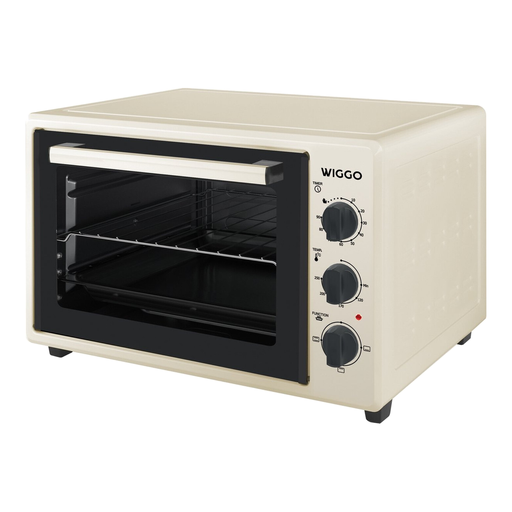
Why it suits this profile: This freestanding oven takes up less space than a built-in model and offers a 35-litre capacity, which is enough for simple oven dishes, bread rolls and pizza.
The capacity, 1,800-watt power rating and maximum temperature of 250 °C are clearly stated. This means you can compare more than just the number of functions.
Three heating functions, a 90-minute mechanical timer, double-glazed door, and included baking tray and wire rack.
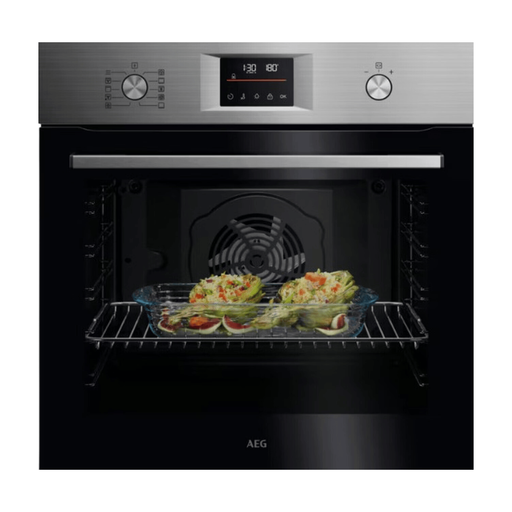
Why it suits this profile: This built-in oven combines a 72-litre capacity with multiple cooking programmes and a pyrolytic cleaning programme, making it suitable for households that cook frequently.
The technical specifications state the capacity, 2,990-watt power rating, five shelf positions and the minimum and maximum temperatures.
45 listed cooking programmes, child lock, automatic shut-off and pyrolytic self-cleaning.
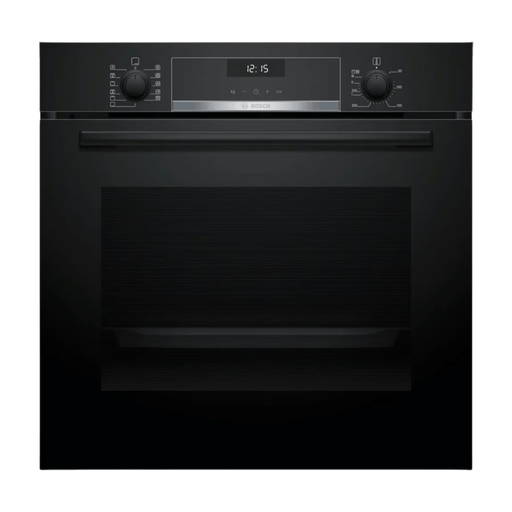
Why it suits this profile: This model is designed for users who bake regularly, want to make use of multiple shelf levels and are looking for an oven with a grill and fan-assisted cooking.
The product information lists eight heating systems, a range of 50 to 275 °C and a capacity of 71 litres. This makes it clear what the functions mean in practical terms.
3D fan-assisted cooking, large grill, Air Fry programme, child lock, telescopic rails and EcoClean Direct according to the product description.
We have compiled a complete, up-to-date list of products that fully meet these strict selection criteria and the applicable European safety regulations.
Many built-in ovens have an external width of around 60 cm, but the exact niche dimensions vary. Measure the existing niche and always check the installation details for your chosen model before ordering.
For everyday use by several people, a capacity of around 65 to 76 litres is often practical. If you mainly prepare snacks, small oven dishes or toast, a compact oven with a capacity of 10 to 35 litres may be sufficient.
This depends on the power rating, set temperature, heating time and programme duration. You can estimate the cost by multiplying the power rating in kilowatts by the number of hours of use and your electricity tariff. Use the oven efficiently by preparing several dishes one after another and keeping the door closed as much as possible while cooking.
