Brands to compare
The features listed apply to the specific models and product lines below; they are not recommendations for a brand’s entire range.
Tomado
A spacious freestanding option if you’re not looking for a built-in oven. Tomado lists a capacity of 75 litres and five shelf positions for the TEO7501B.
- Tomado lists fan-assisted cooking, a baking tray and an adjustable temperature of 90–230 °C.
- The timer runs for up to 60 minutes. Check how you’ll keep track of the cooking time if your recipe takes longer. The capacity and shelf positions don’t prove that your tin will fit or that several dishes will cook evenly at the same time.
Inventum
A mid-range freestanding option if you’re not looking for a built-in oven. Inventum lists a capacity of 60 litres, fan-assisted cooking, and top and bottom heat for the OV607B.
- Inventum lists a baking tray and wire rack as included, along with a five-year manufacturer’s warranty for this model.
- Inventum says the OV607B doesn’t have a defrost function. Also check that your chosen baking tin will fit.
Bosch
A built-in option for a kitchen with a suitable space. Bosch lists top and bottom heat and 3D fan-assisted cooking for the HBA534BS3.
- Bosch lists cooking on up to three shelf levels and a cleaning assistance function for this model.
- Check the dimensions of the built-in space. The option to cook on multiple levels doesn’t prove that several bread puddings will achieve the result you want at the same time.
Severin
A more compact freestanding option if you can bake in smaller batches. Severin lists a capacity of 42 litres for the TO 2058.
- Severin lists fan-assisted cooking, top and bottom heat that can be used separately, four shelf positions and a repair service.
- Check that your baking tin will fit and ask the retailer about current availability.
Ovens at Joybuy
This selection of Joybuy products includes compact and larger freestanding ovens, a built-in oven and a freestanding gas cooker with an oven. Whatever you choose, check that the tins, installation space or built-in space, and cooking method suit your needs.
 No image available
HAUSWIRT C40 convection oven with thermometer, 35 L, four-tier baking rack
A compact freestanding option to consider if you can bake in smaller batches and your chosen tins will fit.
The product name lists 35 L, a thermometer and a four-tier baking rack.
View at Joybuy
 No image available
Wiggo WMO-E657(B) freestanding oven, 65 L, 2000 W
A larger freestanding option to compare if you’re not looking for a built-in oven and have enough space for the appliance.
The product name lists 65 L and 2000 W; the product details list four shelf positions.
View at Joybuy
 No image available
Bosch HBG536EB4 Double Oven, 71 L, 3D Hot Air
A built-in option to consider if your kitchen has the required space and the installation requirements are right for you.
The product name lists 71 L and 3D Hot Air. The product details give the built-in dimensions as 58,50 × 56,80 × 55 cm and specify installation by a qualified electrician.
View at Joybuy
 No image available
Wiggo WMO-E353(X) oven, 1800 W, 35 L, stainless steel
A compact freestanding option to compare if you can plan to bake in smaller batches.
The product name lists 35 L and 1800 W. The product details list top heat, bottom heat and four shelf positions. The instructions require at least 10 cm of clear space around the oven and 30 cm above it; don’t place the oven in an enclosed cupboard.
View at Joybuy
 No image available
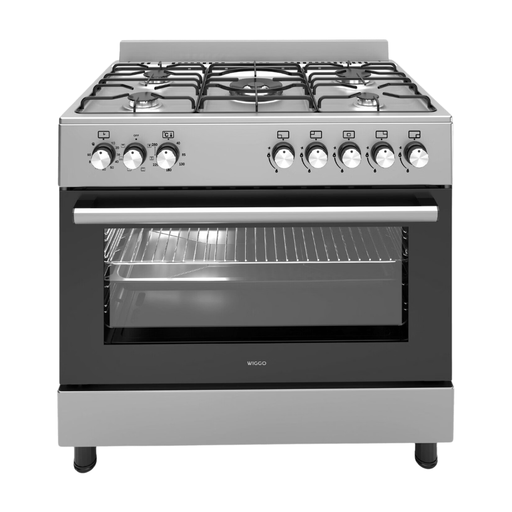
Wiggo WO-E906B(XX) freestanding gas cooker with oven, 90 cm, 110 L
This larger freestanding model is only an option if you’re looking for a gas cooker and your kitchen layout is suitable.
The product name lists 90 cm, 110 L and five burners. The safety information requires installation by a professional gas installer and adequate ventilation.
View at Joybuy
Frequently asked questions
What size baking tin needs to fit in the oven?
It depends on the recipe and how you arrange the tins. The Albert Heijn Allerhande recipe consulted, which serves eight, uses a 30 cm cake tin in a 30 × 20 cm roasting tin with hot water. If you choose this recipe, measure both tins. These dimensions aren’t required for every bread pudding recipe.
Can I bake a bread pudding recipe without a water bath?
Not without changing the method. The water bath recipe consulted uses 150 °C, while another Albert Heijn Allerhande bread pudding recipe is baked in a roasting tin at 180 °C. Follow one chosen recipe and your oven’s instructions rather than mixing and matching cooking times and temperatures from different recipes.
How should I store bread pudding until the school sale?
As well as baking, plan for cooling, chilled storage and transport. Voedingscentrum advises putting cooked leftovers in a sealed container in the fridge or freezer within two hours and keeping the fridge at 4 °C. The NVWA requires perishable food to be kept at the correct temperature when it’s sold; agree the practical arrangements with the school.
What allergen information should I provide at the sale?
The NVWA says you must be able to provide information before purchase about allergens in unpackaged food offered to consumers. Keep a record of the ingredients in your bread pudding and check the school’s policy too.
Is an HACCP plan always required for a one-off school sale?
Not simply because it’s a school sale. For markets and events, the NVWA says that anyone who prepares and sells food several times a year must have a food safety plan based on HACCP. Safe, hygienic preparation, storage and selling are always important. Ask the school to confirm how the sale will be organised and which rules apply to the organiser.


