
Host with a large oven dish
You want to bake bread pudding for guests in one dish and need to know whether it will actually fit in the oven. The Consumentenbond advises checking the internal dimensions and measuring your largest oven dish.


Don’t choose based on the stated capacity in litres alone. Measure your largest oven dish and compare it with the usable internal dimensions and shelf positions of the exact model, as the Consumentenbond also advises. If you don’t have a suitable built-in space but do have a suitable spot for an appliance, compare freestanding ovens. If you have a suitable housing unit, you could consider built-in models. Also compare the oven settings and energy use per cycle where this information is available: these factors don’t guarantee the results you’ll get from a specific model.
You want to bake bread pudding for guests in one dish and need to know whether it will actually fit in the oven. The Consumentenbond advises checking the internal dimensions and measuring your largest oven dish.
You don’t have a suitable built-in space or much worktop room, so you need to balance where the oven will go with the baking space you need. The Consumentenbond and manufacturers Inventum and Severin offer guidance on oven dimensions and positioning.
You want to make bread pudding and have a choice of oven settings for other dishes. Voedingscentrum and oven manufacturers explain the differences between conventional heat and fan-assisted cooking.
A good fit if: you don’t have a suitable built-in space but do have somewhere appropriate to put the oven.
Bear in mind: you’ll need enough clear space, a suitable connection and safe access around hot parts, as set out in the instructions.
A good fit if: your kitchen has a suitable housing unit and connection.
Bear in mind: check the housing unit dimensions and connection; the stated oven capacity doesn’t guarantee that your dish will fit.
A good fit if: you also want a microwave function and have confirmed that your oven dish fits inside the appliance.
Bear in mind: according to the Consumentenbond, combination microwaves often have fewer oven functions or shelf positions, and some don’t have bottom heat. Check the specific model.
| What to consider | What to check | Who does this matter to? |
|---|---|---|
| Will the dish fit? | Measure your largest oven dish and compare it with the usable internal dimensions, door opening and shelf positions of the exact model. | I want to bake bread pudding for guests in one dish that fits. Around 36% of consumers say dish capacity is their main concern when buying. |
| Will the oven fit in your kitchen? | For a built-in model, check the housing unit dimensions and connection details. For a freestanding model, check its dimensions and positioning instructions. | I need to fit the oven into the available space in my kitchen or have it built in. For around 29% of consumers, positioning is their main concern when buying. |
| Are the oven settings suitable? | Check the settings on the exact model and follow the recipe’s instructions for the oven setting you use. | I want to bake bread pudding and choose the right settings for other oven dishes too. Around 21% of consumers put oven settings first. |
| How do size and energy use compare? | Where available, compare energy use per cycle and oven capacity across models that fit your dish. Don’t look at the energy label alone. | I don’t want to choose a larger model than I need, and I also consider energy use. For around 14% of consumers, energy use is their main concern when buying. |
Milieu Centraal points out that, in some cases, a smaller oven with a lower energy rating can use less energy than a larger oven with a higher rating. Where possible, compare energy use per cycle, but don’t assume that one model will always be more efficient in every situation.
The stated oven capacity doesn’t tell you whether a particular dish will fit on the shelf. You may need to use a different oven dish or bake in several batches.
Measure your dish and check the internal dimensions and shelf space of the exact model.
If your dish doesn’t fit, you may need another dish or have to bake the bread pudding in several batches.
Oven functions and shelf positions vary, and some combination microwaves don’t have bottom heat. This means the setting you need for a recipe may not be available.
Check the heating settings and shelf positions available on the model you’re considering.
Size and the energy label alone don’t tell you how much energy it takes to cook a dish. Milieu Centraal notes that a smaller oven rated A+ can use less energy than a larger oven rated A+++.
Where applicable, compare energy use per cycle alongside the size and the space you actually need.
Inventum also makes freestanding ovens. The OV607B is one model to consider if you’re looking at freestanding options.
Severin offers freestanding baking and toast ovens. The TO 2058 is one example, with a capacity of 42 litres stated by the manufacturer.
Bosch makes built-in ovens. The HBA534BS3 is one option for a kitchen with a suitable housing unit.
Electrolux makes built-in ovens. The EOF6H46Z is one model to consider if you’re comparing ovens with several heating settings.
The models shown are mainly freestanding ovens, with one built-in oven for kitchens with a suitable housing unit.
 No image available
A freestanding oven that, according to the product description, is suitable for baking and larger meals.
The stated capacity is 65 litres. The description lists six cooking functions, a 90-minute timer and five shelf positions; the turbo fan is optional.
Keep the ventilation openings clear and take care around hot surfaces during use.
 No image available
A built-in oven to consider if your kitchen has a suitable housing unit and you want to use conventional heat.
The description lists a 71-litre capacity, conventional heat and 3D Hotair. The stated housing unit dimensions are 585 × 560 × 550 mm and the connection rating is 3600 W.
Check the housing unit dimensions and connection against your kitchen.
 No image available
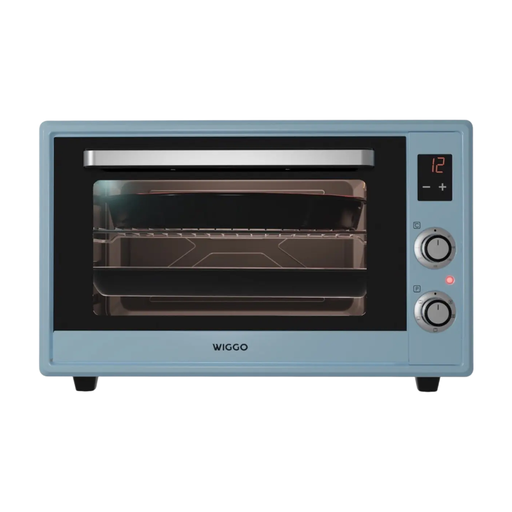
A freestanding mini oven to consider for bread pudding and other oven dishes.
The stated capacity is 45 litres. The description lists top heat, bottom heat and convection, along with six functions and a rotisserie function. There’s a hotplate on top.
Place the model on a stable, heat-resistant surface and keep the ventilation openings clear.
 No image available
A freestanding oven with top and bottom heat, which can be used together, for those who want to choose these settings when baking.
The stated capacity is 35 litres. The description lists four shelf positions, a 90-minute timer and a supplied baking tray and shelf.
According to the product description, leave at least 10 cm of clear space on all sides and 30 cm above the oven.
 No image available
A compact freestanding oven to consider if your oven dish fits within the stated dimensions.
The description lists a 22-litre capacity and baking tins up to 25 cm in diameter. It has five heating settings, including combinations with fan-assisted cooking, as well as top and bottom heat.
Place the oven on a flat, heat-resistant surface with plenty of ventilation.
Follow the setting and temperature in your recipe. Koopmans’ bread pudding recipe recommends baking it at around 200 °C for 45 minutes; this isn’t a universal setting. Voedingscentrum says that fan-assisted cooking generally requires a lower temperature, around 10% lower.
No, their baking options may differ. According to the Consumentenbond, combination microwaves often have fewer oven functions or shelf positions, and some don’t have bottom heat. So check the functions and internal dimensions of the specific appliance.
Don’t assume this applies to every small model. The European Commission cites small ovens as an example of products outside the scope of the oven rules discussed. Check the product category and compare the available energy-use information only for models covered by the comparison.
Treat it like any cooked leftover: let it cool quickly, cover it and store it in the fridge. Voedingscentrum advises keeping leftovers covered in the fridge for no more than two days.
No, the Netherlands doesn’t have a fixed statutory warranty period. According to the Dutch government, products must be of satisfactory quality, and their expected lifespan is taken into account. If a product is faulty, the retailer is your point of contact; any manufacturer’s warranty is in addition to your statutory rights.