
Baking one large dish
Measure your dish and compare its dimensions with the oven’s usable space. The Consumentenbond recommends checking the oven’s internal dimensions against your own baking dish.


Start with an oven that fits your baking dish and has the setting your recipe calls for: the capacity in litres alone won’t tell you whether the dish will fit. If you’re baking several dishes, usable space and shelf positions matter too. With a freestanding model, weigh up the space you have against the dimensions of a built-in oven cavity. A suitable oven doesn’t replace the NVWA requirements for selling food safely and providing allergen information.
Measure your dish and compare its dimensions with the oven’s usable space. The Consumentenbond recommends checking the oven’s internal dimensions against your own baking dish.
If you’re making more than one dish to sell, you may also want to consider the shelves and their positions. The Consumentenbond likewise recommends comparing the internal dimensions with your own dish.
If you don’t have a suitable built-in oven cavity, compare the space available for a freestanding oven with the room your dish needs inside it.
First, check that the oven setting suits your recipe and that your dish will fit. Then decide which type of oven and cleaning requirements work best for your bake sale.
| What to consider | What to look for | Who is this important for? |
|---|---|---|
| Oven setting for your recipe | Follow the setting and temperature in the berry recipe you’re using. Albert Heijn Allerhande gives 175 °C for a clafoutis made with different fruit; this isn’t a guarantee of the cooking time or temperature for your recipe. | If I’m following a berry recipe, I want to be able to set the oven to the specified setting and temperature. Around 31% of consumers prioritise the setting required by their recipe. |
| Dish and batch capacity | Measure your dish, including its handles, and check the internal dimensions, shelf and available height. If you’re using several dishes, check the guidance for the exact model. | When I’m making several portions, I want to know whether my dish and planned arrangement will fit; the capacity in litres alone won’t tell me. Around 31% of consumers prioritise dish and batch capacity. |
| Positioning in your kitchen | For a built-in model, compare the cavity dimensions and installation instructions. For a freestanding model, check the external dimensions and positioning requirements. | Without a suitable built-in oven cavity, I’d first check where a freestanding appliance can be placed safely. Around 23% of consumers prioritise positioning when comparing ovens. |
| Cleaning after baking | Check which parts are removable and what the manual says about cleaning the oven interior and accessories. | After a baking session, I want to know how much cleaning the oven will need. Around 15% of consumers prioritise cleaning and maintenance after use. |
The capacity won’t tell you whether your baking dish will fit. The Consumentenbond recommends comparing the oven’s internal dimensions with your dish.
Measure your dish, including its handles, and compare its dimensions with the oven space, shelf and available height.
If your dish doesn’t fit, you may need to use a different one or reconsider your choice of oven.
Oven settings and shelf positions vary between models. The Consumentenbond explains the differences between combination ovens and combination microwave ovens.
Check the individual oven settings for the exact model and make sure your dish will fit in the position you want to use.
A suitable oven won’t ensure that your baked goods are prepared and stored safely, or provide customers with allergen information. The NVWA sets requirements for selling food safely and hygienically, and for informing customers about allergens.
Plan how you’ll prepare, store and transport your food, and provide allergen information before organising the sale.
Depending on how and where you’re selling, you may also need refrigeration and a way to provide allergen information.
Freestanding ovens; the OV607B is worth considering if you don’t want to use a built-in oven cavity.
Built-in ovens; the OM316MZ is worth a look if you want to compare ovens with space for several dishes or multiple shelf positions.
Built-in ovens; the HBG536EB4 is an example to consider when comparing conventional heating with fan heating.
Compact built-in ovens with an integrated microwave; the H 7240 BM is relevant if you’re looking for both functions.
Freestanding ovens; the Optimo OF4958 is an example to consider if you’re looking for a standalone appliance with baking functions.
These products are all freestanding ovens. Compare the listed features with your recipe and measure the oven space before choosing a model.
 Image unavailable
An option to compare if you’re looking for a freestanding oven; measure the internal space against your own dish.
Capacity: 65 L. Power: 2000 W. The product description lists six cooking functions, a turbo fan and an enamel interior.
Manual cleaning is required.
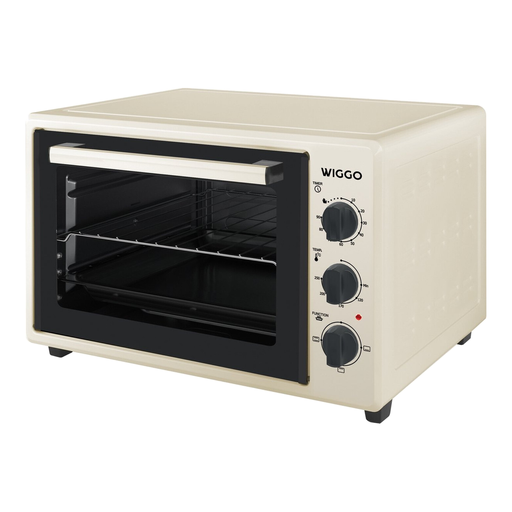 Image unavailable
An option if your recipe calls for conventional heating; check that your dish will fit in the oven.
Capacity: 35 L. Power: 1800 W. The product description lists an adjustable temperature of up to 250 °C, a timer, conventional heating, and an included baking tray and shelf.
The instructions call for a stable, heat-resistant surface and at least 10 cm of clearance on all sides.
 Image unavailable
An option to consider if you’re looking for an oven with an integrated hob; check that there’s enough room for your baking dish.
Capacity: 45 L. Power: 3534 W. The product description lists conventional heating, convection and a turbo fan.
Don’t choose based on the product name alone. Check the oven setting, shelf position and space for your dish on the exact model. The Consumentenbond explains the differences between combination ovens and combination microwave ovens; Miele, for example, lists a separate fan setting for the H 7240 BM.
Follow the berry recipe you’re actually using. For a clafoutis made with different fruit, Albert Heijn Allerhande recommends preheating the oven to 175 °C and baking the dish on a shelf. Don’t automatically use the same temperature and cooking time for a berry recipe.
Plan storage and transport separately from your choice of oven. The NVWA requires food sold to the public to be prepared and stored safely, and says that perishable food at markets and events must be kept below 7 °C. Voedingscentrum advises covering leftovers, refrigerating them within 2 hours and setting your fridge to 4 °C. Adapt your approach to your recipe and selling situation.
The NVWA requires customers to receive allergen information before purchase. How you provide it depends, among other things, on whether portions are prepacked or unpackaged. According to the NVWA’s step-by-step guide, you need to register if you sell food several times a year, but not if you do so once a year. Check how often you plan to sell.
Check the details of the specific offer for positioning or installation requirements and warranty terms. Remember to factor in cleaning, and measure the internal space before choosing a larger oven; the stated capacity alone won’t tell you whether your dish will fit.