
Baking a loaf for a celebration
You want to use an existing loaf tin and a recipe for several people. So check the usable internal dimensions and cooking setting, rather than relying on the oven’s stated capacity alone.


First, measure your own tin and check that it fits in the oven with enough room around it; the capacity in litres alone won’t tell you that. If there’s already an oven there, you may not need to buy another one. A freestanding oven or air fryer will only work if the tin, cooking setting and placement are all suitable. If you’re buying a new electric oven covered by Directive 2014/35/EU, also check the CE marking and conformity of the exact model. The European Union makes clear that CE marking is not a quality test.
You want to use an existing loaf tin and a recipe for several people. So check the usable internal dimensions and cooking setting, rather than relying on the oven’s stated capacity alone.
You’re thinking of bringing an oven with you or setting one up temporarily. Check in advance that there’s enough worktop and ventilation space, and that the electrical connection is suitable. The Fire Service recommends plugging high-power appliances directly into a socket wherever possible.
You might want to make a smaller loaf in an air fryer. Philips recommends leaving space around the tin in the basket, so check that your tin fits and that air can circulate.
A good fit if: the holiday cottage already has an oven with a suitable cooking setting and enough room for your tin.
Bear in mind: the settings and available cooking time of the oven on site.
A good fit if: there isn’t a suitable oven and your tin fits inside the oven.
Bear in mind: the external dimensions, space needed for heat to escape and a suitable electrical connection.
A good fit if: you’re making a smaller loaf and the ovenproof tin fits in the basket with space around it.
Bear in mind: you can’t use a recipe for a large loaf or a standard cake tin without checking the dimensions and cooking method first.
For a nut loaf, the most practical option depends on whether your tin fits, which cooking settings you need and where the appliance can go in the cottage.
| What to consider | What should you check? | Who is this important for? |
|---|---|---|
| Whether your tin will fit | Measure the length, width and height of your own tin and compare them with the usable internal dimensions and shelf positions. The capacity in litres doesn’t confirm that it will fit. | If you want to bake a whole loaf in your existing tin, you need to make sure it actually fits. That’s why around 33% of consumers put fit first. |
| Cooking setting and time | Check which heat settings, temperature and timer are available, and compare them with your recipe. The Allerhande recipe we consulted uses 175 °C for around 50 minutes; that setting isn’t guaranteed to work for every oven. | If you want to follow the recipe as closely as possible, you’ll need suitable heat settings and enough time. Around 27% of consumers give cooking controls top priority. |
| Placement and connection | Check the external dimensions, the model’s placement instructions and the electrical connection in the cottage. The Fire Service recommends plugging high-power appliances directly into a socket wherever possible, rather than using a multi-socket adaptor or cable reel. | If worktop space is limited or you need to assess the connection on site, you’ll want to know where the oven can be safely placed and plugged in. Around 20% of consumers put safe placement first. |
| Using the oven after baking | Check which accessories are included and read the cleaning instructions. Only choose extra features if you’ll use them during your stay. | If you want to use the oven for more than one type of cooking, accessories and maintenance matter as well as baking your loaf. Around 20% of consumers give versatility and maintenance top priority. |
The stated capacity doesn’t tell you whether your cake tin will fit in the usable oven space. If it doesn’t fit, you won’t be able to use it for this recipe.
Measure your tin and compare its dimensions with the internal space and shelf positions of the exact model.
You may need a different baking tin if your own one doesn’t fit.
For the Rommelsbacher BG 1055/E, the manufacturer lists a capacity of 18 litres and a 60-minute timer, while a Joybuy listing for the same model designation states 10 litres and 30 minutes. These figures don’t match, so don’t assume they’re the same specifications without checking.
Check the model designation, rating plate and manual for the actual appliance before relying on those details.
A freestanding oven needs a suitable place where heat can escape, and the electrical connection in a holiday cottage may vary.
Read the model’s placement instructions and check the connection before use. The Fire Service recommends plugging high-power appliances directly into a socket wherever possible.
The OV-3620 is a compact 19-litre mini oven with top and bottom heat.
According to Inventum, the freestanding OV207B has a capacity of 20 litres and six oven settings.
According to Tefal, the Optimo OF4648 has a capacity of 33 litres and includes fan and pastry settings.
The TO 2068 is a mini oven with a capacity of around 20 litres, convection and adjustable top and bottom heat.
For the BG 1055/E, the manufacturer lists a capacity of 18 litres, several heat settings and a 60-minute timer.
The Joybuy options below are freestanding ovens for anyone who wants to bring an oven along or set one up temporarily. Before buying, check that your tin fits, that the oven will fit in the available space and that the exact model meets the applicable product requirements.
 No image available
The description lists baking, top and bottom heat, and convection. Check that the oven space is suitable for your own baking tin.
2000 W; 45L; white.
Before buying, check the CE marking and conformity of the exact model and appliance against the applicable EU requirements.
 No image available
The description lists top and bottom heat and several fan settings, giving you options to compare with your recipe.
The stated capacity is 22 litres. The listed size of up to 25 cm applies to round baking tins and doesn’t confirm that your loaf tin will fit.
Before buying, check the CE marking and conformity of the exact model and appliance against the applicable EU requirements.
 No image available
The description lists separate top heat, bottom heat and convection functions. Compare these with the cooking method in your recipe.
45 Litres; 3534 W; black.
Before buying, check the CE marking and conformity of the exact model and appliance against the applicable EU requirements.
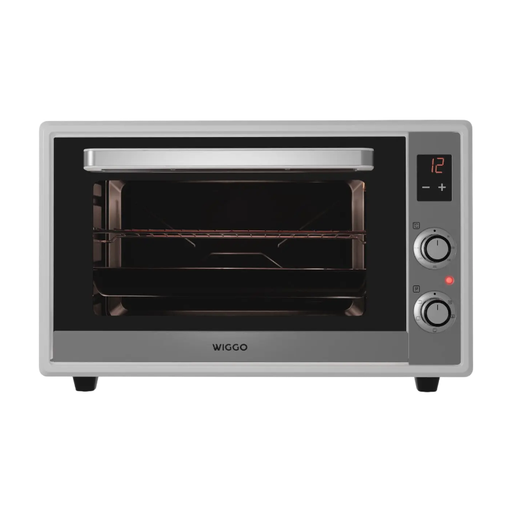 No image available
The description lists six cooking functions, including baking, grilling and roasting. Check which one is right for your recipe.
65L; stainless steel; 2000W. The stated external dimensions are 60 × 49 × 40 cm and the weight is 14 kg; compare the dimensions with the space available.
Before buying, check the CE marking and conformity of the exact model and appliance against the applicable EU requirements.
 No image available
With a stated capacity of 10 litres and baking trays up to 20 cm, it’s important to check the dimensions of your own tin in advance.
Top and bottom heat; adjustable temperature from 80–230 °C; maximum timer duration 30 minutes. For the recipe we consulted, which takes around 50 minutes, you’ll need to set the cooking time in stages and keep checking.
The oven weighs 4,4 kg according to the description. Before buying, check the CE marking and conformity of the exact model and appliance against the applicable EU requirements.
Only if the ovenproof tin fits in your model’s basket with enough space around it for air to circulate. Philips says that ovenproof dishes can be used in its Airfryers, but that doesn’t confirm that your particular tin will fit.
Follow your own recipe and check that the loaf is cooked through. The Allerhande recipe we consulted uses 175 °C for around 50 minutes for a loaf baked in a 1-litre cake tin; that guidance won’t necessarily apply to every loaf or oven.
Read the model’s manual and check the electrical connection on site. The Fire Service recommends plugging high-power appliances directly into a socket wherever possible; fully unwind any cable reel you use. Also follow the oven’s placement instructions.
Contact the seller if the product is faulty. According to the Dutch Government, you’re entitled to a product that works properly, and the seller must provide a solution if there’s a problem. A manufacturer’s warranty is in addition to your statutory rights.
Electrical equipment covered by Directive 2014/35/EU must meet the applicable EU product requirements and carry CE marking. Check the marking and the identity of the exact model. According to the European Union, CE marking is not an independent quality test or an EU approval certificate.