
Home baker making cakes for guests
Your main priorities are making sure your cake tin fits and being able to select the oven setting in your recipe.


First, choose between a freestanding oven that you can place somewhere suitable and a built-in oven that fits your kitchen. Then check that there’s enough room for your cake tin. The Voedingscentrum describes conventional top-and-bottom heat as the usual setting for many recipes; a fan setting isn’t automatically the right choice for every cake. Follow the setting and temperature in your recipe, and check that the cake is baked through.
Your main priorities are making sure your cake tin fits and being able to select the oven setting in your recipe.
You’re looking for a freestanding oven and need to check both the space available and whether your cake tin will fit.
You’re comparing oven settings and ease of use, but first you need to check that a model will fit the existing space.
A good fit if: you don’t have a suitable built-in space and can place the oven safely in a suitable spot.
Bear in mind: the capacity in litres won’t tell you whether your cake tin will fit. Check the internal dimensions and the manual.
A good fit if: you have a suitable built-in space or are replacing an existing built-in oven.
Bear in mind: check the installation dimensions and connection requirements. Manufacturer claims about baking on multiple shelf levels aren’t independent cake-baking tests.
| What to consider | What should you check? | Who is this most important to? |
|---|---|---|
| Cake tin and oven setting | Measure your tin and check the usable internal space and oven settings of the exact model. | I want to know whether my tin will fit and which setting my recipe requires. Around 36% of consumers put baking cakes first. |
| Where it will go in the kitchen | Compare the available space or built-in housing with the model’s dimensions and installation instructions. | I want to know in advance whether a freestanding model will fit in my chosen spot or a built-in model will fit in its housing. Around 29% of consumers put placement first. |
| Space for baking more often | Compare the internal dimensions, shelf levels and stated capacity with your largest cake tin. | If I want to bake more often or make more at once, usable space is my main consideration. Around 21% of consumers put this first. |
| Energy use, maintenance and aftercare | Where applicable, compare energy use per cycle and check the maintenance instructions and warranty terms. | I also want to know what’s involved in using and cleaning the oven, and who to contact if something goes wrong. Around 14% of consumers put energy use, maintenance or aftercare first. |
The stated capacity won’t tell you how wide or tall the usable space is for your cake tin.
Measure your cake tin and check the internal space and shelf position before choosing a model.
If your current tin doesn’t fit, you may need to buy a different one.
Many recipes use conventional top-and-bottom heat. If you choose a different oven setting, you may need to follow different temperature guidance.
Choose a model with the settings you want to use, and start by following the instructions in your recipe.
A built-in model must fit its housing; a freestanding model needs a suitable spot, as described in the manual.
First decide which type of oven suits your kitchen, then check the dimensions and installation instructions for the exact model.
A built-in oven may require installation work.
The European Commission excludes small and portable ovens from the scope of the oven energy-labelling rules referred to here.
First decide which type of oven you’re comparing. For ovens covered by the rules, compare the stated energy use per cycle.
The OV457B we looked at is a 45-litre freestanding oven with a fan setting and conventional top-and-bottom heat.
The TEO4500B we looked at is a 45-litre freestanding oven with a fan setting and conventional top-and-bottom heat.
According to Bosch, the built-in HBA534BS3 we looked at combines 3D HotAir with conventional top-and-bottom heat.
The OU5AB20WCM we looked at is a 65-litre built-in oven with conventional and fan settings.
This selection includes one freestanding oven and several built-in ovens. Compare how they’re installed, their stated capacity and the features listed for each exact model.
 No image available
A freestanding model for anyone who doesn’t need a built-in oven; check that your cake tin fits in the usable internal space.
The product name states a capacity of 65 L and a power rating of 2000 W.
 No image available
A built-in model for an existing or new oven housing; check the dimensions of the housing before you buy.
The product name lists 71 L, 3D HotAir and EcoClean Direct.
 No image available
A built-in model; check that it fits your oven housing and that its features suit the way you bake.
The product name lists an Air Fry function, steam cooking and pyrolytic self-cleaning.
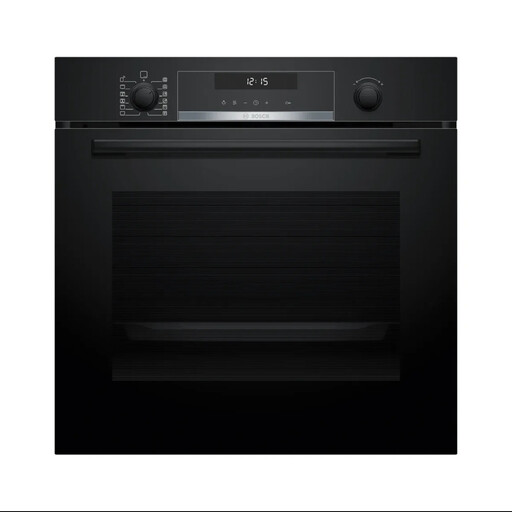 No image available
A built-in model for anyone looking for an oven that fits their kitchen; check the dimensions of the exact model’s housing.
The product name lists an Air Fry function, Home Connect and pyrolytic self-cleaning.
 No image available
A built-in oven for anyone looking for a fan-assisted model; check the oven housing and whether the available features suit your needs.
The product name lists 71 L, Air Fry and EcoClean Direct.
No. Many recipes use conventional top-and-bottom heat. The Voedingscentrum advises following the setting in your recipe; if you switch to a fan setting, it recommends a lower temperature and checking the cake towards the end of the baking time. Bosch lists conventional top-and-bottom heat as an option for delicate bakes.
Towards the end of the recipe’s baking time, test the cake with a cocktail stick. According to the Voedingscentrum, the cake is ready if no mixture sticks to the stick. The baking time for one recipe won’t necessarily work for every coffee cake or crumb cake.
Follow the manual for the exact model when installing, using and cleaning the oven. The Inventum OV457B manual recommends using oven gloves when putting food in or taking it out, as accessible parts may be hot.
For ovens covered by the EU rules, also compare the stated energy use per cycle. The European Commission excludes small and portable ovens from the scope of these oven energy-labelling rules. In the Netherlands, your statutory guarantee applies alongside any manufacturer’s warranty. According to the Dutch government, the retailer is your point of contact if there’s a problem with the product.
For online product purchases, you’ll generally have up to 14 days after delivery to change your mind. ACM ConsuWijzer also explains that there are exceptions, so check the terms that apply to your purchase.