
Baker making small lunch portions
You want to bake a cake and take it with you in portions. A suitable tin and useful oven setting matter more than automatically choosing the largest oven.


Start by measuring the outside of your cake tin and comparing it with the oven’s usable internal dimensions. The capacity in litres alone won’t tell you whether the tin will fit. The Dutch Consumers’ Association says conventional top-and-bottom heat is suitable for cakes, while a fan setting offers extra flexibility when baking on multiple shelves. Then choose between a freestanding and built-in model based on the space available and the installation it requires.
You want to bake a cake and take it with you in portions. A suitable tin and useful oven setting matter more than automatically choosing the largest oven.
You’re weighing up the space on your worktop against a suitable built-in space, or looking for an appliance that can also work as a microwave.
As well as a lunchbox cake, you want to bake larger dishes or several dishes at once, so you’re looking at usable space and shelf positions.
First compare your cake tin and the oven settings, then decide which oven suits your kitchen and how often you bake larger portions too.
| What to consider | What to look for | Who should pay particular attention? |
|---|---|---|
| Baking results | Check the top-and-bottom heat setting and cake settings in the manual. The Dutch Consumers’ Association says top-and-bottom heat is suitable for cakes; a fan setting can be useful when baking several dishes on different shelves. | If I mainly want to know which setting suits my cake recipe, I prioritise doneness and the right setting; around 40% of consumers say baking results are their main consideration. |
| A suitable cake tin | Measure the tin and compare its width, depth and height with the usable space on the shelf position you want to use. The Dutch Consumers’ Association recommends checking the internal dimensions. | If you want to use a tin for lunch portions, you’ll want to know whether it fits in the oven with enough room around it; around 30% of consumers prioritise this fit. |
| Positioning and connection | Compare the external dimensions and installation instructions with the available space, ventilation clearance and connection. Brandweer Nederland (the Netherlands Fire Service) stresses that heat from appliances must be able to escape. | If my kitchen has little spare space, I want to know in advance whether a freestanding or built-in model will fit practically; around 20% of consumers make positioning their top priority. |
| Frequent baking | Compare oven sizes and, where available, energy use per baking session. Milieu Centraal recommends comparing ovens by electricity use per use or per year. | If you bake regularly, you’ll want to avoid using an unnecessarily large oven for small portions and keep an eye on electricity use; around 10% of consumers prioritise running costs. |
The stated capacity won’t necessarily tell you whether your cake tin will fit on the shelf or have enough space above it.
Measure the tin and compare it with the usable internal dimensions at the shelf position you want to use.
The Dutch Consumers’ Association says top-and-bottom heat is a suitable setting for cakes. Other settings may require a different temperature; Bosch warns in its baking advice that cakes can dry out more quickly with a fan setting.
Follow your recipe and the manual for your exact model. Use a wooden skewer to check whether the cake is baked through.
A built-in oven needs a suitable housing space and connection; a freestanding appliance takes up room on the worktop. For both types, heat must be able to escape in line with the positioning instructions.
Check the external dimensions and installation manual before choosing a model, and leave the specified ventilation clearance.
Inventum describes the freestanding OV307B as an oven with a net capacity of 30 litres, a fan setting and top-and-bottom heat. According to Inventum, the OV607B has a capacity of 60 litres.
According to Tefal, the freestanding Optimo OF4648 has a capacity of 33 litres, a fan setting and a separate pastry setting for baking items such as cakes.
ETNA lists the built-in OM316MZ oven as having a stated capacity of 77 litres, five shelf positions, turbo fan cooking and top-and-bottom heat.
Bosch lists the built-in HBG7741B1 oven as measuring 60 × 60 cm and featuring pyrolytic cleaning.
This selection includes freestanding appliances and built-in ovens to consider when choosing an oven for coffee cake. For the exact model, check the applicable electrical safety information, connection requirements and specified positioning.
 No image available
A freestanding model to consider if you want to bake larger dishes as well as cakes.
The product name lists a capacity of 65L and a power rating of 2000W. According to the product information, leave at least 10 cm of space at the sides and 30 cm above the appliance, and don’t block the ventilation openings.
 No image available
A built-in model to consider if you have a suitable housing space and want to use the oven for other baking too.
The product name lists a capacity of 66L, five cooking programmes and an ecoClean self-cleaning function. Follow the installation instructions provided.
 No image available
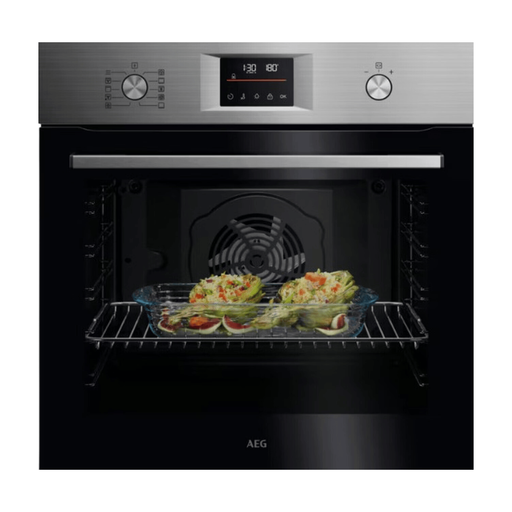
A built-in model to consider if you have a suitable housing space and prepare larger dishes as well as small cakes.
The product name lists a capacity of 72L, pyrolytic cleaning, an A++ energy rating and 45 cooking programmes. Follow the installation instructions provided.
 No image available
A freestanding model to consider if you’re looking for a more compact oven for baking items such as cakes.
The product name lists a capacity of 30L and a power rating of 1500W. According to the product information, place the appliance on a stable, heat-resistant surface, away from water and flammable materials.
 No image available
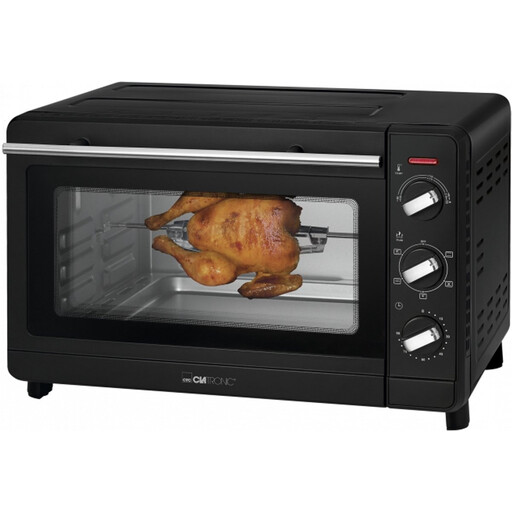
A freestanding air fryer oven to consider if you’re looking for a baking function in an appliance that circulates hot air.
The product name lists a capacity of 30L, 21 programmes, a rotisserie and a dehydrator function. Keep the appliance away from flammable materials while cooking, and clean the inside after use.
No. The Dutch Consumers’ Association says top-and-bottom heat is suitable for cakes; a fan setting can be useful when baking several dishes on different shelves. Follow your recipe and your oven’s manual. If a recipe only gives a top-and-bottom heat setting, the Dutch Consumers’ Association says that a fan setting is usually around 20 °C lower.
Insert a wooden skewer into the cake: according to Bosch, the cake isn’t ready if batter sticks to it. Baking time also depends on the mixture and the height of the tin.
For ordinary cake, the Netherlands Nutrition Centre recommends storing it in a kitchen cupboard and keeping it wrapped to prevent it drying out. Don’t automatically apply this advice to cakes with perishable fillings or toppings, such as cream cheese; check the storage advice for those ingredients.
As well as any manufacturer’s warranty, you’re entitled to a legal guarantee: if a product is faulty, the seller must provide an appropriate solution. ACM ConsuWijzer says that for an ordinary online purchase, the cooling-off period usually ends 14 days after delivery. Check any exceptions and the returns policy that applies to your order.
The Netherlands Food and Consumer Product Safety Authority (NVWA) sets out the legal safety requirements for electrical appliances. Electrical equipment with a rated AC voltage of 50–1000 V must meet the requirements of the Low Voltage Directive; for equipment with Wi-Fi, Bluetooth or a radio-frequency module, the Radio Equipment Directive may apply to the entire product. The applicable rules depend on the exact model; a product listing alone doesn’t confirm that a particular appliance meets the requirements.