
Vandaag of morgen in huis

Kwaliteit gegarandeerd

Welkomstaanbiedingen ontgrendelen: GRATIS bezorging | Tot 80% korting | Gratis 30 dagen JoyPlus-proefperiode
Download de app
Choosing an outdoor wall light might seem straightforward: pick a design, check the colour and mount it on the wall. In practice, many people end up with the wrong light because of an unsuitable IP rating, a forgotten bulb or a solar panel that gets very little direct sunlight. When choosing a wall-mounted outdoor light, it’s especially important to consider where it will go, the type of light you want and how it will be powered.
An IP44 outdoor light is protected against solid objects and splashing water from different directions. This makes IP44 suitable for many exterior walls, balconies, verandas and sheltered patios. It doesn’t mean you can point a jet of water at the light or leave it submerged for long periods.
So don’t install an IP44 outdoor wall light where rainwater can collect or spray directly onto the casing. For a very exposed exterior wall, a higher IP rating, such as IP65, may be more practical.
A GU10 or E27 outdoor wall light is often supplied without a bulb. That’s not a problem if you want to choose the colour temperature, brightness and energy consumption yourself. But it can mean extra costs, and leave you with a light fitting you can’t use if you order the wrong bulb.
So always check:
A solar wall light doesn’t need a fixed power supply, but its solar panel needs enough direct sunlight during the day. A north-facing wall, a covered area or a spot beneath a dense tree can limit charging. The light may also stay on for less time during the darker winter months.
A wall light with a motion sensor only comes on when it detects movement, but it still needs a well-charged battery. Position the light so the panel is unobstructed, and clean it regularly.
Choose the level of protection according to where the light will actually be installed. IP44 is often suitable for a sheltered exterior wall. The Philips Fylx, Philips Ulio, Philips Juli and various Brilliant models have IP44 protection according to their product specifications. The Philips UltraEfficient Zyren is listed as IP65 in its product specifications, offering greater protection against dust and water.
The IP rating only applies if the light is installed correctly and its seals are properly closed. Wired models must be connected to the mains in accordance with local electrical regulations by a qualified installer.
Warm white light of around 2700 to 3000 K is usually pleasant for an entrance or patio. Cooler light can be more practical by a garage, garden path or back door. Also consider how the light is distributed:
The lumen figure indicates the light output. A 180-lumen light is suitable for subtle orientation lighting; 800 to 1000 lumens provides noticeably brighter, more functional light. The right choice depends on the mounting height, the wall and the purpose of the exterior lighting.
A mains-powered LED outdoor wall light generally provides consistent illumination as long as the power is switched on. Models with GU10 or E27 fittings are handy if you want to choose your own LED bulb. Solar outdoor lighting is easier to install and doesn’t use electricity from the mains, but its performance depends on sunlight and battery capacity.
A USB-rechargeable model is a halfway option. It doesn’t need to be wired in, but it does need charging regularly. Also check the sensor angle, detection range and whether you can switch the sensor off.
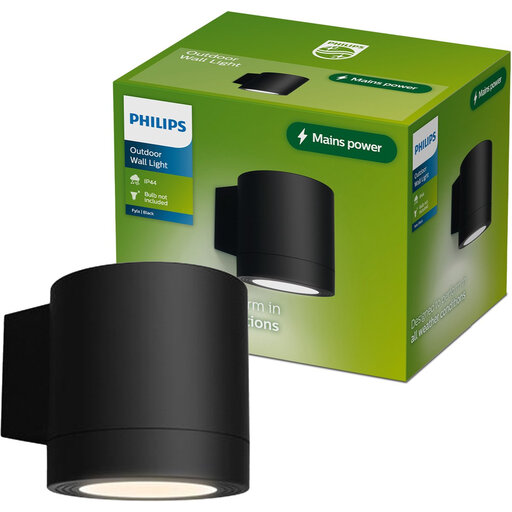
Why it suits this profile: This compact outdoor wall light gives you the freedom to choose your own GU10 LED bulb and light colour.
The GU10 fitting is clearly specified and the bulb is replaceable. Bear in mind that the spotlight is not included, according to the product information.
Aluminium casing, compact dimensions of approximately 9 × 11,6 × 9 cm and an IP44 rating.
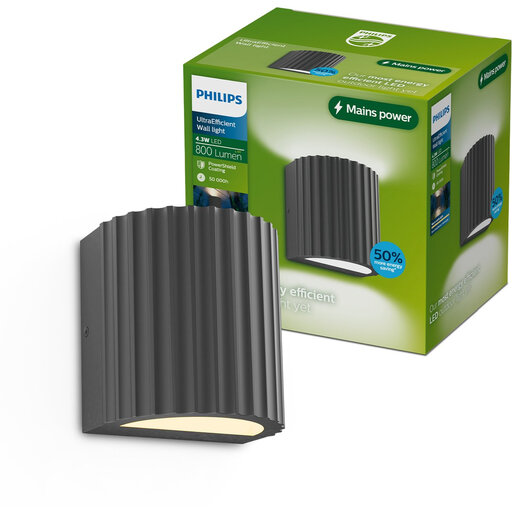
Why it suits this profile: The integrated LED and two-way light distribution work well on a modern exterior wall or by an entrance where you want a polished lighting effect.
The product details specify an integrated LED, 800 lumens and 2700 K. So there’s no need to look for a separate fitting or spotlight.
Two-way lighting, 4,3 W power and IP44 rating. According to Philips’ own product specifications, the stated lifespan is up to 50.000 operating hours.
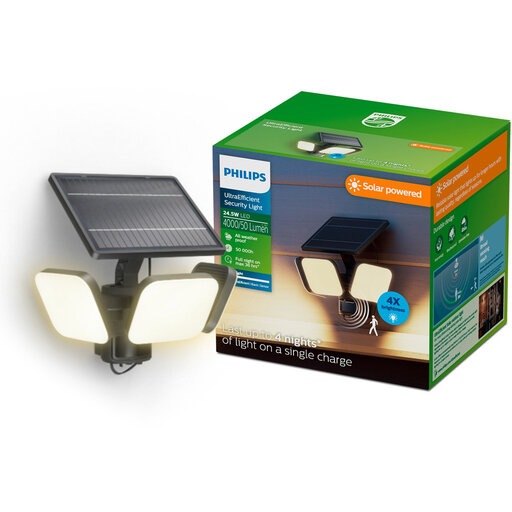
Why it suits this profile: This solar wall light is designed for people who want plenty of light and automatic activation by a driveway, back garden or entrance.
Its stated IP65 rating is higher than IP44. The light also has dusk and motion sensors, so it doesn’t need to stay on all the time.
According to the product specifications, the integrated LED system delivers 4000 lumens, with detection up to 8 metres when approached head-on and 16 metres from the side.

Why it suits this profile: The magnetic mount and USB-C charging are practical if you don’t want to install wiring or would like to be able to move the light.
It doesn’t rely on a fixed power supply. The product information gives an IP44 rating, but also states that the light is splash-resistant rather than waterproof.
Integrated LED, 300 lumens according to the product specifications, motion sensor and rechargeable battery.
We’ve put together a complete, up-to-date list of products that meet these strict selection criteria and the applicable European safety regulations.
IP44 is suitable for many sheltered outdoor locations and protects against splashing water. It doesn’t make a light suitable for immersion or direct jets of water. Also check that it has been installed and sealed correctly.
Lifespan varies by model, usage and conditions. Manufacturers sometimes state an expected lifespan for integrated LED models. For example, Philips gives a figure of up to 50.000 operating hours for certain models in its own product specifications. This is a manufacturer’s estimate, not a guarantee for every real-world situation.
A solar wall light doesn’t use electricity from the mains while it’s on. Its solar panel charges an internal battery. The actual operating time depends on sunlight, the season, battery charge and how often the motion sensor is activated. Keep the panel clean and place it somewhere as free from shade as possible.
