
Vandaag of morgen in huis

Kwaliteit gegarandeerd

Welkomstaanbiedingen ontgrendelen: GRATIS bezorging | Tot 80% korting | Gratis 30 dagen JoyPlus-proefperiode
Download de app
An outdoor wall light may seem like a simple purchase, but the wrong specifications can quickly lead to disappointment. A light may provide too little illumination, fail to charge properly in the shade or be less suitable for a wall directly exposed to rain. Terms such as “water-resistant”, “solar” and “motion sensor” are also not always interpreted correctly.
Use these practical checkpoints to compare an outdoor wall light based on its intended use, technology and installation. This will help you make a more informed choice for an entrance, balcony, patio, exterior wall, or garden path.
A black outdoor light or anthracite wall light may complement your exterior wall, but its design says nothing about its brightness or protection against moisture. Always check the number of lumens, the light colour and the IP rating.
A solar outdoor wall light needs daylight to charge its internal battery. Under a covered area, next to a tall fence or on a north-facing wall, the energy yield may be lower. The light may then work for less time or appear less bright than expected.
IP44 outdoor lighting is protected against splashing water and solid objects above a certain size. This makes IP44 suitable for many sheltered outdoor locations, such as a balcony, veranda or entrance. A light with IP65 offers greater protection against dust and water jets, making it more suitable for a wall that is more exposed to rain. Neither rating means that the light can be placed underwater.
Lumens indicate how much light a lamp produces. For atmospheric lighting beside a patio, a lower lumen output is often sufficient. For a driveway, dark entrance or security lighting, more light is generally more practical.
Colour temperature is expressed in kelvins:
An LED outdoor wall light with an integrated light source is generally ready to use straight away. However, check whether the LED can be replaced. With some models, the entire fitting must be replaced when the light source reaches the end of its stated service life.
An outdoor wall light with a motion sensor switches on when movement is detected. Check the detection angle and range, especially if you are lighting a long driveway or side path. A dusk sensor, also known as a wall light with a dusk sensor, switches the light on as soon as it gets dark. Some solar models combine both functions with a permanent or temporary lighting mode.
Pay attention to the difference between:
Aluminium is lightweight and is often used for fixed outdoor lights. Plastic can be practical for solar lighting because it is light and does not require an electrical connection. Also check the installation instructions and the surface you will be mounting the light on. A fixed 230-volt light must be connected in accordance with local regulations. If in doubt, it is advisable to use a qualified installer.
A light fitting with a replaceable bulb offers greater flexibility. An E27 outdoor wall light works with a suitable LED bulb with a large screw fitting. A GU10 outdoor wall light uses a spotlight bulb with a GU10 fitting. Always check that the fitting specified in the product information matches the bulb you want to use.
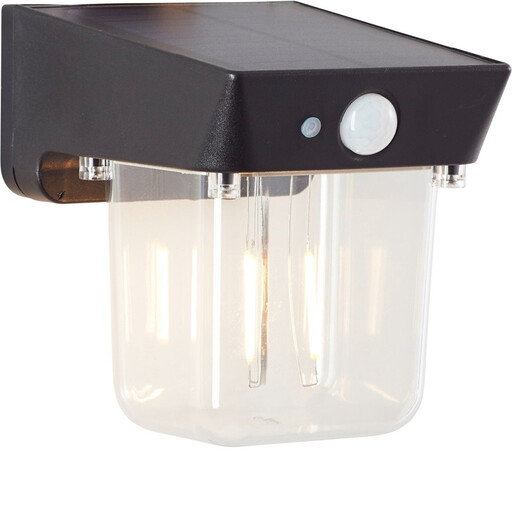
Why it suits this profile: This compact solar outdoor wall light works without fixed wiring, making it practical for a balcony, shed or small entrance.
The product details specify an integrated motion sensor, solar power and IP44 protection. However, make sure you install the light somewhere with sufficient daylight.
180 lumens, 2700K warm white light, integrated battery and a compact size of approximately 11.5 cm.
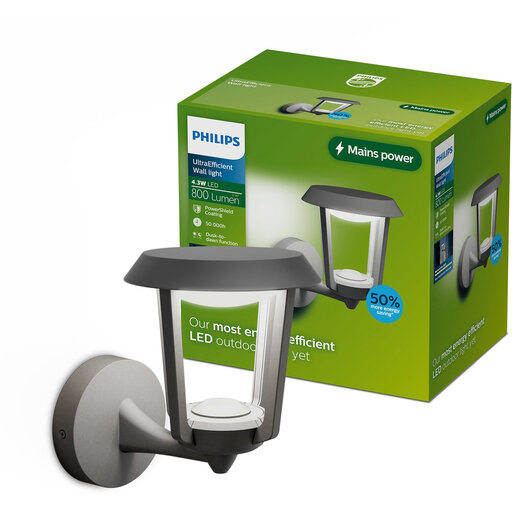
Why it suits this profile: For anyone looking for a fixed, understated lighting solution for an exterior wall or entrance with integrated LED lighting.
The specifications mention aluminium, a PowerShield coating and IP44. This gives you a clearer idea of what the light is designed for than a product described only as “weather-resistant”.
800 lumens, 2700K, integrated LED, 4.3 W and a stated service life of 50,000 hours.
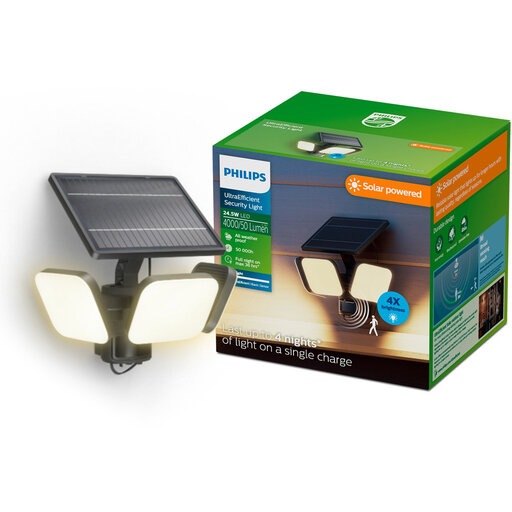
Why it suits this profile: This solar outdoor wall light is designed to provide broad, bright illumination beside a driveway, rear wall or larger garden path.
The product information specifies IP65, an adjustable lamp head and a detection range of 8 metres for direct approach and 16 metres from the side.
4000 lumens, 3000K warm white light, two lighting modes and, according to the product description, up to four nights of illumination from a fully charged battery.
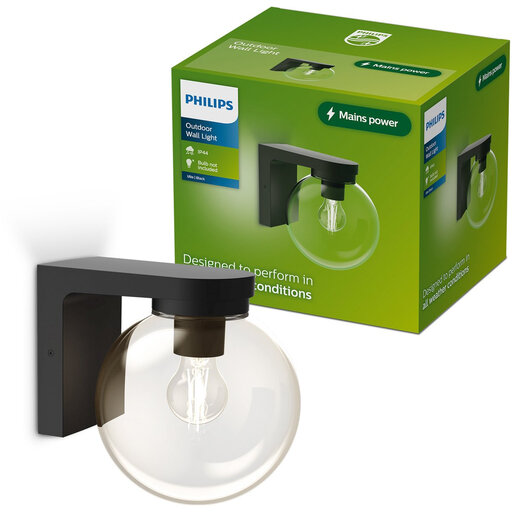
Why it suits this profile: This fixed outdoor wall light is suitable for anyone who wants to choose their own light source, colour temperature and, if required, dimmable LED bulb.
The fitting and the fact that no light source is included are clearly stated. This means you can select a suitable E27 LED bulb in advance.
E27 fitting, IP44, aluminium and glass, replaceable light source and diffused light all around.
Switch off the electricity before starting work on a fixed outdoor wall light. Check that the wall plugs are suitable for brick, concrete or another surface. For connection to 230 volts, professional installation is advisable if you are not familiar with electrical work.
With solar lighting, positioning and maintenance are more important than many buyers expect:
We have put together a complete, up-to-date list of products that fully meet these strict selection criteria and the applicable European safety regulations.
For a sheltered entrance, balcony or veranda, IP44 is often suitable. For a wall that receives a lot of rain or a less sheltered location, IP65 may be more practical. Always check the installation instructions for the specific model.
A solar outdoor wall light does not use electricity from the mains during normal operation. However, its performance depends on sunlight, battery capacity, temperature and the selected lighting mode. In winter or in a shady location, the operating time may be shorter.
The stated service life varies from one model to another. Some product descriptions specify 25,000 or 50,000 operating hours, but this is a product specification rather than a guarantee for every real-life situation. Also check whether the LED can be replaced or whether the entire fitting needs to be renewed.
