
Vandaag of morgen in huis

Kwaliteit gegarandeerd

Welkomstaanbiedingen ontgrendelen: GRATIS bezorging | Tot 80% korting | Gratis 30 dagen JoyPlus-proefperiode
Download de app
A light that switches on automatically by the front door, garage or driveway is convenient. However, not every outdoor light with a motion sensor is suitable for every location. A solar outdoor light with a motion sensor, for example, may be easy to install but perform less effectively on a shaded façade. An outdoor wall light with a sensor generally provides more consistent illumination, but usually requires a mains connection.
The right choice therefore depends on three factors: the available power source, the desired brightness and the level of protection against weather and moisture.
A high lumen rating does not automatically mean that a light will provide comfortable or practical illumination. 300 lumens may be suitable for a balcony or pathway, while a wide driveway requires more light and a greater range. Also consider the light distribution. A light with adjustable heads or multiple light sources spreads illumination differently from a compact wall-mounted fixture.
An IP44 outdoor light is protected against solid objects and splashing water. This makes IP44 suitable for many sheltered entrances, balconies and façades. However, it is not designed for immersion or direct, high-pressure water jets.
An IP65 outdoor light offers complete protection against dust and protection against water jets according to the IP rating. This is a more logical choice for an exposed wall, garage, shed or security lighting. Always check that the light is installed correctly; the IP protection applies only under the conditions specified by the manufacturer.
A solar-powered outdoor light needs sufficient daylight to charge its battery. A north-facing façade, a position beneath a balcony or a location behind dense vegetation can reduce operating time. This is particularly relevant during winter in the Netherlands. Choose a position with as much direct daylight as possible and keep the solar panel clean.
Do not look only for the presence of a sensor. Also consider:
For example, the UME light specifies a detection distance of 60 feet, equivalent to approximately 18 metres, with a 180-degree angle. According to the product description, the Philips Zyren detects movement at 8 metres when approached directly and 16 metres from the side. These are stated product specifications; actual performance may depend on mounting height, temperature and obstacles.
Warm white outdoor lighting typically uses a colour temperature of around 2700 to 3000K. This works well on a patio, balcony or by an entrance. According to the product specifications, the Philips Swyn, Diara, Hara and Capricorn use a colour temperature of 2700K. The Philips Fyns and Zyren use 3000K and variants of 3000K or 5000K respectively.
A colour temperature around 5000K appears cooler and more distinct. This can be functional for a driveway or garage, but is less atmospheric on a patio. Also check the lumen output. Examples in the range vary from 180 lumens for the Brilliant Parson to 4000 lumens for the Philips Zyren.
A solar wall light does not require a permanent cable, making it an attractive option for rental properties, garden paths and locations without an existing power connection. Its light output does, however, depend on available daylight and battery charge.
A fixed wall light, such as the Philips Capricorn or Brilliant Todd, operates on 230V. According to the product information, installation must be carried out by a qualified electrician. This is important for a façade or patio light connected to the mains.
Also note the difference between a motion sensor and a dusk sensor. The former responds to movement; the latter switches the light on when it gets dark. Some models combine both functions.
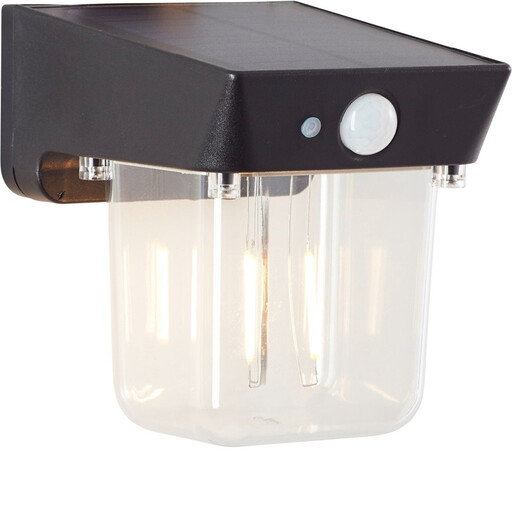
Why This Fits Their Persona: This compact solar wall light is well suited to an entrance, balcony or small patio where no wiring is available. According to the product specifications, it delivers 180 lumens and warm white light at 2700K.
The stated lumen output makes it clear that this model is primarily intended for orientation and ambient lighting, rather than powerful illumination across a large driveway.
Solar power, motion sensor, two modes and IP44 splash protection according to the product information.
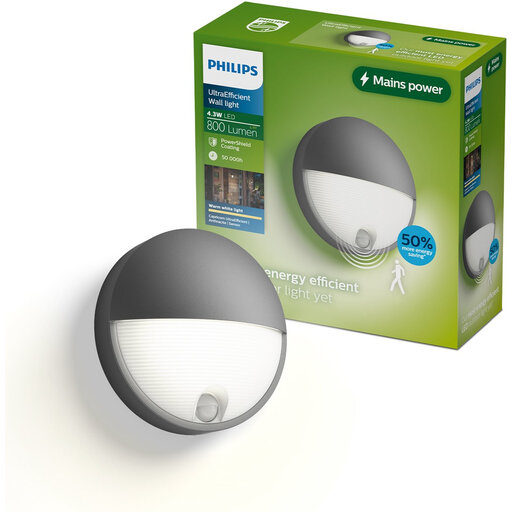
Why This Fits Their Persona: Ideal for anyone looking for a permanent wall light by the front door or on the façade with a clean, understated appearance. The model operates on 230V and features integrated LED lighting rated at 800 lumens and 2700K, according to the specifications.
You are not dependent on a solar panel positioned on a shaded façade. Do bear in mind that professional installation is required and that IP44 provides splash protection, not protection against direct water jets.
Integrated motion and dusk sensors, an aluminium housing and 800 lumens at 2700K.

Why This Fits Their Persona: This model is designed for larger outdoor areas such as a garage, garden, wide driveway or rear yard. According to the product description, it features three light heads, a stated output of 3000 lumens and an IP65 rating.
The broad light distribution and IP65 rating are better suited to a large, less sheltered area than a small IP44 wall light.
Three lighting modes, three adjustable heads, a stated detection angle of 180 degrees and installation without permanent wiring.

Why This Fits Their Persona: Suitable for users looking for a broad, powerful beam without running a cable to the façade. Philips states in the product description that it delivers 4000 lumens, has an IP65 rating and offers a sensor range of 8 metres straight ahead and 16 metres to the side.
The stated sensor distances and IP65 rating provide more meaningful guidance than a broad claim about “security” alone. Check the lighting mode and installation location in advance.
Adjustable light head, two lighting modes and integrated dusk and motion sensors according to Philips.
We have curated an up-to-date selection of products that meet these practical selection criteria and European safety requirements.
Do not position the sensor directly opposite a busy street or a tree that moves in the wind. This can cause the light to switch on unnecessarily. Mount a wall light securely on a stable surface and aim the sensor towards the route people take, rather than at an area where pets regularly pass.
For solar outdoor lighting, an unobstructed position for the panel is more important than keeping the light close to the door. Clean the panel and sensor window regularly with a soft, damp cloth. For a fixed 230V light, the power must be switched off during installation and maintenance. Follow the installation instructions and consult an electrician if in doubt.
A solar outdoor light with a motion sensor does not use mains electricity, but depends on sunlight and its built-in battery. A fixed LED outdoor light only consumes power while it is on, depending on its wattage and the set illumination duration. A short sensor activation time helps minimise unnecessary consumption.
It can, but performance depends on the available hours of sunlight, shade, panel orientation and battery capacity. During dark or overcast periods, the light may operate for less time or produce less illumination. Position the panel as unobstructed as possible and keep its surface clean.
IP44 may be suitable for a sheltered façade, entrance or balcony where the light is mainly exposed to splashing water. For a completely exposed location subject to direct rain and wind, IP65 may be more appropriate. Also check the installation instructions, seals and positioning of the light.
