
Vandaag of morgen in huis

Kwaliteit gegarandeerd

Welkomstaanbiedingen ontgrendelen: GRATIS bezorging | Tot 80% korting | Gratis 30 dagen JoyPlus-proefperiode
Download de app
A dark driveway, poorly lit garden or entrance without orientation lighting calls for a practical solution. However, choosing outdoor lighting is not simply a matter of picking the lamp with the highest light output. The wrong IP rating, insufficient sunlight or awkward installation can make your purchase less useful than expected.
Joybuy Product Recommendation Officer helps you translate marketing claims into verifiable features. This makes it easier to choose between solar outdoor lighting, garden lighting, an outdoor light with a sensor or a fixed outdoor wall light.
A high lumen count sounds appealing, but the application determines how much light you need. Soft lighting is often sufficient for path lighting or a flower bed. A driveway or dark corner beside the garage is more likely to need targeted security lighting with a motion sensor.
Also consider the light colour. 2700K to 3000K generally produces warm white light for patio lighting and ambience. Around 4000K looks more neutral. 6500K to 7000K produces a cooler, brighter effect and is more suited to functional lighting.
A lamp with IP44 is protected against splashing water from various directions, but not against powerful water jets or immersion. It is therefore best to place an IP44 outdoor light under a canopy or on a sheltered wall.
An IP65 outdoor light offers protection against dust and water jets according to its classification. This makes the rating more suitable for open garden paths, lawns and parts of the driveway that are directly exposed to rain. The IP rating does not automatically protect against frost, impact or incorrect installation.
Solar garden lights need direct daylight to charge the battery. Beneath a balcony, next to a tall fence or on the north side of a property, charging time may be limited. Therefore, check:
According to the UME path lighting product description, around 6 to 8 hours of sunlight is needed for the stated operating time. This is a product specification, not a guarantee for every garden or weather condition.
Choose IP44 outdoor lighting for a sheltered entrance, balcony, veranda or covered patio. For open borders, garden paths and driveway lighting, IP65 is often more practical, provided the lamp is installed correctly.
Lumens indicate the total amount of light. The shape of the lamp then determines where that light falls. A path light providing 10 lumens per light point is intended for subtle orientation lighting. A solar floodlight with 3000 lumens is much more suitable for a wide area, such as beside a garage or driveway.
A wide beam angle is useful for a large area. For a façade, plant border or front door, targeted lighting can help reduce glare.
Solar outdoor lighting works without a mains connection, but depends on sunlight and a built-in battery. A fixed 230-volt LED outdoor light is more consistent, but if a new connection is required, it must be installed by a qualified installer.
For GU10 or E27 wall lights, check carefully whether the light source is included. Several Brilliant and Philips wall lights below include the fitting, but you need to choose a suitable bulb separately. Always check the maximum wattage in the product information.
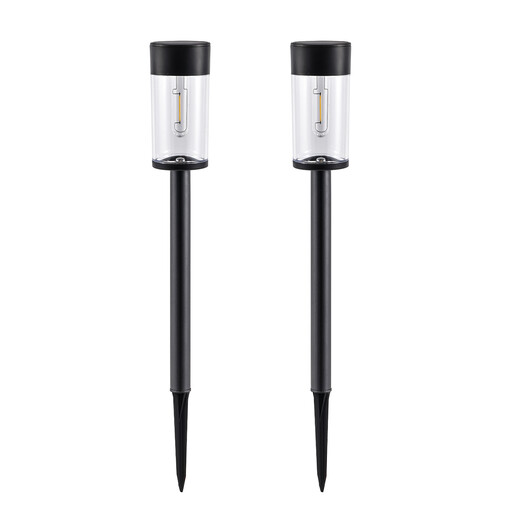
Why it suits this profile: This set is designed for garden paths, borders and the edge of a driveway. It is installed using ground stakes and requires no wiring.
The stated IP65 rating is more suitable for an open outdoor location than IP44. The description also mentions an automatic light sensor and a recommended charging location with 6 to 8 hours of direct sunlight.
Set of 2, 3000K warm white light, 10 lumens per lamp and, according to the product information, 8 to 12 hours of illumination under suitable charging conditions.

Why it suits this profile: This solar outdoor wall light is ideal for an entrance, patio or façade where you want to combine permanent wall mounting with motion detection.
The product information lists two lighting modes, a dusk sensor and a motion sensor. This allows you to tailor its use for orientation or temporary lighting.
1000 lumens, integrated LED, 3000K light colour, solar power and IP44 splash protection according to the product specifications.

Why it suits this profile: This solar security light is designed for larger areas such as a garage, wide driveway, back garden or patio where a strong beam is required.
The specifications state a motion range of 60 feet, a detection angle of 180° and three modes. However, check beforehand that the chosen installation location receives enough sunlight.
302 LEDs, 3000 lumens, three adjustable light heads, stated 270° coverage and an IP65 rating according to the product description.
We have put together a complete, up-to-date list of products that fully meet these strict selection criteria and the applicable European safety regulations.
For a sheltered location, IP44 outdoor lighting is often suitable. For an open garden, path or driveway, IP65 outdoor lighting may be more practical. Also check the installation instructions and avoid direct water jets or immersion, even when the lamp has a higher IP rating.
The operating time depends on sunlight, temperature, battery capacity, panel cleanliness and the selected lighting mode. Clean the solar panel regularly and place the lamp somewhere with as much direct daylight as possible. A motion sensor can reduce energy consumption because the lamp does not remain on at full brightness continuously.
An LED outdoor light generally uses less energy than a comparable traditional light source, but actual consumption depends on wattage and operating hours. Solar garden lights do not use mains electricity during normal operation, but they do depend on their battery and charging conditions. For fixed lighting, you can easily estimate consumption using the formula: wattage × operating hours ÷ 1000 = kilowatt-hours.
