
Vandaag of morgen in huis

Kwaliteit gegarandeerd

Welkomstaanbiedingen ontgrendelen: GRATIS bezorging | Tot 80% korting | Gratis 30 dagen JoyPlus-proefperiode
Download de app
A light that only comes on when someone walks past is useful by the front door, garage, driveway or garden path. However, not every outdoor light with a motion sensor is right for every location. A cheap solar-powered outdoor wall light, for example, may work perfectly well on a sunny shed wall but less well under a canopy. And a high lumen rating doesn’t automatically mean the light will be comfortable or well directed.
As Joybuy Product Recommendation Officer, I filter the key product specifications to help you compare marketing claims with what you actually need.
A high lumen count means more light output, but not necessarily better lighting for your needs. A 4,000-lumen light may be unnecessarily bright for a small entrance, while a compact 300 to 500-lumen LED outdoor light could be enough for a balcony or patio.
Pay attention to the colour temperature too:
The IP code indicates how well a product is protected against dust and water. IP44 outdoor lighting is protected against splashes and suits many sheltered walls, balconies and covered patios. It isn’t suitable for exposure to powerful jets of water or immersion.
IP65 outdoor lighting offers greater protection against dust and water jets. This makes an IP65 water-resistant outdoor light a more suitable choice for an exposed wall, garage or driveway. Always check the full product description: an IP rating won’t prevent a light from being installed incorrectly or left underwater for a prolonged period.
An outdoor solar light needs direct daylight to charge its battery. A north-facing wall, dense foliage or a spot under a balcony can limit how long it stays lit. In winter, or after several cloudy days in a row, the lighting time may also be shorter.
If sunlight is limited, it’s better to choose a wired LED outdoor wall light or a wireless outdoor light that you can recharge via USB.
Don’t just check whether “sensor” appears in the title. Look at the stated detection range, viewing angle and how movement is detected. A range of 8 metres may be enough for a front door, while a wide driveway could benefit from a sensor with a wider angle or several adjustable light heads.
Position the light so that people cross the detection zone as they walk past. Some PIR sensors are slower to register movement directly towards them. Once the light is installed, test it to make sure it isn’t triggered unnecessarily by passing traffic, moving branches or pets.
Lumens indicate the total light output. For general garden lighting with a sensor, 180 to 500 lumens is often suitable. For a larger driveway or as a solar security light, 1,000 lumens or more may be more practical. Also check whether the light only comes on when it detects movement, stays on at a low brightness or offers several modes.
A solar-powered outdoor wall light doesn’t need mains electricity or an installer, but it does need a sturdy surface and plenty of sunlight. A wired 230 V outdoor wall light must be connected by a qualified electrician, in accordance with the product information.
Also check:
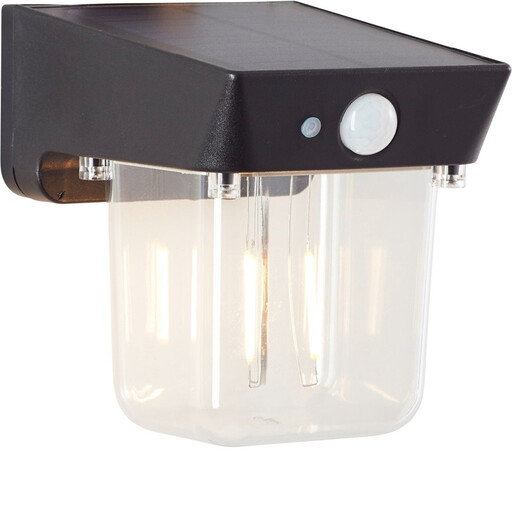
Why it suits this profile: This compact solar-powered outdoor light is designed for an entrance, patio or small garden wall without a power point nearby.
The specifications clearly state 180 lumens, 2700 K and IP44. That tells you this is mainly functional, gentle lighting rather than a powerful floodlight.
Solar power, integrated LED, motion sensor and compact dimensions of 11,5 × 10 × 11 cm.

Why it suits this profile: A practical choice if you’re looking for a bright solar security light for your garage, entrance or driveway without the need for wiring.
The product details state 1,000 lumens, 3,000 K and two lighting modes. This makes it easier to assess than a model with only a general claim about brightness.
Integrated LED, solar power, motion and dusk sensors, and IP44 protection.

Why it suits this profile: This model is designed for larger areas such as a wide driveway, garage, garden or back garden where broad light coverage is needed.
The stated IP65 rating makes the difference from IP44 clear. The 60-foot detection range, 180° viewing angle and three lighting modes are also listed.
302 LEDs, stated light output of 3,000 lumens, three adjustable heads and solar power.

Why it suits this profile: Ideal if you want to light a large area and value an adjustable head and an extended detection range.
The stated detection distance is 8 metres when approached head-on and 16 metres for lateral movement. The IP65 rating makes it suitable for a more exposed installation location.
Stated output of 4,000 lumens, 5,000 K, two lighting modes, dusk sensor and adjustable light head.
We’ve put together a complete, up-to-date list of products that meet these strict selection criteria and the applicable European safety regulations.
The right height depends on the model and its detection range. Follow the instructions to mount the light on a sturdy surface, and point the sensor towards the route people take. Mounting it too high can reduce the detection zone; mounting it too low may cause false triggers from pets.
How long it stays lit each night varies depending on the battery, lighting mode, amount of sunlight and season. Some brands state that a fully charged battery can provide light for several nights, but this is a manufacturer’s claim, not a guarantee for every location. Keep the solar panel clean and position it in direct sunlight as much as possible.
An outdoor solar light doesn’t use mains electricity. For a wired LED outdoor light, power consumption depends on the wattage and how long it stays on. A motion sensor limits how long the light is on, but remember to check the set time delay too. A light with just a few watts is often enough for a small entrance; for larger areas, the chosen light output is the main consideration.
