
Vandaag of morgen in huis

Kwaliteit gegarandeerd

Welkomstaanbiedingen ontgrendelen: GRATIS bezorging | Tot 80% korting | Gratis 30 dagen JoyPlus-proefperiode
Download de app
Choosing a new outdoor light often seems straightforward. But many disappointing purchases come down to the wrong IP rating, an unsuitable fitting or a light that only looks good in the product photo. Whether you’re lighting a balcony, exterior wall, entrance, garden path or patio, design isn’t the only thing that matters. Where the light will be installed and how you plan to use it will determine which type of outdoor lighting is right for you.
Look out for these common pitfalls:
The IP code indicates how well an electrical product is protected against solid objects and water. IP44 is a relevant specification for many uses around the home. It means the light is protected against solid objects larger than 1 millimetre and splashing water from any direction.
IP44 doesn’t mean a light is completely waterproof. So don’t install a fitting with this rating somewhere it will be exposed to powerful jets of water for long periods or to extreme weather. A covered exterior wall, veranda or sheltered patio may be more suitable than a fully exposed spot.
For example, an IP44 outdoor wall light is a practical choice by a front door, garage or covered exterior wall. Also check the installation instructions and protection class. The Brilliant Keola, for instance, is listed as protection class I and has an IP44 rating. The manufacturer states that it must be installed by a qualified electrician.
A GU10 outdoor light gives you flexibility: you can choose a suitable GU10 LED bulb in a colour temperature that works for the space. Warm white light is often a good choice for a patio or entrance, while a cooler white light can be more practical for a garage or shed.
Check the maximum wattage. The Philips Fylx has one GU10 fitting and a stated wattage of 5 watts per light point. The Brilliant Keola takes one GU10 bulb of up to 10 watts. According to the product information, both models are supplied without a light source.
For lights with built-in lighting, check whether the light source can be replaced. The Atmosphera Zack is supplied with a light source, which is removable. This can be useful if you’re looking for a portable light that doesn’t need to be connected to a fixed power supply.
Aluminium is a popular material for weather-resistant outdoor lights. Always check the full product specifications and recommended installation location. A compact outdoor wall light suits a narrow exterior wall or entrance, while an outdoor floor lamp needs more space and must stand securely.
For a balcony or small patio, a portable light with a slim design may be more practical than a fixed fitting. A ceiling light, on the other hand, is suitable for a hallway. Be sure to distinguish between indoor and outdoor use: a light with IP20 is intended for dry indoor spaces and shouldn’t be used outdoors.
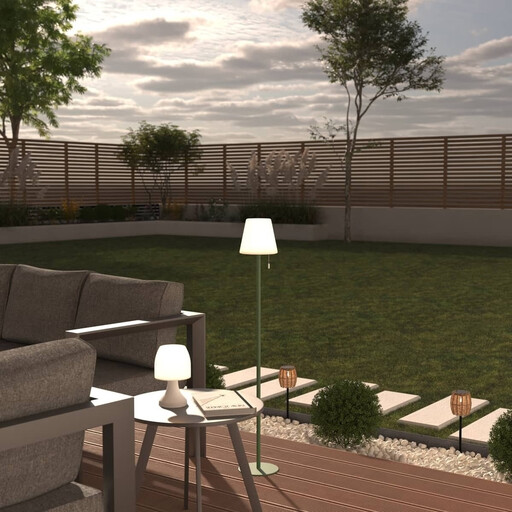
Why it suits this profile: This portable, battery-powered light is suitable for a balcony, patio or garden without a fixed power connection. It’s 108 cm tall and has three lighting modes: multicolour, flame effect and white light.
The product information lists IP44, an included light source and a battery life of up to ten hours. So there’s no need to buy a separate fitting or outdoor cable straight away.
Battery-powered, three lighting modes, removable light source and a steel base with a plastic shade.
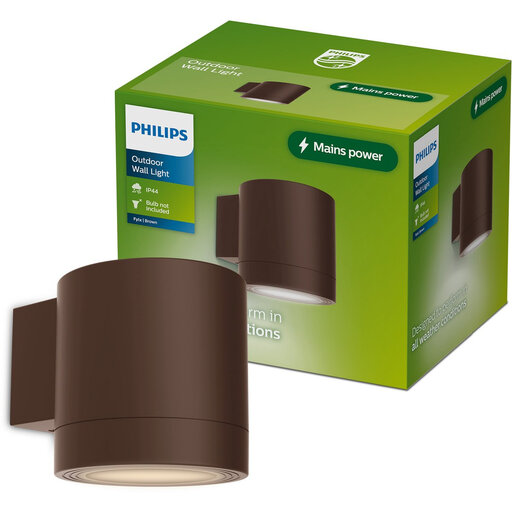
Why it suits this profile: This minimalist outdoor wall light is ideal if you want to choose the colour and brightness yourself by adding a GU10 bulb.
The fitting is clearly specified as GU10 and the IP44 rating is listed. Just remember to choose the GU10 LED bulb and colour temperature you want.
Aluminium housing, one GU10 light point, IP44 rating and a removable light source.
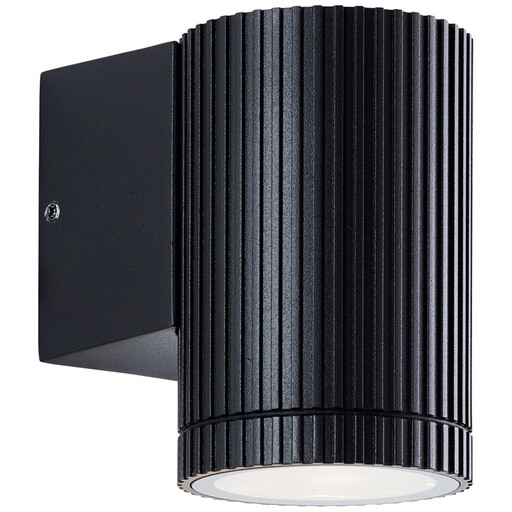
Why it suits this profile: This compact, downward-facing outdoor wall light is a good fit for entrances, garages, patios and sheltered exterior walls where focused lighting is needed.
The product information specifically lists IP44 and a maximum wattage of 10 watts. The fitting isn’t waterproof, so choose a sheltered installation spot.
Aluminium and glass construction, GU10 fitting, compact dimensions of 6,3 × 9,5 cm and external dimming with a suitable bulb.
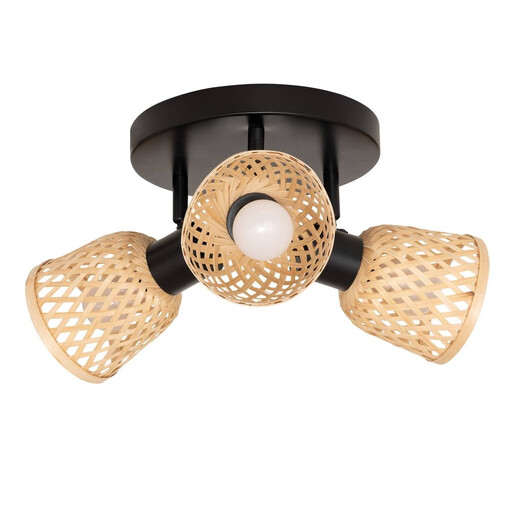
Why it suits this profile: For a hallway or another dry indoor space, this ceiling light offers three adjustable spotlights and a natural look, with FSC-certified bamboo.
The product information clearly states that it’s for indoor use and has an IP20 rating. So it’s immediately clear that this isn’t a garden or patio light.
Three adjustable E14 fittings, up to 25 watts and bamboo shades with an FSC certification statement.
We’ve put together a complete, up-to-date list of products that meet these strict selection criteria and comply with current European safety regulations.
First decide where the light will go and how it will be powered. A fixed outdoor wall light needs a suitable cable, a solid surface and the correct connection. Switch off the power before installation and follow the manufacturer’s instructions. Have a qualified electrician carry out any work involving mains electricity.
Battery-powered lighting is easier to install, but check the battery level regularly and make sure the light is stable. Clean outdoor lights according to the product manual. The Atmosphera Zack instructions recommend using a damp cloth, while the Brilliant Keola should be cleaned with a soft, dry cloth.
An LED outdoor light can help keep energy use low, but actual consumption depends on the wattage, how long it’s switched on and the number of light points. If you’re choosing separate GU10 or E14 bulbs, you can easily compare these details in advance by checking the energy label and product specifications.
No. IP44 protects against splashing water, but it doesn’t make a light completely waterproof. It’s best to use a fitting with this rating in a sheltered spot and follow the installation instructions.
This isn’t recommended if the light is intended for indoor use only. A model with IP20, such as the Atmosphera Lio, is suitable for dry indoor spaces, not a garden, open balcony or exterior wall.
That depends on the wattage, how many hours the light is on and the light source you choose. A low-wattage GU10 LED bulb will generally use less energy than a more powerful bulb that stays on for longer. Always check the stated wattage, and choose a timer, sensor or manual control to suit the way you’ll use the light.
