
Vandaag of morgen in huis

Kwaliteit gegarandeerd
Download de app
Categorieën

Choosing an outdoor security camera can be overwhelming. You want to secure your home, garden, or driveway, but the market is vast and specifications are often unclear. A poor choice can result in a camera that doesn't meet your expectations: blurry images, a complicated app, or poor performance in the dark. This article will help you make an informed decision based on factual specifications, ensuring you find the right outdoor Wi-Fi security camera for your needs.
Before choosing a model, it's helpful to understand the key features. These parameters determine how the camera performs in real-world scenarios.
Image quality is expressed in resolution. While Full HD (1080p) was the standard for a long time, 2K resolution (also referred to as 3MP or higher) is becoming increasingly common. This provides a significantly sharper image, making details like faces or license plates more recognisable. For effective surveillance, a 2K security camera is a solid starting point.
An outdoor Wi-Fi security camera offers ease of installation, as no network cable needs to be run to the camera. Pay attention to the supported Wi-Fi frequency. Most cameras operate on 2.4 GHz, which has a greater range. Some newer models also support 5 GHz for a faster, more stable connection over shorter distances. A model with both Wi-Fi and a wired (Ethernet) connection offers the most flexibility.
Standard night vision uses infrared LEDs for black-and-white footage in the dark. A security camera with colour night vision uses built-in spotlights to illuminate the area, resulting in a full-colour, more detailed image. Many cameras offer a 'smart' mode that switches between infrared and colour when motion is detected.
A security camera with motion detection and alarm sends a notification to your phone as soon as activity occurs. More advanced systems offer auto-tracking, where the camera follows a moving object. A PTZ camera (Pan-Tilt-Zoom) is a pan-and-tilt outdoor security camera. You can remotely pan, tilt, and zoom via the app, allowing you to monitor a much larger area than with a fixed camera.
Footage can be stored locally on a microSD card or remotely in the cloud.
An outdoor IP camera must be able to withstand the elements. The IP rating indicates the degree of protection. IP66 is a common rating, signifying that the camera is dust-tight and protected against powerful water jets, such as heavy rain.
Based on the criteria above, we have selected a few models that offer a great balance of functionality and ease of use.
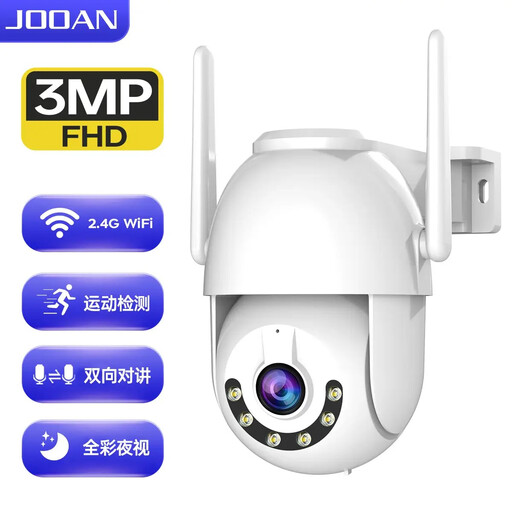
Why this product: This model is a versatile all-rounder. The combination of 2K resolution and 360° PTZ functionality allows you to monitor a large area, such as an entire back garden or driveway, with a single camera.
Pros:
Who is this for: Homeowners looking for a flexible solution to monitor a wide, open outdoor area without needing to install multiple cameras.
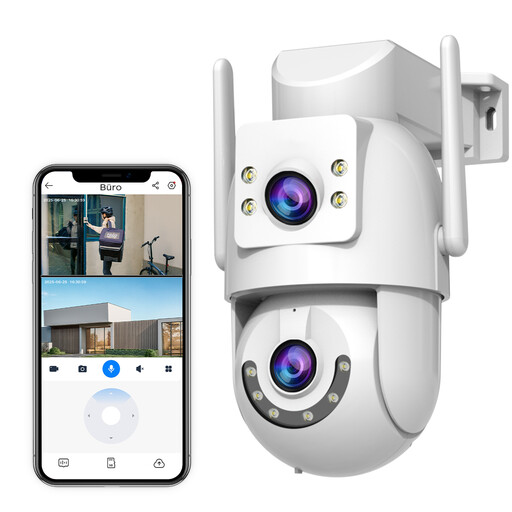
Why this product: The dual lens is the standout feature here. You get two camera views in one device, offering unique surveillance capabilities. Support for both 2.4 GHz and 5 GHz Wi-Fi is a plus for network stability.
Pros:
Who is this for: Users who want to monitor a fixed point (like a front door) and the wider surroundings simultaneously. Ideal for corners of a house or a shopfront.
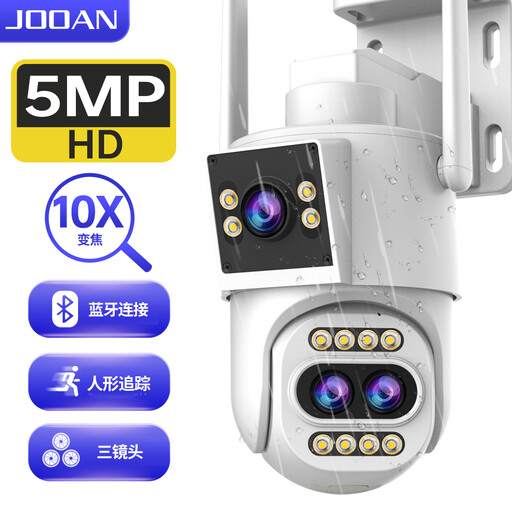
Why this product: The 10x optical zoom is the key feature. Unlike digital zoom, which simply enlarges the image, optical zoom preserves image quality when zooming in. This makes it possible to capture sharp details at a distance.
Pros:
Who is this for: Small business owners or owners of larger properties who need to identify details from a distance, such as in a car park, on a long driveway, or across a large yard.
The models mentioned above are aimed at users who value PTZ and zoom functionality. If your needs are different—for example, a compact fixed camera, a battery-powered model, or an indoor camera—there are countless other options available. For a broader overview of surveillance solutions, you can browse our smart electronics category.
1. What is the difference between optical and digital zoom? Optical zoom uses a physical lens adjustment to magnify the image, just like binoculars. This preserves image quality. Digital zoom crops a portion of the image and enlarges it using software, which always results in a loss of resolution and detail. For identifying details at a distance, optical zoom is superior.
2. Do I need a subscription for an outdoor camera? Not necessarily. Most cameras, including the models mentioned here, support local storage on a microSD card. This is a one-time purchase with no monthly fees. A subscription for cloud storage is an optional service that provides added peace of mind, as your footage is stored securely off-site.
3. What about privacy laws for outdoor cameras? In most regions, you are permitted to film your own property, but you generally cannot film public streets or your neighbours' property. Ensure your outdoor security camera is positioned to primarily capture your own land (garden, driveway, facade). It is often required to post a sticker or sign indicating that video surveillance is in use.