
Vandaag of morgen in huis

Kwaliteit gegarandeerd

Welkomstaanbiedingen ontgrendelen: GRATIS bezorging | Tot 80% korting | Gratis 30 dagen JoyPlus-proefperiode
Download de app
An outdoor wall light can make your entrance, façade, balcony or patio far clearer. But a handsome design isn’t automatically right for every outdoor spot. Many poor purchases happen because people only look at the shape or light colour. Installation, protection against water and your choice of power source are just as important.
An IP44 outdoor light is protected against solid objects larger than 1 millimetre and splashes of water from various directions. That doesn’t mean the light is suitable for direct water jets, immersion or every exposed wall. Ideally, place an IP44 light under a canopy or somewhere rainwater doesn’t sit directly on the housing.
For a very exposed wall, a higher IP rating, such as IP65, is often more practical. Always check the installation instructions and the exact IP classification of the model.
A solar outdoor light needs direct daylight to charge its battery. A north-facing wall, a balcony under an overhang or a spot with lots of shade can limit run-time. In winter and after several cloudy days, the light output can also be lower.
So pay attention to the position of the solar panel, the battery capacity and the chosen light mode. A motion sensor often uses less energy than a light that stays on all night, but actual run-time depends on sunlight, temperature and usage.
Some models have integrated LEDs, while a GU10 outdoor light or E27 outdoor light is supplied without a bulb. With the latter category you’ll need to purchase a suitable bulb separately. Check the lamp holder, maximum wattage, brightness and colour temperature before you order.
A replaceable light source offers flexibility. With integrated LEDs you don’t have to choose a separate bulb, but when they reach the end of their lifespan the entire fitting often needs replacing according to the product information.
A mains-powered outdoor wall light generally delivers consistent performance, but it requires fixed wiring. Have a hard-wired model installed by a qualified electrician and follow local regulations. Switch off the power during installation and maintenance.
Solar models are attractive for a façade, shed, garden path or patio without an existing power supply. Don’t just rely on terms like “energy-saving”, but on verifiable details such as lumen, colour temperature, battery type and light modes.
Cordless models with USB charging are handy for tenants or locations where you don’t want to drill into the electrical installation. With magnetic mounting, pay extra attention to the weight, the surface and the risk of the light falling.
Lumen (lm) indicates how much light a lamp produces. For atmospheric patio lighting, lower brightness can be enough. For an entrance, driveway or functional wall lighting, more light is usually more practical.
Colour temperature is expressed in Kelvin:
A lamp with 800 lumens isn’t automatically suitable for every situation. Consider the light distribution too. A downlight directs light downwards, while a lantern-style garden wall light spreads it more all around.
Aluminium, plastic, glass and stainless steel are common in outdoor lights. The material alone doesn’t tell you how well a light will suit your wall. Also check the dimensions, fixing points and whether the surface is suitable.
A heavier fitting needs a sturdy wall and appropriate wall plugs. In a rental home, a compact, rechargeable light with a mounting plate can be more practical than a fixed connection. Also take into account doors, downpipes and the movement range of a sensor.
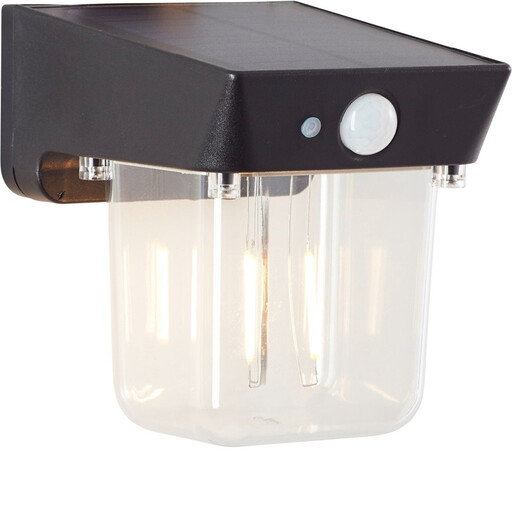
Why this suits the profile: This compact solar outdoor light works without a fixed power connection and has an integrated motion sensor. The specifications list 180 lumens, 2700 K, IP44 and an integrated battery.
The product details clearly state the power source, brightness, sensor and IP rating. Do check that the chosen mounting spot gets enough daylight.
Solar-powered, integrated LED, motion sensor and warm white 2700 K light.
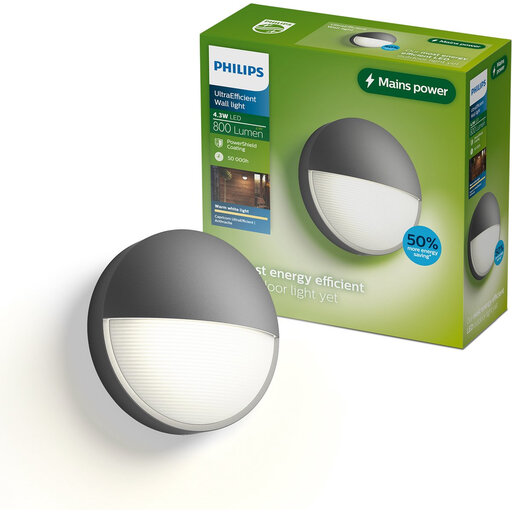
Why this suits the profile: For a permanent façade or patio solution, this model offers integrated LEDs with 800 lumens and 2700 K. According to the product information, the housing is aluminium and plastic and has IP44 protection.
Brightness and colour temperature are clearly specified. Allow for professional installation, fixed mains power and the fact the LED light source can’t be replaced.
800 lumens, warm white light, aluminium housing and a stated lifespan of up to 50,000 hours according to the product description.

Why this suits the profile: This model is aimed at powerful lighting around a driveway, shed or large façade. The stated specifications include 4000 lumens, a motion sensor, IP65 and a solar panel.
The IP65 classification is higher than IP44 and therefore suits a more exposed location. Still check the fixing and the light spread you want.
4000 lumens, solar power, integrated motion and dusk sensor, and IP65 according to the product data.
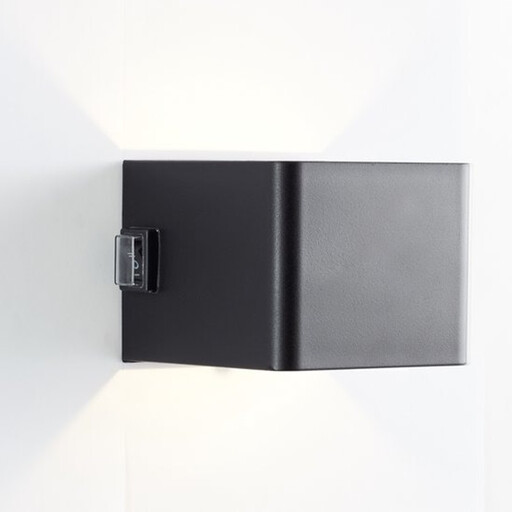
Why this suits the profile: The rechargeable light features magnetic mounting, a USB‑C port, 300 lumens, 3000 K and a motion sensor. That makes it suitable for a balcony, veranda or a temporary mounting spot.
No fixed wiring is required. With magnetic mounting, the mounting plate still needs to be secured firmly and be suitable for the weight.
USB‑C charging, integrated LED, motion sensor and IP44 for splash resistance.
We’ve compiled a complete, up-to-date list of products that fully meet these strict selection criteria and the applicable European safety regulations.
IP44 is suitable for splashes and many sheltered outdoor locations, such as a covered entrance, balcony or patio. The classification doesn’t mean the light is waterproof. For a wall that’s directly exposed to rain and wind, a higher IP rating may be more suitable.
For mood lighting on a patio, a lower lumen count can be sufficient. For an entrance, driveway or security-focused application, more light is desirable. In addition to lumens, consider the beam, mounting height and the distance to the area you want to illuminate.
A solar outdoor light doesn’t use mains electricity during normal operation, because the battery is charged via the solar panel. Performance depends on the amount of daylight, the battery and the selected mode. Clean the panel regularly and position the light so the panel receives as much direct light as possible.
