
Vandaag of morgen in huis

Kwaliteit gegarandeerd

Welkomstaanbiedingen ontgrendelen: GRATIS bezorging | Tot 80% korting | Gratis 30 dagen JoyPlus-proefperiode
Download de app
A light by your front door, on the exterior wall or beside the garage should do what you expect: switch on when someone approaches, provide enough light and stand up to the British weather. However, choosing the right outdoor wall light with a motion sensor is not always straightforward. Product titles often focus on lumens, solar power or being “weatherproof”, while important details are less obvious.
So look out for these three common pitfalls:
Check whether the light has just a motion sensor or a dusk sensor as well. A motion sensor switches the light on when it detects movement. A dusk sensor determines when automatic lighting becomes active, for example when it gets dark.
Some models offer several modes. According to the product information, the Philips Swyn has Auto and On modes. This is useful when you want continuous light temporarily, such as during a party on the patio. Check the detection direction and range too. A light for a narrow entrance has different requirements from a sensor light for a wide driveway.
The IP code consists of two digits. The first indicates protection against solid particles; the second relates to water. For an IP44 outdoor light, this means protection against objects larger than 1 millimetre and splashing water from different directions.
IP44 is often suitable for a sheltered exterior wall, balcony, entrance or patio. For a completely exposed spot, a higher rating such as IP65 may be a more suitable choice. Always check the installation instructions too. Even weather-resistant outdoor lighting can run into problems if water gets in through an open connection or incorrect installation.
A 230-volt LED outdoor wall light generally provides predictable light output, but requires a suitable connection. Have a qualified installer carry out any permanent wiring. A solar-powered outdoor wall light is easier to install because it doesn’t need an electrical cable. However, the panel needs direct or prolonged daylight.
For a cosy feel and an entrance, many households choose warm white light of around 2700 to 3000 kelvin. For a driveway or security lighting, a higher light output may be more important. Don’t just look at wattage: with LED lighting, the number of lumens is a better indication of how much light the lamp produces.

Why it suits this profile: This solar-powered outdoor wall light works without permanent wiring and, according to the product information, has two light modes, a motion sensor and a 400-lumen output. That makes it a convenient option for an entrance, balcony or small garden.
The IP44 rating makes it clear that the light is protected against splashing water, not immersion. So position the solar panel somewhere with enough direct daylight.
No mains connection needed; 2700 K warm white light; choice of Auto or On mode according to the product description.
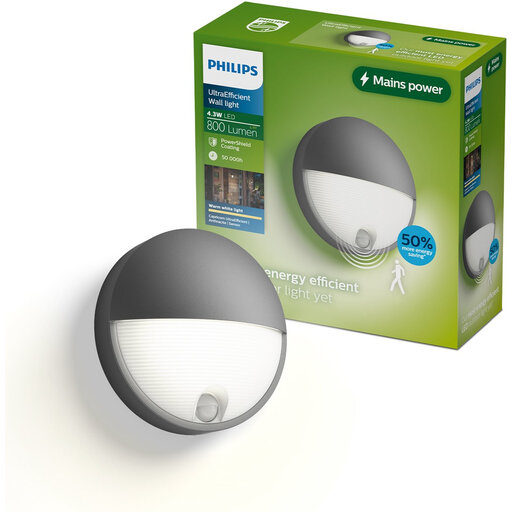
Why it suits this profile: For permanent exterior lighting by the front door, this LED outdoor wall light offers an integrated light source, 800 lumens and warm white light at 2700 K. Its aluminium housing is well suited to permanent installation.
The stated 800 lumens and 4.3 watts provide more useful information than simply calling it “energy-efficient”. The product information also lists an integrated motion and dusk sensor.
Aluminium construction; integrated LED; IP44 rating; 800 lumens with a 2700 K light colour.

Why it suits this profile: This model is designed for a wide driveway, garden or garage. According to the product information, it has three adjustable light heads, a 180-degree detection angle and an IP65 rating.
The wider coverage helps prevent a narrow beam from missing the whole driveway. Do check that the stated 3000 lumens and detection distance suit your actual mounting height.
Solar-powered; three light modes according to the product information; three light heads; IP65 rating.
We’ve put together a complete, up-to-date list of products that meet these strict selection criteria and the applicable European safety regulations.
It depends on the power, how long the light stays on and how often it switches on. LED models generally use few watts for the light they produce. A solar outdoor light doesn’t use electricity from the mains, but its performance depends on sunlight and battery capacity. So consider the lumens, wattage and selected light mode together.
No. IP44 is suitable for splashing water and many sheltered outdoor locations, such as an entrance, balcony or exterior wall. The rating doesn’t mean the light can withstand immersion or powerful jets of water. For a completely exposed location, a product with a higher IP rating may be more suitable.
Lifespan varies by product and conditions of use. Some brands state an expected operating life, but this is a product specification, not a guarantee for every situation. Proper installation, adequate ventilation, regular cleaning and protection from misuse can help keep the light working for longer.
