
Vandaag of morgen in huis

Kwaliteit gegarandeerd

Welkomstaanbiedingen ontgrendelen: GRATIS bezorging | Tot 80% korting | Gratis 30 dagen JoyPlus-proefperiode
Download de app
An outdoor wall light can brighten an entrance, patio, balcony, exterior wall or driveway. But looking at the design or lumen count alone isn’t enough. A light may look great in the product photo, yet prove less suitable in practice because of the wrong IP rating, insufficient sunlight or an awkward installation.
As a Joybuy Product Recommendation Officer, I filter the key product specifications to help you assess marketing claims and make a more informed choice.
An IP44 outdoor light is protected against solid objects and splashing water from different directions. That doesn’t mean it’s suitable for direct jets of water, immersion or a completely exposed position subject to severe weather. That’s why many outdoor wall lights in the range are explicitly described as splash-resistant, but not waterproof.
Where possible, fit an IP44 light under an overhang, on a sheltered wall or somewhere rain won’t fall directly on the housing and connections. A higher IP rating may be more suitable for very exposed locations.
A solar-powered outdoor light doesn’t need mains electricity, but its panel needs enough direct sunlight during the day. A north-facing wall, a balcony beneath a deep canopy or a heavily shaded spot can limit charging performance.
Also check that the panel stays clear of leaves, dirt and bird droppings. A solar outdoor light with a motion sensor uses its battery more efficiently when it only switches on when movement is detected, but its available run time still depends on the charging conditions.
More lumens means greater light output, but it doesn’t automatically make a light the better choice. For a welcoming entrance, warm white light of 2700K to 3000K can be pleasant. A higher light output may be more practical for a driveway or back path. Also consider how the light is distributed: a light that shines mainly downwards will illuminate a path differently from one with a wider spread.
An LED outdoor wall light with an integrated light source is ready to use straight away, but the LED usually can’t be replaced by the user. So check the stated lifespan, light output and colour temperature.
A light with a GU10 fitting gives you more choice. For example, the Brilliant Jelani has a GU10 socket for a maximum of 1 10 W bulb and is supplied without a light source. This means you can choose a suitable LED bulb yourself. The product information states that external dimming is possible if the chosen light source and installation are suitable.
An outdoor light with a motion sensor is useful by a front door, garage or garden path. Check:
On a solar wall light, a motion sensor is particularly useful for avoiding unnecessary battery drain. With mains-powered models, such as some Philips outdoor lights, a combination of motion and dusk sensors can provide automatic operation. These features are described in the product details; how well they work in practice depends on the mounting height, surroundings and settings.
Aluminium, metal, plastic and glass are common materials for exterior lighting. Don’t just consider the material: check the protection around the connections, the mounting surface and the maintenance requirements too.
According to the product information, a fixed 230V outdoor wall light must be connected by a qualified electrician. Switch off the power before carrying out maintenance and follow local installation regulations. Solar and rechargeable models are easier to install, but they still need to be securely fixed to a stable wall.
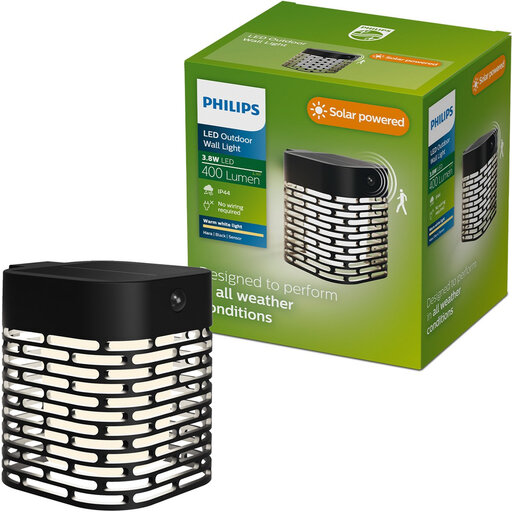
Why it suits this user: This solar outdoor light works without mains electricity or cabling and has two light modes. That makes it a practical choice for an entrance, balcony or garden shed where you want to add lighting quickly.
The product information clearly states that it runs on solar power and has IP44 protection. Make sure to place the light somewhere with enough direct daylight; IP44 means splash-resistant, not fully waterproof.
400 lumens, warm white light at 2700K, integrated LED and motion sensor, according to the product details.
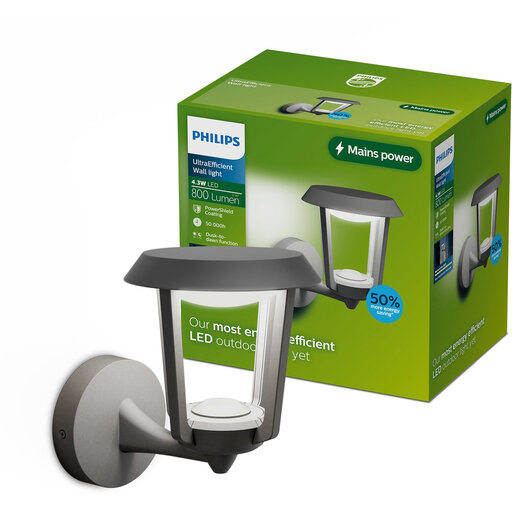
Why it suits this user: Its aluminium housing, integrated LED and classic lantern shape make it a good match for a permanent fitting on an exterior wall, patio or smart entrance.
The specifications include the light colour, wattage and IP rating. So you don’t have to rely on the appearance alone or a vague claim about weather resistance.
800 lumens, 4.3 W, 2700K and an integrated LED; the product information also mentions a PowerShield coating.

Why it suits this user: For a driveway, garage or back garden where you need clear light when movement is detected, this solar model offers a higher stated light output than compact ambient lighting.
Its 1000-lumen output and motion sensor are clearly specified. Before installation, check that the solar panel will receive direct sunlight in the chosen location.
1000 lumens, 3000K, integrated LED, two light modes and IP44, according to the product specifications.
We’ve put together a complete, up-to-date list of products that meet these strict selection criteria and current European safety regulations.
Yes. IP44 is designed to protect against splashing water and is often used in sheltered outdoor locations. It doesn’t offer complete protection against water jets or immersion. So fit the light according to the installation instructions and avoid very exposed locations if the manufacturer advises against them.
How long it runs each evening depends on the battery capacity, amount of sunlight, chosen light mode and how often the motion sensor is triggered. A cloudy day or shaded installation location can reduce the run time. Also check whether the battery is replaceable; on many integrated models, it isn’t intended to be replaced by the user.
An integrated LED light typically uses little power compared with traditional light sources. Actual consumption depends on the wattage and number of hours it’s switched on. A motion or dusk sensor can reduce the time it stays lit. A solar outdoor light doesn’t use mains electricity while it’s on, but it still relies on sunlight and battery capacity.
