
Vandaag of morgen in huis

Kwaliteit gegarandeerd

Welkomstaanbiedingen ontgrendelen: GRATIS bezorging | Tot 80% korting | Gratis 30 dagen JoyPlus-proefperiode
Download de app
An outdoor wall light needs to do more than look good in a product photo. At an entrance, balcony, patio, shed or garden path, brightness, installation and protection against rain also matter. Yet purchases often go wrong because of three recurring pitfalls:
The IP code consists of two digits. The first indicates protection against solid particles, while the second refers to water. IP44 means practical protection against solid objects from 1 millimetre and splashing water from various directions.
This makes an outdoor wall light with IP44 suitable for, for example, an entrance, balcony or sheltered façade. Install the fitting according to the instructions and prevent water from collecting around connections or the lampholder. For an exposed façade, carport or location subject to heavy driving rain, a higher IP rating, such as IP65, may be a more suitable choice.
Lumens (lm) indicate the amount of light produced. Wattage mainly tells you how much power a lamp uses, so it is less suitable for comparing brightness.
Colour temperature is expressed in Kelvin (K). Warm white light around 2700 K creates a softer look. 3000 K is slightly more neutral. 4000 K appears brighter and more functional. Also consider the light distribution: a lamp that shines upwards and downwards mainly illuminates the façade, while a focused beam may work better by a keyhole or garden path.
Outdoor lighting with a sensor can switch on automatically when it detects movement or at dusk. Check the detection range, activation time and whether the sensor can be adjusted. A motion sensor prevents the lamp from staying on unnecessarily, but a sensor aimed at a busy footpath may activate frequently.
With an outdoor solar wall light, the panel direction, battery and lighting mode are important. A lamp that only shines brightly when movement is detected can use its stored energy more efficiently than a model that provides continuous lighting throughout the evening.
You should also choose between integrated LED, GU10 and E27:
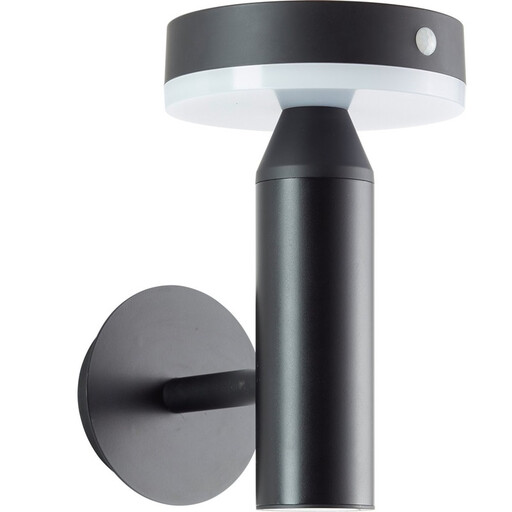
Why it suits this profile: This black outdoor wall light combines an integrated LED, solar power and a motion sensor. That makes it practical for an entrance, balcony or small garden without an existing power connection.
The specifications state 350 lumens, IP44 and a detection angle of 120 degrees. However, check that the chosen wall receives sufficient daylight.
Integrated LED, integrated battery, solar power and a compact height of approximately 20.8 cm.
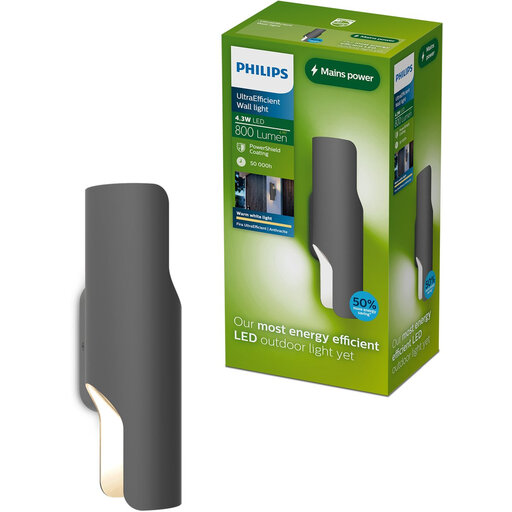
Why it suits this profile: For a fixed 230V connection and a neat façade finish, this aluminium outdoor wall light provides two-way lighting with warm white light.
The product specification lists 800 lumens, 2700 K and IP44. The lamp therefore does not depend on sunlight, but installation at 230 V requires safe fitting.
Aluminium and plastic, integrated LED, 800 lumens and light directed in two directions.

Why it suits this profile: This outdoor solar wall light is designed for a driveway, rear path or wider entrance where a clearer beam and automatic activation are desirable.
Brightness is specified as 1000 lumens and the lamp has a motion sensor. Mount the panel in a location with direct sunlight for charging.
1000 lumens, 3000 K, integrated LED, solar power and an IP44 rating.
When installing a wired garden wall light or façade lighting, switch off the power before starting. If you are unsure about the wiring, have a fixed connection checked or installed by a qualified electrician. Use wall plugs suitable for brick, concrete, wood or cladding.
Clean the solar panel regularly with a soft cloth. For an outdoor light with a motion sensor, check whether branches, fencing or a busy walkway affect detection. With an E27 or GU10 fitting, the chosen LED lamp must stay within the maximum wattage. A suitable light source is also needed to maintain the specified IP protection.
With LED lighting, pay attention to the difference between a brand claim and a guaranteed operating life. According to Philips’ own information, some integrated LED models can have a lifespan of up to 50,000 operating hours; the actual lifespan depends, among other things, on usage, temperature and installation. With solar products, hours of sunlight, shade and battery condition affect the operating time.
We have put together a complete, up-to-date list of products that fully meet these strict selection criteria and the applicable European safety regulations.
For many sheltered outdoor locations, yes. IP44 protects against splashing water, but not against immersion or powerful water jets. Check the installation location and follow the fitting instructions.
For a small entrance, around 180 to 400 lumens is often suitable. If you want to illuminate a larger driveway or dark path, look for a higher light output and a sensor that only activates the beam when movement is detected.
An outdoor solar wall light uses a built-in battery during the day, which is charged via the solar panel. No fixed mains connection is required. Operating time depends on sunlight, battery capacity, lighting mode and how often the sensor is activated.
