
Vandaag of morgen in huis

Kwaliteit gegarandeerd

Welkomstaanbiedingen ontgrendelen: GRATIS bezorging | Tot 80% korting | Gratis 30 dagen JoyPlus-proefperiode
Download de app
An outdoor wall light can make an entrance feel safer, create an inviting atmosphere on a patio or make a dark façade more functional. However, the difference between a suitable garden wall light and a poor purchase is not always immediately obvious. An attractive design, for example, says little about light output, installation or protection against rain.
Pay particular attention to these three common pitfalls:
Mistaking IP44 for being completely waterproof
An IP44 outdoor light is protected against splashing water and solid objects larger than 1 millimetre. This does not mean that the light is suitable for direct jets of water, immersion or a location where rainwater collects.
Buying a light without a suitable bulb
With a wall light with an E27 fitting or a wall light with a GU10 fitting, the bulb is often not included. Check in advance whether you still need to buy an LED bulb or spotlight, and what the maximum permitted wattage is.
Installing solar lighting in an unsuitable location
An outdoor solar wall light needs enough daylight to charge its battery. Under a canopy, on a north-facing wall or among tall trees, the operating time may be disappointing, particularly during dark Dutch winter days.
For many façades, balconies, entrances and sheltered patios, IP44 is a practical rating. This means the light can withstand splashing water from various directions. Ideally, do not install an IP44 outdoor light in a completely exposed location where it is constantly subjected to heavy rain or a garden hose.
A weather-resistant wall light must also be securely fitted. Check that the supplied wall plugs are suitable for your type of wall, such as brick, concrete or a hollow wall. For fixed models connected to 220-240 volts, installation by a qualified electrician is advisable and may sometimes be required by local regulations.
Light output is measured in lumens. A moderate light output is often sufficient for finding your way at the front door. For a larger garden or driveway, a model with more lumens may be more practical. Also pay attention to the colour temperature:
Also check the difference between an LED outdoor wall light with an integrated light source and a fitting supplied without a bulb. With the first option, you do not need to choose a separate bulb. With the second, you can tailor the lighting yourself, but you will need to factor in the additional cost and compatibility.
A wall light with a motion sensor switches on automatically when movement is detected. This is useful by a front door, garden path or shed. Do not just check whether a sensor is included; also see whether it can be adjusted and whether a dusk function or manual switch is available.
A mains-powered outdoor light with sensor is generally ready to use straight away. A wireless model runs on a rechargeable battery or disposable batteries and is easier to install, but needs to be recharged or replaced periodically. With solar lighting, performance depends on the amount of sunlight available. None of these options is automatically suitable for every location.
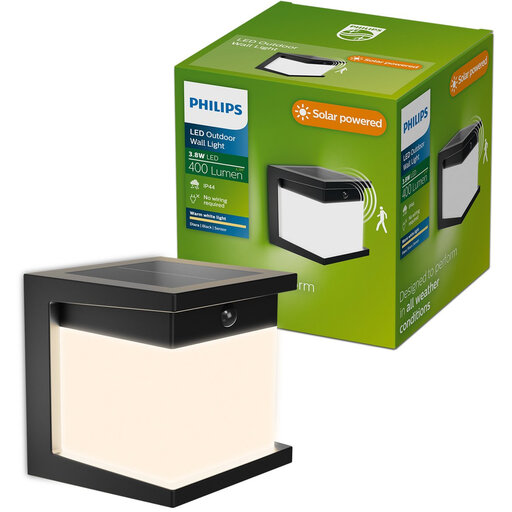
Why it suits this profile: This compact outdoor solar wall light works without fixed wiring, making it suitable for a balcony, garden wall or entrance without a power point.
The specifications clearly state that it has an integrated LED, a battery, two light modes and an IP44 rating. Make sure it receives enough direct sunlight to charge.
400 lumens, warm 2700 K light, a motion sensor and a stated power rating of 3.8 W.
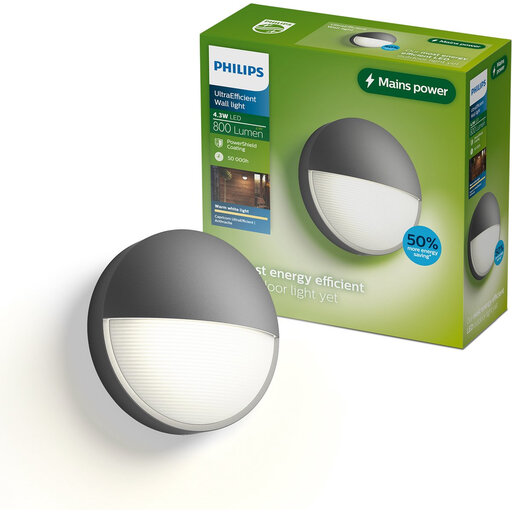
Why it suits this profile: A fixed LED outdoor wall light is ideal if you want sleek façade lighting without regularly replacing a bulb or recharging a battery.
The product information states that it has an IP44 rating, an aluminium construction and an integrated LED. The light source is not replaceable; once it reaches the end of its service life, the fitting must be replaced.
800 lumens, 2700 K, 4.3 W and a stated service life of up to 50,000 operating hours according to the product description.
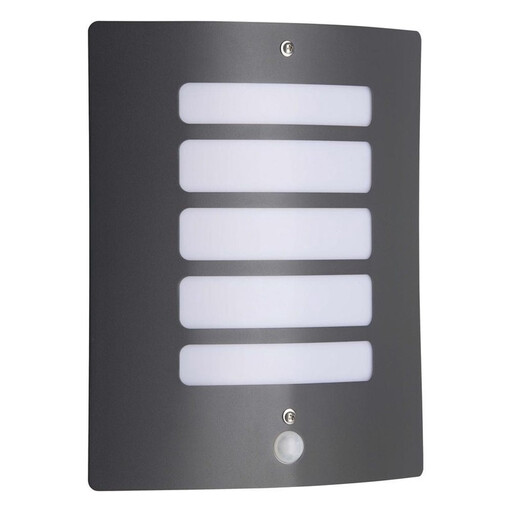
Why it suits this profile: This fixed wall-mounted outdoor light is designed for entrances, façades or garden paths where automatic mains-powered lighting is preferred.
The E27 fitting and maximum power of 60 W are specified, as is the fact that the light source is not included. IP44 means protection against splashing water, not a waterproof construction.
Integrated motion sensor, anthracite finish, downward-facing light and the flexibility to choose an E27 LED bulb.
Choose a fixed light if you want permanent lighting by a front door, garage or driveway and already have a power connection. A model with E27 or GU10 is useful if you want to replace the light source or adjust the colour temperature later.
A wireless LED outdoor wall light is more practical for rented homes, balconies and places without cabling. The Brilliant Iseo portable light has an integrated 4W LED, 300 lumens, 3000 K, USB charging, a motion sensor and magnetic mounting. When using magnetic mounting, check that the surface is flat, clean and strong enough. The light must not be allowed to fall where it could hit people or belongings.
For an outdoor solar wall light, the installation location and charging capacity are more important than the number of lumens alone. Keep the solar panel free from leaves and dirt, and expect a shorter operating time when there is little sunlight.
We have put together a complete, up-to-date list of products that fully meet these strict selection criteria and the applicable European safety regulations.
IP44 is suitable for many sheltered outdoor locations, such as a façade, balcony or covered entrance. The rating protects against splashing water, but not direct jets of water or immersion. Therefore, also check the exact installation instructions and do not position the light where water can collect.
This depends on the power rating and the number of hours it is switched on. A 4 W light that operates for 1,000 hours uses approximately 4 kWh. An integrated LED light or separate LED fitting generally uses less electricity than a traditional light source for the same purpose. With an outdoor solar wall light, the energy comes from the battery, but it still needs to be charged sufficiently.
A low-voltage or rechargeable model can usually be installed without fixed wiring, provided that the wall and mounting method are suitable. For a fixed outdoor wall light connected to 230 volts, installation by a qualified electrician is the safest option. Switch off the electricity supply before carrying out maintenance or replacement, and always check the instructions.
