
Vandaag of morgen in huis

Kwaliteit gegarandeerd

Welkomstaanbiedingen ontgrendelen: GRATIS bezorging | Tot 80% korting | Gratis 30 dagen JoyPlus-proefperiode
Download de app
An outdoor wall light can instantly make an entrance, balcony, patio, shed or driveway more practical. However, a quick purchase is not always the wisest choice. For example, a high light output says little about operating time, while a description such as “waterproof” is sometimes confused with an official IP rating.
Pay particular attention to these three common pitfalls:
The first code after “IP” refers to protection against solid particles; the second relates to water. IP44 protects against solid objects from 1 mm and splashing water from various directions. This makes an IP44 outdoor light suitable for many sheltered walls, balconies and entrances.
IP65 offers a higher level of protection against dust and water jets. This is relevant for an outdoor wall light on an exposed wall, garage or shed, where the light is more directly exposed to rain and dirt. No IP rating means that a fitting may be placed underwater. Also check that cable entries and connection points are sealed in accordance with the installation instructions.
Lumens indicate the total light output. For ambient lighting by a balcony or front door, around 180 to 500 lumens may be sufficient. For a driveway or security-focused lighting, a higher value makes more sense, but excessive light can disturb neighbours.
Colour temperature is expressed in kelvin:
A motion sensor prevents the light from staying on unnecessarily long. Pay attention to the detection range and adjustment options. A sensor aimed at a busy footpath may activate more often than desired.
A solar wall light works without a mains connection, but its performance depends on the season, shade and the battery’s charge level. Position the panel where it can receive as much direct daylight as possible and keep it free from leaves and dirt.
An LED outdoor wall light with a 230 volt mains connection generally provides a predictable light source, but requires a suitable cable and safe installation. With models featuring integrated LEDs, the light source cannot always be replaced by the user. A fitting with a GU10 or E27 socket gives you more flexibility to choose a different bulb later.
Also check the dimensions and material. Aluminium may offer a different appearance and construction from plastic, while a large light will not fit every narrow wall.
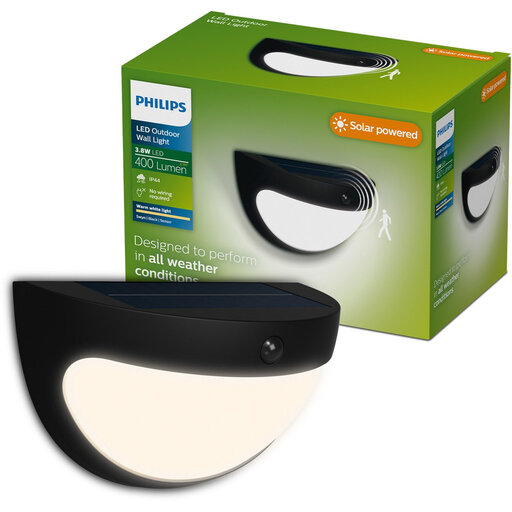
Why it suits this profile: This solar wall light requires no fixed wiring and has an integrated motion sensor. That makes it practical for a front door, garden path or balcony where you want to add lighting without an electrician.
The product information lists two light modes, a daylight sensor and IP44. Positioning in direct sunlight remains essential; IP44 is not intended for immersion or powerful water jets.
Solar power, warm white light at 2700 K, 400 lumens per light point and no fixed mains connection according to the product description.
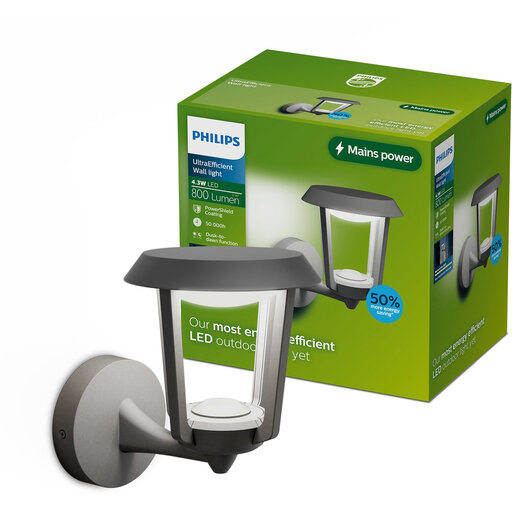
Why it suits this profile: For a fixed wall light by an entrance or patio, this model offers integrated LED lighting, an aluminium housing and a sleek anthracite design.
The specifications list 230 volts, 800 lumens and IP44. Check the electrical connection beforehand and install the light somewhere that is not exposed to direct water jets.
Integrated LED, 2700 K warm white light, 800 lumens and aluminium with a PowerShield coating, according to Philips.

Why it suits this profile: This model is designed for large areas such as a driveway, garage or spacious garden where a broad, powerful beam is required.
The product specifications list IP65, 4000 lumens, a motion sensor and an adjustable head. Position the light carefully to reduce glare and disturbance.
Solar power, IP65, 5000 K light colour and, according to the product description, a detection range of up to 8 metres when approached directly.

Why it suits this profile: The cordless design and magnetic attachment are useful when you do not want to drill into a wall or want to move the light temporarily.
The product information lists USB-C charging, a motion sensor and IP44. The magnetic surface must be flat, clean and strong enough; do not position the light above a passageway if it could come loose.
Cordless installation, integrated LED, 300 lumens, 3000 K and a rechargeable battery according to the product specifications.
We have compiled a complete, up-to-date list of products that fully meet these strict selection criteria and the applicable European safety regulations.
Install an outdoor wall light on a sturdy surface and use fixings suitable for brick, concrete, wood or wall cladding. With a 230 volt model, the power circuit must be switched off. Have fixed electrical connections installed by a qualified electrician if you are unsure about the installation.
With solar models, the position of the panel is crucial. Clean the panel and sensor regularly with a soft cloth. Also check screws, wall brackets and cables after storms or frost. An IP44 outdoor light should not be installed where water can collect.
A solar wall light uses energy from its charged battery during normal operation, rather than mains electricity. Actual operating time depends on sunlight, the season, battery capacity and how often the sensor is activated. Output may be lower in winter.
Lifespan varies by model and operating conditions. Some product descriptions, for example, state 20,000, 25,000 or 50,000 hours of illumination. These are stated product specifications and do not guarantee that the light will function for exactly that long. With integrated LEDs, the entire fitting often needs to be replaced when the light source reaches the end of its lifespan.
For a sheltered wall, balcony or entrance, IP44 is often suitable for protection against splashing water. For a completely exposed location with a lot of rain, dust or water jets, IP65 outdoor light is a more logical specification to consider. Always check the installation instructions and prevent immersion.
