
Vandaag of morgen in huis

Kwaliteit gegarandeerd

Welkomstaanbiedingen ontgrendelen: GRATIS bezorging | Tot 80% korting | Gratis 30 dagen JoyPlus-proefperiode
Download de app
An outdoor wall light can provide practical illumination for an entrance, patio, balcony or garden path. However, the difference between a suitable light and a disappointing purchase often goes beyond appearance. A stylish fitting may not provide enough light, a solar outdoor wall light may not charge sufficiently on a shady façade, and a light with a motion sensor may react inconveniently to passing cars or moving branches.
Joybuy Product Recommendation Officer therefore helps you assess the specifications first. This allows you to compare an outdoor LED wall light, solar lighting and mains-powered outdoor wall lighting based on the factors that matter in everyday use.
An IP44 wall light is protected against splashing water and solid objects larger than 1 millimetre. This does not mean that the light is suitable for immersion or direct jets of water. It is therefore best to install an IP44 light under an overhang or on a façade where rain does not constantly fall directly onto the housing.
For greater exposure to rain, a higher IP rating, such as IP65, is worth considering. Also check the installation instructions and the quality of the wall mounting.
Wattage indicates energy consumption, not the amount of light produced directly. Lumens are the useful measurement here. For example, a compact outdoor solar wall light with 180 to 350 lumens is suitable for an entrance or small balcony. A wider façade or driveway requires more light.
Also consider the colour temperature:
A solar-powered outdoor light needs direct daylight during the day to charge its battery. A north-facing wall, a position beneath a balcony or a location with lots of shade can limit the operating time. Check that the solar panel has an unobstructed view of the sky.
On some models, the panel can be installed separately from the light using a cable. This offers greater flexibility on a dark façade. Bear in mind that cloudy winter weather and shorter days can affect charging performance.
Do not just look at the number of lumens; consider the direction of the light too. A light with upward and downward illumination can accentuate a façade. An adjustable spotlight is more practical when you want to illuminate a garden path, gate or driveway precisely.
A motion sensor also affects how the light can be used. Check the detection angle, range and whether the light can also be switched on continuously. A sensor with a wide angle can be useful at an entrance, but requires careful positioning to reduce unwanted activation.
There are three common options:
Aluminium and plastic are commonly used for outdoor lights. Pay attention to the finish, the mounting materials and whether the solar panel or light cover can be cleaned easily. Dust and dirt can affect light output or charging.
With an integrated LED, the light source cannot be replaced by the user. With a light featuring an E27 fitting, you can change the light source, provided that the type and maximum wattage are compatible.
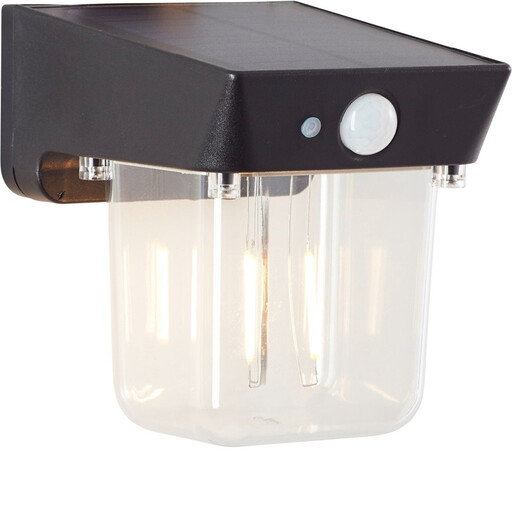
Why it suits this profile: This compact outdoor solar wall light works without wiring and combines 180 lumens with a motion sensor. It is suitable for a front door, small patio or garden path where you mainly need light when someone passes by.
The product details clearly state 180 lumens, 2700K, solar power and IP44. This means you can see in advance that it is an atmospheric, splash-resistant light rather than a completely waterproof floodlight.
2 W power, integrated 18650 Li-ion battery, motion sensor and a compact height of 11.5 cm.
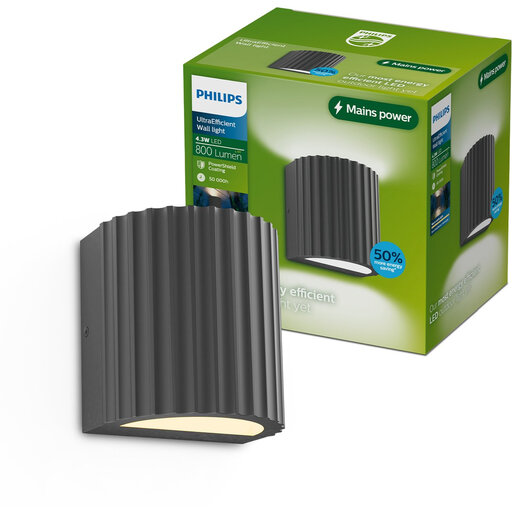
Why it suits this profile: This fixed Philips outdoor light is designed for anyone looking for a sleek façade fitting with directional light distribution. The integrated LED spreads warm white light in two directions.
The specifications show 800 lumens, 4.3 W, 2700K and IP44. You can therefore weigh its atmospheric appearance against specific light output and protection data.
Aluminium and plastic, integrated LED, 800 lumens and a stated service life of up to 50,000 operating hours.

Why it suits this profile: For a driveway, large façade or entrance where high light output and wide motion detection are needed, this model offers 4000 lumens, an IP65 rating and a sensor range of up to 8 metres when approached directly.
The IP65 rating is more specific than IP44, and the product information states the sensor range and two light modes. Do check whether 5000K suits the atmosphere you want to create.
Solar power, adjustable lamp head, dusk sensor, two light modes and 4000 lumens according to the product specification.
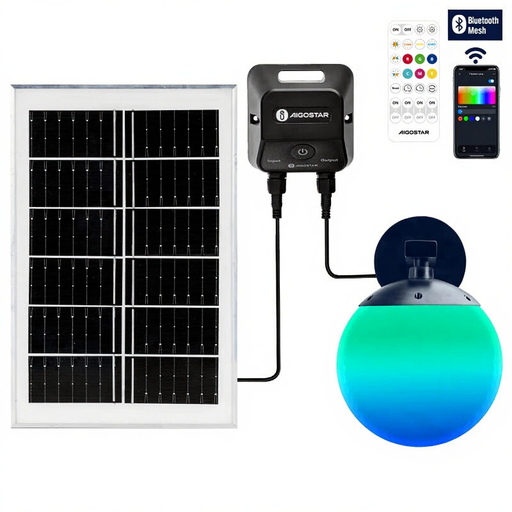
Why it suits this profile: This wireless outdoor solar wall light offers RGB plus adjustable white light and Bluetooth mesh control. It is an interesting option for a balcony, veranda or garden where you want to create different lighting atmospheres without wiring.
The light works without wiring, but the details also state 200 lumens and a charging time of 4 to 6 hours. This makes the expected light output and charging requirements clear in advance.
RGB plus 2700K–6500K, Bluetooth mesh for more than 200 devices, 5 W solar panel and a battery capacity of 4000 mAh.
We have put together a complete, up-to-date list of products that fully meet these strict selection criteria and the applicable European safety regulations.
Choose a firm, flat surface and use mounting materials suitable for the façade. Do not drill without first checking for pipes or cables. A fixed 230V connection requires extra attention to electrical safety.
For solar lighting, check the following beforehand:
An integrated battery or LED light source can reduce maintenance, but it often also means that you cannot replace the relevant component yourself.
For atmospheric lighting beside a front door or patio, around 180 to 350 lumens is often a practical starting point. For a broad façade, driveway or stronger orientation lighting, 800 lumens or more may be appropriate. The right amount depends on the distance, light distribution and the level of brightness you want.
Yes, an IP44 wall light is designed for applications involving splashing water, such as many sheltered façades, balconies and patios. IP44 does not mean that the light is waterproof. Do not position it where it is exposed to direct jets of water, and never immerse it.
An outdoor solar wall light does not use mains electricity during normal operation. Running costs are therefore mainly related to the purchase price, cleaning the panel and replacing the battery if necessary. Operating time remains dependent on sunlight, charging time, battery capacity and the selected light mode.
