
Vandaag of morgen in huis

Kwaliteit gegarandeerd

Welkomstaanbiedingen ontgrendelen: GRATIS bezorging | Tot 80% korting | Gratis 30 dagen JoyPlus-proefperiode
Download de app
Good outdoor wall lighting needs to do more than simply look attractive. At an entrance, patio, balcony, driveway or façade, brightness, protection against rain and ease of installation are just as important as appearance. Even so, there are several common pitfalls that can make a wall light less suitable than expected.
A product with a high lumen output does not automatically provide comfortable or practical illumination. A powerful light may be ideal for a driveway but too harsh beside a front door or on a small balcony. Also consider the colour temperature:
In addition to lumens, consider the direction of the beam. A downward-facing wall light performs differently from an adjustable security spotlight.
Marketing copy sometimes uses the word waterproof even when the actual level of protection is more limited. An IP44 outdoor light is protected against solid particles larger than 1 millimetre and splashing water from various directions. This makes it suitable for many sheltered façades, balconies and entrances, but not for direct water jets or immersion.
An IP65 outdoor light is dust-tight and protected against low-pressure water jets. This is a sensible choice for a more exposed façade, garden wall or driveway. Also make sure that the wall, cable entry and mounting hardware are suitable for outdoor use. The lamp’s IP rating alone does not determine the safety of the complete installation.
A solar outdoor light does not require a mains connection, but its solar panel must receive enough direct light during the day. Shade from a canopy, tree or north-facing wall can reduce charging performance. In winter, the days are shorter and there is less sunlight, which can reduce operating time.
According to the product descriptions of various brands, solar wall lights switch on automatically at dusk or when movement is detected. That is convenient, but check the stated battery capacity, lighting modes and charging requirements in advance. A light with a dedicated motion-activated setting can use energy more efficiently than one that remains brightly lit throughout the night.
For a front door or small patio, around 300 to 800 lumens is often a useful starting point, depending on the mounting height and the desired atmosphere. A driveway or larger property may call for a higher light output. The Philips UltraEfficient Zyren is listed in the product information with 4000 lumens, a colour temperature of 5000K and an adjustable light head. According to the brand description, this model is designed for powerful illumination and motion detection.
A warm LED outdoor light at 2700K or 3000K will generally complement garden furniture and façades better than bright white light. Check whether the light source is integrated. With an integrated LED, you normally replace the entire fitting rather than just the bulb. With a GU10 or E27 socket, you can choose and replace the light source yourself.
An outdoor light with a motion sensor is useful at an entrance, garage or back door. Check:
According to the product specifications, the UME Solar Outdoor Lights 302 LED has three adjustable light heads, a 180-degree detection angle and a stated detection range of 60 feet, or approximately 18 metres. The product information also lists 3000 lumens and IP65 protection. Values like these are particularly relevant for a wide driveway, garden or garage area. Avoid pointing the sensor directly at a busy street if you want to minimise unnecessary activation.
Solar wall lights can usually be installed without wiring, but they still require a solid wall and suitable plugs. An electric wall light connected to 230 volts must be installed by a qualified professional. This applies, for example, to models with an E27 or GU10 socket.
Before buying, check:
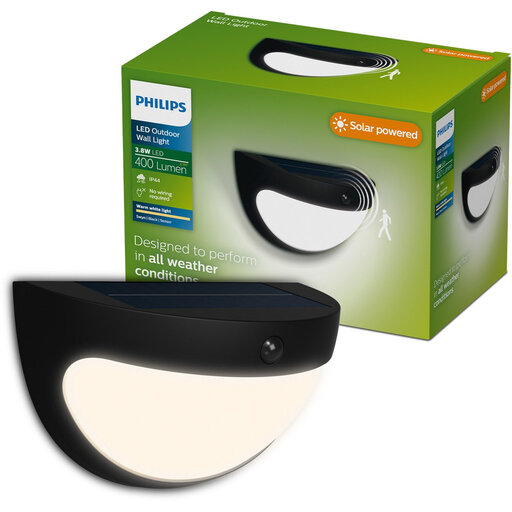
Why it fits: A practical solar wall light for a balcony, small garden or entrance without an existing power connection. The light has two lighting modes, a motion sensor and a stated light output of 400 lumens.
The IP44 rating makes it clear that this is splash protection, not protection against direct water jets. It is therefore best installed in a sheltered position.
No mains connection required; warm white 2700K light and a compact size of approximately 17.7 × 10.9 cm.

Why it fits: Designed for a driveway, garage or large garden area where bright, cooler light and broad detection are important.
The IP65 specification is clearly better suited to an exposed location than IP44. The light head is adjustable, so illumination is not limited to a straight-ahead beam.
Stated specifications include 4000 lumens, 5000K and PIR detection up to 8 metres when approached directly and 16 metres from the side.

Why it fits: The three light heads and wide coverage are practical when a single wall light needs to illuminate a larger area.
The IP65 rating and adjustable heads make the specifications verifiable for outdoor use. Make sure the panel is positioned in direct sunlight.
The product information lists 3000 lumens, three modes, 180-degree detection and wall mounting.
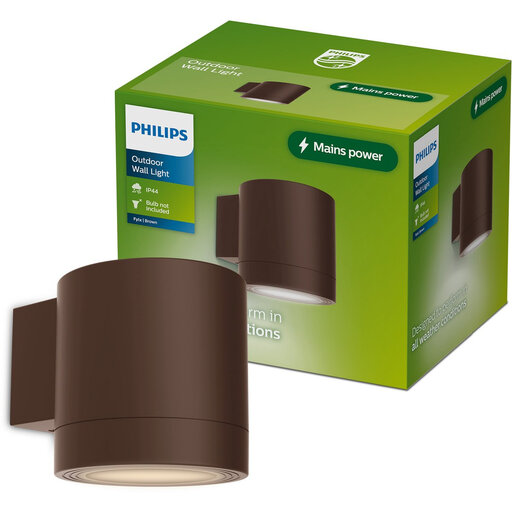
Why it fits: For homeowners who want to choose the GU10 LED bulb, colour temperature and brightness themselves for a façade or balcony.
The socket type and maximum load are clearly specified. The light is supplied without a GU10 bulb, so you should factor that additional cost into your decision.
Aluminium housing, downward-facing beam and IP44 protection for sheltered outdoor locations.
Browse a current selection of outdoor lights and compare light output, IP protection, socket type and installation requirements for each product.
It can be, but performance depends on available sunlight, positioning, battery capacity and the selected lighting mode. Position the panel where it will receive as much unobstructed light as possible and clean it regularly. An electric wall light provides more consistent operating time when dependable illumination is important.
An IP44 outdoor light is designed for splash protection and is often suitable for a sheltered façade, entrance or balcony. An IP65 outdoor light provides dust-tight protection and handles water jets more effectively. Neither rating means that the light can be placed underwater.
An integrated LED light generally uses less energy than traditional light sources with the same light output. Actual consumption depends on the wattage and the number of operating hours. A motion or dusk sensor can reduce the time the light remains on. Solar lighting does not draw power from the mains, but you should account for charging conditions and periodically maintain the solar panel.
