
Vandaag of morgen in huis

Kwaliteit gegarandeerd

Welkomstaanbiedingen ontgrendelen: GRATIS bezorging | Tot 80% korting | Gratis 30 dagen JoyPlus-proefperiode
Download de app
An outdoor wall light can make your entrance, garden, balcony, patio or driveway safer and more welcoming. However, not every outdoor wall light is suitable for every exterior wall. A light may look sturdy in the product photo, yet provide too little light in practice, respond incorrectly to movement or offer insufficient protection against rain.
As a Joybuy Product Recommendation Officer, I filter the key product specifications and set marketing language aside. Pay particular attention to these three common pitfalls before buying an outdoor light.
Wattage indicates how much energy a light uses, not how much light it produces. So look at lumens. A compact LED outdoor light producing 400 to 800 lumens may be suitable for an entrance or balcony. A broad driveway or lighting intended for security may require more light.
Also consider the colour temperature:
A light with a high lumen output is not automatically the right choice. A beam that is too strong can disturb neighbours or cause glare when the light is mounted at eye level.
An IP44 outdoor light is protected against solid objects and splashing water from different directions. This makes IP44 suitable for many sheltered exterior walls, balconies and entrances. However, it does not mean that the light is waterproof or able to withstand direct jets of water.
For an exterior wall fully exposed to rain, a higher level of protection such as IP65 may be worth considering. Also check the installation location. Ideally, place an IP44 light under an overhang or somewhere water cannot collect on the housing.
A fixed outdoor wall light operating at 230 volts will generally need to be connected to the mains supply. If you are unsure about the wiring or installation, the fitting should be carried out by a qualified electrician. A solar outdoor light works without a mains connection, but needs direct sunlight to charge the battery properly.
When buying, check:
An integrated LED outdoor light is ready to use straight away and does not require a separate bulb. For example, Philips Nuvy has an integrated LED with 800 lumens, 2700 K and a stated power rating of 4.3 W.
With a light using an E27 or GU10 fitting, you can choose the light source yourself. This gives you more flexibility in terms of colour, dimming and light output, but the light is often supplied without a bulb. The Brilliant Todd uses an E27 fitting up to a maximum of 60 W and is supplied without a bulb. Philips Fylx requires a GU10 bulb.
An outdoor light with a motion sensor switches on when movement is detected. This is practical by a front door, side entrance or driveway. Note the difference between a motion sensor and a dusk sensor:
Also check the installation height and the direction of the sensor. A sensor pointed towards a busy pavement may switch on more often than you would like.
Aluminium and metal generally feel sturdier than plastic, but the material alone does not determine how long a light will last. Also look at the finish, fixings and IP rating. A black or anthracite outdoor light often suits modern exterior walls, while a lantern-style model creates a more traditional look.
Measure the available space before ordering. A wall light next to a narrow door frame needs to remain compact. Also check whether the beam shines downwards, upwards or in several directions.
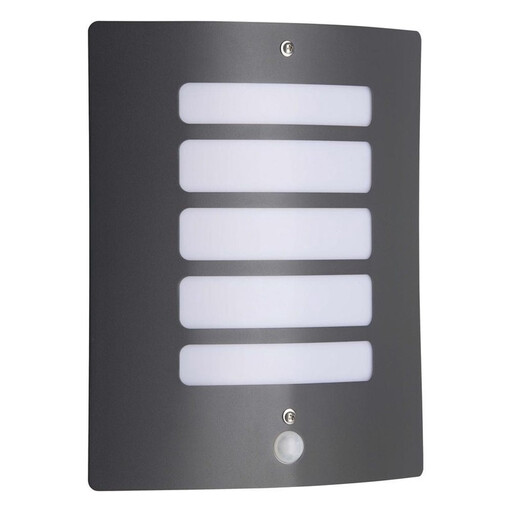
Why it suits this profile: This fixed outdoor wall light has an E27 fitting, allowing you to choose a suitable LED bulb yourself. The integrated motion sensor is practical by an entrance or side door.
The specifications clearly state that the light source is not included. This means you can factor in the additional purchase of an E27 bulb in advance.
E27 fitting, motion sensor, 230V connection and IP44 splash protection.
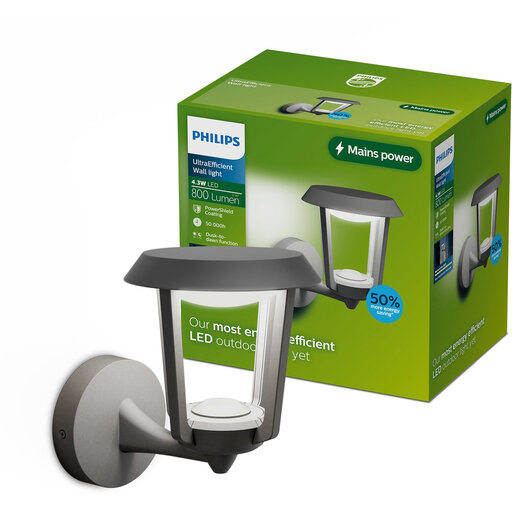
Why it suits this profile: This Philips outdoor light combines an aluminium housing with integrated LED lighting and warm white light for fixed entrance or exterior wall lighting.
The product details specify 800 lumens, 2700 K and IP44. This allows you to compare light output, colour and protection in advance.
Integrated LED, 800 lumens, 2700 K and aluminium with PowerShield coating according to the product description.

Why it suits this profile: For a driveway, large garden or spacious outdoor area, the stated light output of 4000 lumens may be relevant. The adjustable head helps you direct the beam.
The light has an IP65 rating rather than IP44. This indicates a higher stated level of protection against dust and water, although placement and installation remain important.
4000 lumens, IP65, solar power, dusk sensor, motion sensor and a detection range stated in the product information.

Why it suits this profile: This solar outdoor light does not require a mains connection. That is useful for a balcony, shed or exterior wall where there is no power outlet.
The product information lists two light modes, a motion sensor and the need for direct sunlight. This makes it clear when solar lighting may be less suitable.
400 lumens, 2700 K, IP44, two light modes and installation without wiring.
We have put together a complete, up-to-date list of products that fully meet these strict selection criteria and the applicable European safety regulations.
A fixed outdoor wall light should be mounted on a stable surface. Use wall plugs suitable for brick, concrete, wood or exterior cladding. Switch off the power before working on a wired light. Have the connection carried out by an electrician if you are unsure about the wiring.
For solar lighting, the position of the panel is crucial. Position the panel towards direct sunlight as much as possible and avoid shade from a roof edge, tree or another exterior wall. Clean the panel regularly with a soft, dry cloth. An IP44 light must not be submerged or exposed to powerful water jets.
IP44 is suitable for many sheltered exterior walls, entrances, balconies and patios. The classification protects against splashing water, but not against submersion or direct jets of water. If the light is completely exposed, also compare models with a higher IP rating.
For ambient lighting by a patio, 180 to 400 lumens may be sufficient. For an entrance or path, 400 to 800 lumens is a sensible choice. A broad driveway or functional security lighting may require more lumens. In addition to lumens, consider the direction of the beam and the colour temperature.
A solar outdoor light uses energy from the solar panel during the day and stores it in a battery. This means it does not need to be connected to the mains. How long it operates depends on factors including sunlight, the season, battery charge and the selected light mode. Always check that the installation location receives enough direct sunlight.
