
Vandaag of morgen in huis

Kwaliteit gegarandeerd

Welkomstaanbiedingen ontgrendelen: GRATIS bezorging | Tot 80% korting | Gratis 30 dagen JoyPlus-proefperiode
Download de app
An outdoor wall light may seem like a straightforward purchase, but differences in power supply, light source and protection rating can determine whether it’s really right for your home. A light for a sheltered front door needs different features from one mounted on an exposed wall or balcony.
Look out for these three common pitfalls:
IP44 is a common rating for many Dutch façades, entrances and covered patios. It means the light is suitable for splashing water from different directions, but not for a spot where rainwater collects or where a garden hose is aimed directly at the fitting.
Also consider the surface. An outdoor wall light must be securely fixed to a suitable wall. Check that the wall plugs and fixings are suitable for brick, concrete, wood or cladding. Wired outdoor lighting must be connected to the mains in accordance with local regulations. If you’re unsure, have a qualified electrician do the work.
A solar outdoor light doesn’t need to be connected to the mains. This makes it easier to install by a shed, garden path or remote wall. However, the solar panel needs enough direct daylight. Clean it regularly and bear in mind that charging opportunities may be more limited on darker days.
A rechargeable outdoor wall light, such as a USB-C model, is easy to move around. On the other hand, you’ll need to recharge it periodically. A wired light is available whenever the power supply is working, but it’s less straightforward to install.
The lumen figure gives you an indication of how much light the lamp produces. A lower light output may be suitable for atmospheric garden lighting. More light is often useful by an entrance or in a dark passageway. A colour temperature of around 2700K to 3000K gives a warm white light, while 4000K looks more neutral.
Check whether the LED is integrated and non-replaceable, or whether the fitting can take a replaceable bulb. With an LED outdoor light that has a GU10 or E27 fitting, you can choose a different colour temperature or brightness later. Always check the permitted wattage.
The recommendations below are based on verifiable information in the product descriptions, such as IP rating, fitting, lumen output, power supply and dimensions. Brand claims about durability or performance are not presented as general guarantees. For example, Philips’ own product information states that certain models are designed for outdoor use; suitability also depends on installation and maintenance.
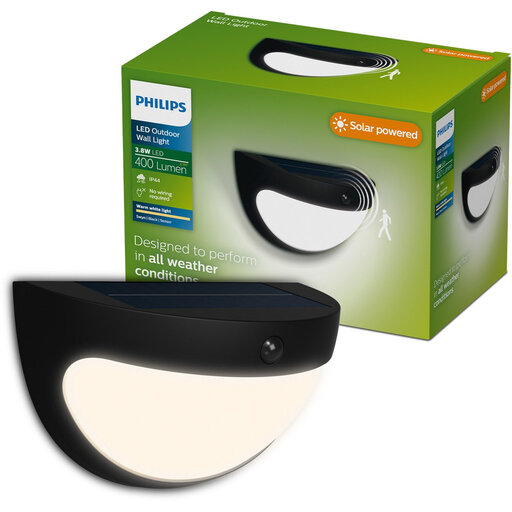
Why it suits this type of buyer: This solar outdoor light works without wiring and has a motion sensor. It’s a practical choice for an entrance, balcony or small garden where you want to add lighting quickly.
The product description lists two modes, a daylight sensor and IP44 protection. You can see in advance which automatic features are included; just make sure you install the panel in a sunny spot.
Integrated LED, warm white light at 2700K, 400 lumens per light, a motion sensor and no mains connection required.
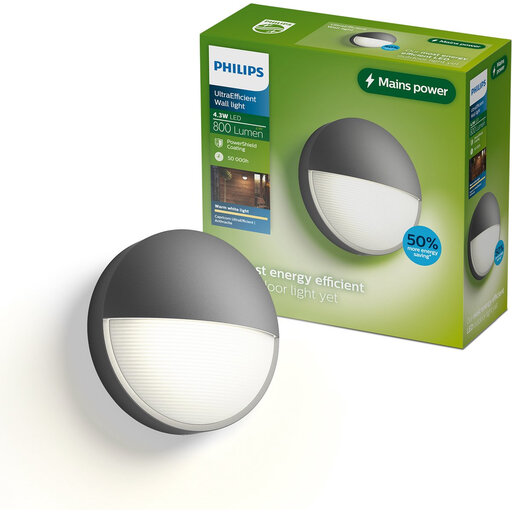
Why it suits this type of buyer: A fixed outdoor wall light with an aluminium housing is a good choice for a façade where you want a permanent lighting solution with a modern look.
The specifications list an IP44 rating, an aluminium body and an integrated LED. Bear in mind that, according to the product information, the LED cannot be replaced.
800 lumens, 2700K warm white light, 4,3 W per light and a compact size of approximately 21,3 × 7,8 cm.

Why it suits this type of buyer: For a dark entrance, shed or side wall, the combination of solar power and higher light output can be practical.
The product information lists 1000 lumens, a motion sensor, a dusk sensor and IP44 protection. The light is not designed to be submerged or exposed to direct jets of water.
Solar power, 3000K warm white light, 1000 lumens, automatic operation and two light modes.
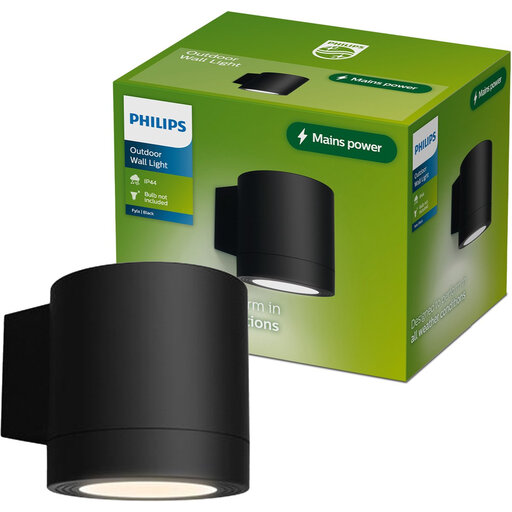
Why it suits this type of buyer: This black outdoor wall light is a good choice if you want to select your own GU10 LED bulb for a façade, balcony or garden.
The fitting and IP44 rating are clearly listed. The GU10 bulb is not included, so you can choose one that suits your needs.
Replaceable GU10 fitting, aluminium housing, downward-facing beam and a compact size of approximately 8,9 × 11,6 × 9 cm.
We’ve put together a complete, up-to-date list of products that meet these strict selection criteria and the applicable European safety requirements.
A solar or rechargeable wall light can usually be installed without electrical wiring. For a wired outdoor wall light, you must switch off the power and make the connection in accordance with local regulations. If you’re unsure, ask a qualified electrician to do the work.
IP44 is suitable for splashing water and many sheltered outdoor locations, such as an entrance, covered patio or façade. It does not mean the light is completely waterproof. Choose a different protection rating or a more sheltered location if the light will be exposed to heavy rain, jets of water or snow.
A solar outdoor light uses no mains electricity while it’s on. For a wired LED outdoor light, energy use depends on the wattage and how many hours it’s on. A 5 W light on for five hours a day uses a theoretical 25 Wh per day. A motion sensor can reduce how long the light stays on, but the actual cost depends on its settings and your energy tariff.
