
Vandaag of morgen in huis

Kwaliteit gegarandeerd

Welkomstaanbiedingen ontgrendelen: GRATIS bezorging | Tot 80% korting | Gratis 30 dagen JoyPlus-proefperiode
Download de app
An outdoor wall light with a motion sensor can instantly make a dark entrance, façade, balcony or garden path more practical. The light switches on when movement is detected, so you do not have to search for a switch. However, not every model is suitable for every location.
Marketing copy often focuses on high lumen outputs, long lifespans or “weather-resistant” materials. The details determine whether a light is actually suitable for your situation outdoors in the Netherlands. Pay particular attention to these three common pitfalls:
A solar outdoor light with a motion sensor works without connecting to the electricity grid. This is useful for rented properties, garden paths and façades without existing cabling. However, check that the solar panel receives direct daylight and that the battery has sufficient capacity for dark winter days.
A wireless outdoor light with a built-in battery is more flexible to position, but needs to be charged periodically via USB. A wired outdoor LED wall light operates at 230 V and requires installation by a qualified electrician. The Brilliant Todd, for example, has an E27 fitting, a maximum power rating of 60 W and is supplied without a bulb. This gives you freedom of choice, but makes professional installation essential.
Lumens indicate how much light a lamp produces according to its product specifications. For a small balcony, 180 to 400 lumens may be sufficient. For a wide driveway or a dark rear façade, a more powerful solar outdoor light with a motion sensor may be the more logical choice.
Colour temperature determines the atmosphere:
A higher light output does not automatically mean a better choice. Bright light can disturb neighbours or cause glare when the lamp is mounted at eye level. Also consider the direction of the light: a downward-facing wall light for gardens and façades often mainly illuminates the ground and the keyhole.
For many sheltered façades and entrances, IP44 is a common specification. Check the installation location carefully. On an exposed façade that catches a lot of rain and wind, a higher IP rating may be more suitable. According to the product details, the Philips Zyren models in this selection have IP65, making them more suitable for a more demanding outdoor location than models with IP44.
Also consider the material. Aluminium can provide a sturdy appearance, while plastic is often lighter and places less strain on the mounting surface. A black outdoor light or anthracite outdoor light suits many façades, but the colour alone says nothing about protection against the weather.
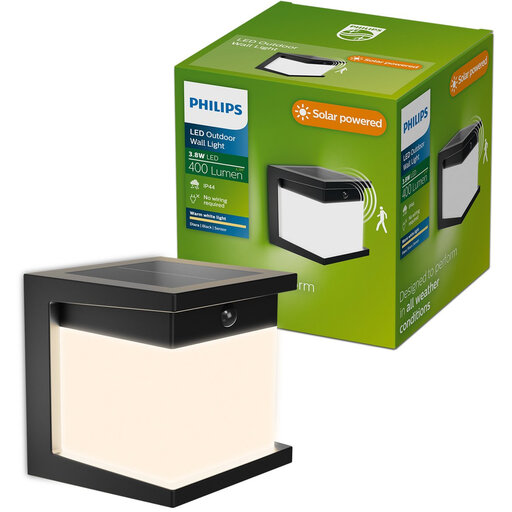
Why it suits this profile: This solar wall light requires no wiring and delivers 400 lumens of warm white light at 2700 K according to the product specifications. That makes it suitable for a small entrance, balcony or garden wall.
The IP44 rating is not presented as waterproof. Install the light in a sheltered location and make sure the panel receives direct daylight.
Integrated LED, two lighting modes, motion sensor and a stated lifespan of 25,000 hours.
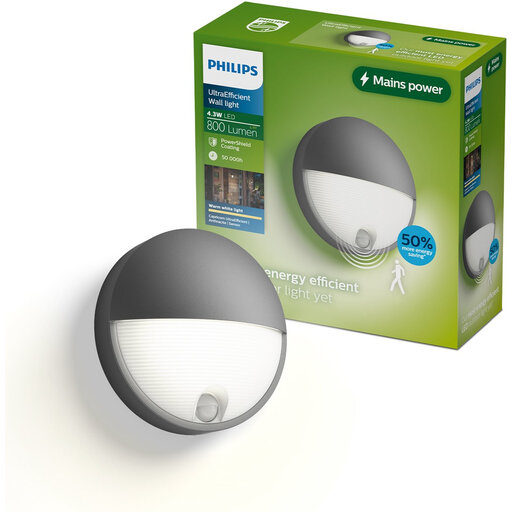
Why it suits this profile: This anthracite outdoor light combines a fixed 230 V connection with integrated LED, 800 lumens and warm white light at 2700 K.
The integrated dusk and motion sensors mean you do not have to rely solely on a general marketing claim; both functions are listed in the product specifications.
Aluminium housing, IP44, 4.3 W power consumption and 800 lumens.
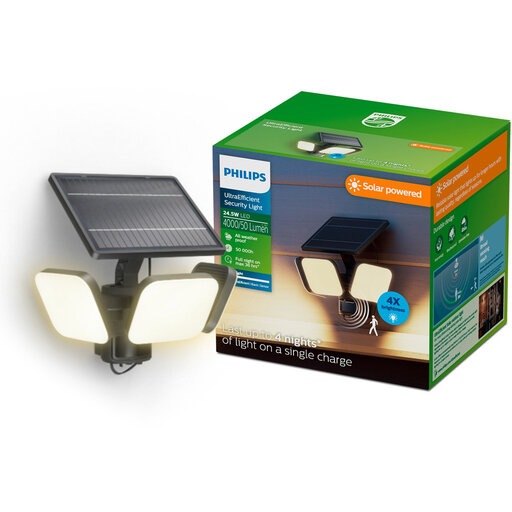
Why it suits this profile: For a wide driveway, large façade or frequently used passage, this solar security light offers 4000 lumens, IP65 and a detection range of 8 metres when approached directly, according to the stated specifications.
The higher IP65 rating is clearly distinct from IP44. The adjustable lamp head also helps direct bright light away from windows or neighbours.
4000 lumens, IP65, adjustable head, dusk sensor and two lighting modes.
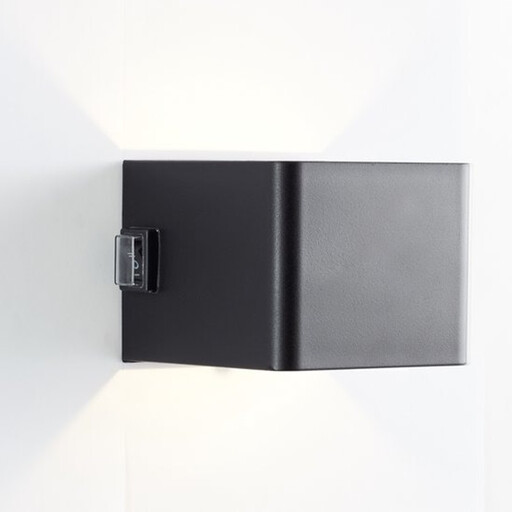
Why it suits this profile: This wireless outdoor light has a rechargeable battery, USB-C connection and magnetic mounting. With 300 lumens and 3000 K, it is suitable for a balcony, covered area or small passage.
You do not need to arrange a permanent connection or professional installation. However, bear in mind that it needs regular charging, and attach the magnetic plate to a flat, sturdy surface.
No wiring, motion sensor, integrated LED and removable light for charging.
We have put together a complete, up-to-date list of products that fully meet these strict selection criteria and the applicable European safety regulations.
Do not position the sensor directly opposite a busy road or moving branches. This can cause the light to switch on unnecessarily. Point the light towards the route you actually want to illuminate, such as the garden path or front door. With a solar model, check that the façade, roof edge or vegetation does not cover the panel for a large part of the day.
A fixed 230 V light must be connected by a qualified electrician according to the product information. Switch off the power before carrying out maintenance. With IP44 and IP65 models, it is still important to check the housing, seals and mounting regularly for dirt or damage.
That depends on the amount of direct daylight, the battery capacity and the selected lighting mode. In winter, the charging hours are shorter. Position the panel as openly as possible and keep it clean. Mains-powered outdoor lighting with a sensor is more predictable when continuously available lighting is important.
A solar model does not use mains electricity, but it does require sufficient sunlight and periodic panel maintenance. With an LED mains-powered light, consumption depends on the wattage and operating time. A 4.3 W light uses approximately 4.3 kWh over 1,000 operating hours, excluding the effect of the sensor settings.
The stated lifespan varies from product to product. The product details for various models, for example, state 10,000, 20,000, 25,000 or 50,000 operating hours. These are the manufacturer’s product specifications and not a guarantee of a particular service life. Installation, moisture, temperature and a battery’s charging behaviour all affect its practical lifespan.
