
Vandaag of morgen in huis

Kwaliteit gegarandeerd

Welkomstaanbiedingen ontgrendelen: GRATIS bezorging | Tot 80% korting | Gratis 30 dagen JoyPlus-proefperiode
Download de app
An outdoor wall light with a motion sensor can make an entrance, garden path, patio or driveway more convenient. However, not every light is right for every exterior wall. A sunny wall calls for a different solution from a sheltered balcony wall or a dark driveway.
Product descriptions often focus on high lumen figures, modern designs or high IP ratings. For a good purchase, these questions matter most: will a solar wall light get enough sun, is the brightness right for the location, and is the IP rating suitable for the amount of rain it will be exposed to?
A solar outdoor light needs daylight to charge its battery. Under a canopy, next to a tall fence or on a north-facing wall, it may receive less sunlight. As a result, the light may not stay on for as long or shine as brightly as you expect.
Before installing it, check:
More lumens means more light, but not necessarily more comfort. Warm white outdoor light of around 2700 to 3000 K may feel more pleasant by a front door or on a balcony. A higher light output may be more practical for a driveway or security light with a motion sensor.
Placement matters too. A powerful light that shines straight into your eyes is less useful than a slightly softer one that lights the ground and the keyhole well.
An IP44 outdoor light is protected against solid objects larger than 1 millimetre and splashing water from different directions. This rating makes it suitable for many exterior walls, entrances and sheltered outdoor areas. However, IP44 does not mean the light can be submerged or withstand a direct jet of water at high pressure.
For an exposed spot that gets a lot of wind-driven rain, an IP65 solar outdoor light may be a better option. An IP65 rating indicates protection against dust and water jets. Always check the installation instructions and the position of the connections too.
A motion sensor switches the light on when it detects movement. A dusk sensor stops it coming on unnecessarily during the day. Some models combine both functions. Check the specifications for the detection angle, range and available modes.
A short activation time is handy by a front door. For a driveway or side path, a wider detection range may be more important. Avoid pointing the sensor directly at a busy road, so passing traffic does not keep triggering the light.
Light output is measured in lumens. The selected models range from 180 to 3000 lumens. A compact wall light for a balcony generally needs less light than a wide security light for a driveway.
Colour temperature is measured in kelvin:
Wireless outdoor lighting runs on solar power, a battery or rechargeable batteries. This avoids the need for a permanent mains connection, but you will need to consider charging and accessibility. If a 230 V light needs wiring, it must be installed by a qualified electrician.
An integrated LED light source usually does not need replacing. Check its expected lifespan, the warranty terms and whether any parts can be replaced. Manufacturer claims of, for example, 20,000 or 50,000 hours of use come from the relevant brand’s product information and are not a guarantee for every situation.
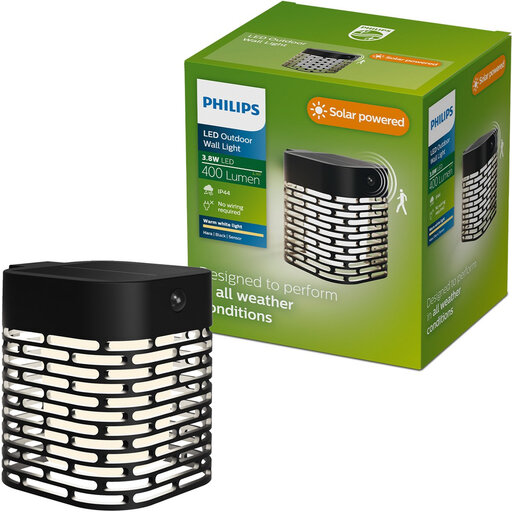
Why it suits this type of user: This black solar wall light works without fixed wiring and offers two lighting modes. With 400 lumens, 2700 K and an IP44 rating, it’s a good fit for an entrance, balcony or sheltered garden wall.
The product information clearly states the IP44 rating, the two modes and the need for direct sunlight. So don’t expect it to work as a waterproof light or in a completely dark spot.
Solar-powered, integrated LED, motion and dusk sensors, and warm white light at 2700 K.
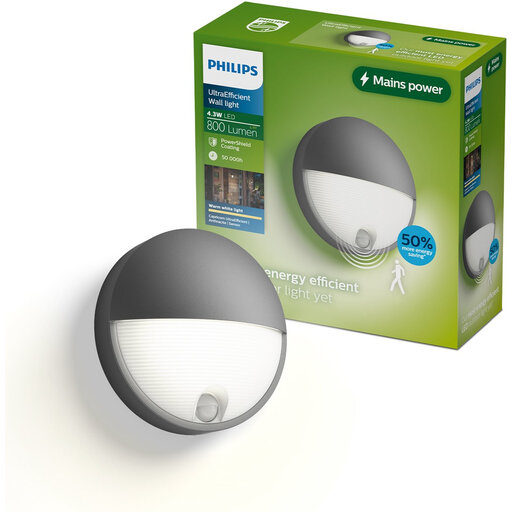
Why it suits this type of user: This mains-powered LED outdoor light is for anyone who would rather not charge a battery. According to the specifications, it delivers 800 lumens of warm white light at 2700 K and uses motion and dusk sensors.
As this isn’t a solar light, you won’t be relying on sunlight. The IP44 rating does have its limits, though: don’t place the light somewhere exposed to direct water jets.
Aluminium housing, 800 lumens, integrated LED and 4.3 W power, according to the product specifications.

Why it suits this type of user: This model is designed to provide wide coverage for a driveway, garage, garden or yard. The product information lists three lighting modes, three adjustable heads and a 180-degree detection angle.
The IP65 rating makes it better suited to a more exposed spot than an IP44 light. However, check that 3000 lumens and the stated 7000 K will give you the level of light you want.
302 LEDs, three lighting modes, IP65 rating and a solar panel, according to the supplied product specifications.
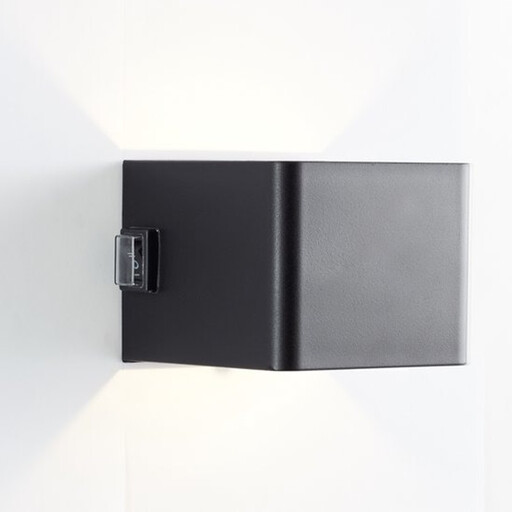
Why it suits this type of user: Magnetic mounting, USB-C charging and a built-in battery make this light a good choice for a balcony, patio or rented home where fixed wiring is less practical.
There’s no need to run a power cable. Bear in mind that you’ll need to recharge it regularly, and attach the magnetic mounting plate to a flat, sturdy surface.
300 lumens, 3000 K, IP44 rating, motion sensor and USB-C rechargeable battery, according to the product description.
We’ve put together a complete, up-to-date list of products that meet these strict selection criteria and the applicable European safety regulations.
Around 1.8 to 2.2 metres is often a practical height for a wall by the front door. The ideal height depends on the detection angle, the shape of the wall and the area you want to light. Adjust the sensor so it detects movement on the path without constantly picking up traffic or swaying branches.
It can, but charging performance depends on daylight, cloud cover, shade and the condition of the solar panel. Days are shorter and the sun is lower in winter. Position the panel somewhere as unobstructed as possible and clean it with a soft cloth. A light with several settings can help keep energy use down.
A solar wall light does not use mains electricity, but its battery still needs to charge sufficiently. A fixed LED outdoor light generally uses little electricity; consumption depends on its wattage and how often it switches on. So compare wattage, how long it stays on and the sensor settings, rather than looking only at the number of lumens.
