
Vandaag of morgen in huis

Kwaliteit gegarandeerd

Welkomstaanbiedingen ontgrendelen: GRATIS bezorging | Tot 80% korting | Gratis 30 dagen JoyPlus-proefperiode
Download de app
An outdoor wall light with a motion sensor provides light when someone walks past the façade, entrance or garden. This is practical when arriving home, on a balcony or next to a shed. However, not every model is suitable for the same location. A budget purchase can disappoint if the sensor responds incorrectly, the lamp does not provide enough light or the housing is not suited to outdoor conditions.
Many models have an IP44 rating. In practice, this means protection against solid objects and splashing water from different directions. An IP44 weather-resistant outdoor light is therefore suitable for general outdoor use, but it is not designed to stand in water or be exposed to direct jets of water for extended periods.
It is best to position an IP44 light under a small overhang or on a façade where rainwater can drain away easily. For an exposed location with lots of driving rain, a higher IP rating, such as IP65, may be the more sensible choice.
More lumens mean more light, but not automatically a better choice. For a front door or balcony, 180 to 500 lumens may be sufficient. A more powerful model may be preferable for a driveway or wide façade. Also consider:
A motion sensor is also different from a dusk or daylight sensor. The motion sensor responds to movement, while the dusk sensor determines whether it is dark enough to activate the light.
A wireless outdoor light with a rechargeable battery is easy to install, but it does need charging. A solar outdoor light with a motion sensor depends on direct sunlight. On a north-facing façade, beneath a balcony or behind dense vegetation, the battery may store less energy.
Therefore, check the following in advance:
There are three practical options:
An E27 or GU10 fitting allows you to choose your own bulb. With an integrated LED outdoor wall light, you get a fixed light colour and brightness. This is straightforward, but the LED module generally cannot be replaced by the user.
Aluminium and metal can provide a sturdy appearance, while plastic is often lighter and easier to install. With a magnetic model, check that the mounting plate is genuinely suitable for the wall. A magnet does not attach directly to every façade, and a smooth, clean surface is important.
For fixed 230 V models, the wall must be suitable for mounting and the cables must be connected in accordance with local regulations. Switch off the power before carrying out any work on the installation.
For a wall light for the garden, patio or balcony, warm light around 2700–3000 K is usually pleasant. For a passageway, garage or driveway, a higher light output may be more practical. A model with 4000 lumens is not necessary for a small entrance and may actually appear too harsh there.
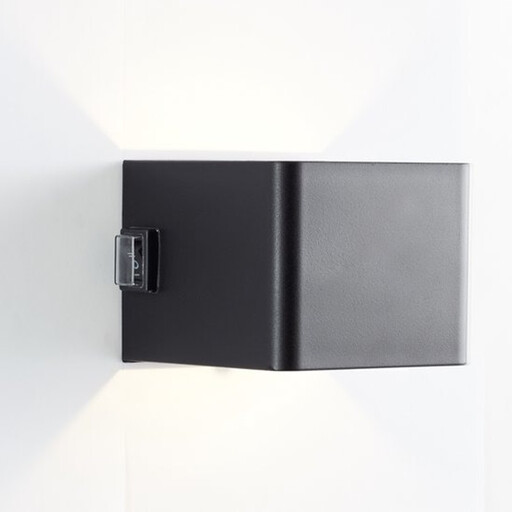
Why it suits this profile: This compact black model works wirelessly with a rechargeable battery and is suitable for a balcony, patio, hallway or smaller entrance.
The specifications state 300 lumens, 3000 K, a motion sensor and IP44. This makes it clear from the outset that it is practical accent lighting, rather than a powerful lamp for a large driveway.
Integrated 4W LED, magnetic mounting, battery and USB charging according to the product information.

Why it suits this profile: Ideal for a large façade, driveway or entrance where a strong beam and a higher protection rating are desirable.
The product details state 4000 lumens and IP65. This makes the difference compared with compact IP44 models easy to verify before choosing the light for a larger area.
Solar power, motion sensor, adjustable lamp head and a stated detection distance of up to 8 metres straight ahead and 16 metres to the sides.

Why it suits this profile: A practical choice for anyone who wants to illuminate a façade, garden path or entrance without wiring and has sufficient sunlight available.
The product information explicitly mentions solar power, two lighting modes, a motion sensor and IP44. However, positioning in direct sunlight remains essential for charging.
1000 lumens, warm white light at 3000 K, integrated LED and installation without a connection to the mains electricity supply.
We have put together a complete, up-to-date list of products that fully meet these strict selection criteria and the applicable European safety regulations.
Install the light according to the instructions and point the sensor towards the route people take. Positioning it too high or in a sheltered spot can limit the detection range. Also check that the light is securely attached and that the wall is suitable for the mounting hardware.
That depends on the amount of direct sunlight and the battery capacity. Short days, cloudy weather and shade can limit the operating time. Keep the solar panel clean and choose a location where it receives as much daylight as possible during the day.
An integrated LED light with a low wattage generally uses little electricity, but actual consumption depends on the number of hours it is switched on. A solar outdoor light does not use mains electricity. For a wired model, you can estimate consumption using: wattage × hours switched on ÷ 1000. Always check the stated wattage and energy label information before buying.
