
Vandaag of morgen in huis

Kwaliteit gegarandeerd

Welkomstaanbiedingen ontgrendelen: GRATIS bezorging | Tot 80% korting | Gratis 30 dagen JoyPlus-proefperiode
Download de app
An outdoor wall light with a motion sensor can instantly make an entrance, driveway, balcony or garage more practical. The light switches on when movement is detected, so you do not have to search for a switch in the dark. However, not every outdoor sensor light is suitable for the same location.
Marketing copy often focuses on a high lumen output, a wide detection range or “waterproof” properties. However, the details determine whether a light is genuinely suitable for everyday use. Pay particular attention to these three common pitfalls:
Light output is measured in lumens (lm). For a front door or balcony, around 180 to 500 lumens may be enough for orientation and ambience. A higher output is more suitable for a garage, long driveway or outdoor security light.
Colour temperature also affects the overall experience:
An LED outdoor wall light with an integrated light source generally uses little power. However, check whether the LED lamp can be replaced. Several models in this selection have an integrated light source that cannot be replaced by the user.
The IP rating indicates how well the housing protects against solid particles and moisture. An IP44 outdoor light is protected against splashing water and is suitable for many sheltered exterior walls, balconies and entrances. Do not install this type of light where it will be directly exposed to powerful water jets.
An IP65 solar outdoor light offers greater protection against dust and water jets. This makes it more suitable for an exposed exterior wall, garage or larger driveway. IP65 still does not mean that you can place the light underwater. Always check the installation instructions and the condition of the seals as well.
A motion sensor responds to movement within a specific range. The exact detection distance, activation time and angle of view vary from one product to another. A sensor aimed directly at a path may respond differently from one that needs to detect movement from the side.
Choose the power supply based on the installation location:
Also consider the supplied mounting materials, the weight and the surface you are mounting the light on. A light held in place only by a magnet should not be installed above a walkway if the mounting is not sufficiently secure.

Why it suits this profile: This compact black cordless outdoor light is suitable for a balcony, patio, hallway or sheltered entrance where you do not want to run a cable. The light runs on two 18650 batteries and can be recharged via USB.
The specifications clearly state 300 lumens, 4W, 3000K and IP44. This makes it immediately clear that it is mainly intended for orientation lighting, rather than for a large driveway or direct exposure to water jets.
300 lumens, warm 3000K light, motion sensor and magnetic mounting without fixed wiring.
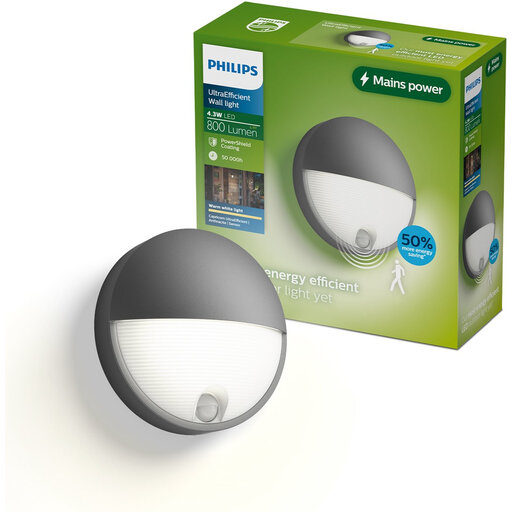
Why it suits this profile: This fixed aluminium wall light is suitable for an entrance, garden wall or balcony where a neat appearance and a permanent power connection are desired. According to the product information, this model provides 800 lumens and has an integrated dusk and motion sensor.
The light output, 2700K colour temperature and IP44 rating are listed separately. This allows you to weigh up the warm light and splash protection against the location where you want to install the light.
800 lumens, aluminium housing, integrated LED and a combination of motion and dusk sensors.
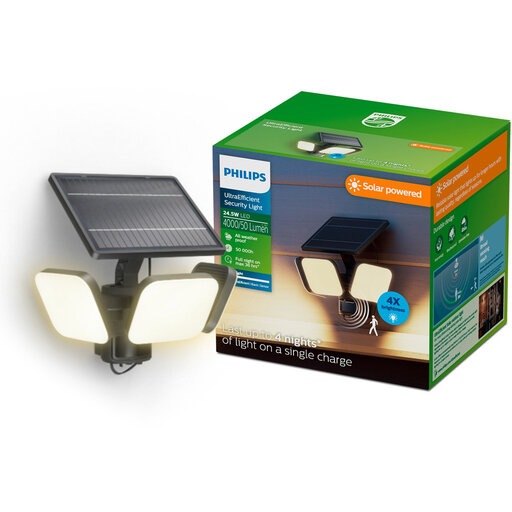
Why it suits this profile: For a spacious driveway, garage or exposed exterior wall, a powerful solar outdoor light with an adjustable head is more practical. According to Philips’ own product information, this model provides 4000 lumens and has a sensor range of 8 metres for direct approach and 16 metres for sideways movement.
The combination of a stated sensor range, adjustable light head and IP65 rating makes the practical limits clearer than a general claim about outdoor use alone.
4000 lumens, IP65, solar power, adjustable head and a stated motion detection range.
We have put together a complete, up-to-date list of products that fully meet these strict selection criteria and the applicable European safety regulations.
Install the light at a height where the sensor can clearly detect the intended path or driveway. Do not point the sensor directly at a busy road, moving branches or a heat source, as this may cause unwanted activation. With a solar wall light, the panel should receive as much direct sunlight as possible during the day.
Check the following before installation:
A fixed 230V wall light, such as a model with an E27 fitting, should be connected in accordance with the applicable installation regulations. Switch off the power before carrying out maintenance or installation.
An IP44 outdoor light is designed to protect against splashing water. This is sufficient for many sheltered exterior walls and entrances. The light must not be immersed and should not be exposed to powerful water jets for prolonged periods. For a completely exposed location, an IP65 solar outdoor light may be a suitable choice, provided that the other installation instructions are followed.
An LED light with a motion sensor only comes on when movement is detected, so it generally uses less electricity than a light that stays on all night. Solar versions do not use mains electricity, but they depend on sunlight and battery capacity. For mains-powered models, check the wattage; for rechargeable or solar lights, check the charging method and operating mode.
The lifespan varies according to the model and operating conditions. Some product descriptions, for example, state 10,000, 20,000 or 25,000 hours of operation. This is a stated product specification, not a guarantee of a particular service life. With an integrated LED, the light source is not intended to be replaced by the user.
