
Vandaag of morgen in huis

Kwaliteit gegarandeerd

Welkomstaanbiedingen ontgrendelen: GRATIS bezorging | Tot 80% korting | Gratis 30 dagen JoyPlus-proefperiode
Download de app
An outdoor wall light with a motion sensor can make your entrance, garage, façade, balcony or patio more practical. The light switches on when someone approaches, so you do not have to search for your keys in the dark. However, not every outdoor light with a sensor is suitable for every location.
A high light output, wide detection range or solar charging label does not tell you everything. You should also consider protection against moisture, the installation method and the conditions around your home. By comparing these points carefully, you can make a more informed choice and avoid being disappointed with the light after only a short time.
A powerful outdoor security light can be useful for a driveway or rear path, but it is not automatically comfortable next to a front door or on a small balcony. Bright light can cause glare or disturb your neighbours. A few hundred lumens may be enough for finding your way at an entrance, while a higher output makes more sense for a wide driveway.
Therefore, consider the combination of lumens, colour temperature and beam direction. Warm white light around 2700 to 3000 K creates a softer look for façade and garden lighting. At 5000 K, the light appears cooler and more direct, making it better suited to functional lighting.
An IP44 outdoor light is protected against solid objects larger than 1 millimetre and splashing water. This makes it suitable for many sheltered façades, balconies and entrances. IP44 does not mean that the light can withstand immersion or a powerful jet of water.
An IP65 outdoor light offers a higher level of protection against dust and water jets. This can be important on an exposed façade or in a location that is frequently affected by rain. Even an IP65 model should be installed according to the mounting instructions, and you should prevent water from remaining around the connections for long periods.
A solar outdoor wall light saves you from installing cables and does not use mains electricity for charging. However, the panel needs sufficient daylight. Shade from a canopy, tree or neighbouring façade reduces the amount of energy generated. During dark winter weeks, the operating time may therefore be shorter than in summer.
When choosing a wireless outdoor light, check where the panel will be mounted, how the battery is charged and whether the light can also be operated manually. Cleaning the panel regularly with a soft cloth helps remove dirt.
Pay attention to the distance, viewing angle and direction in which the sensor detects movement. Someone walking directly towards the sensor may be detected differently from someone passing sideways. Do not position the light directly opposite a busy road, moving branches or a heat source. This reduces the chance of the light switching on unnecessarily.
A dusk or darkness sensor is a useful addition. The light will then only react when it is dark enough outside. Also check whether you can choose between an automatic mode, a permanently-on mode or different lighting modes.
There are three practical options:
With a wired outdoor wall light, you should check the connection voltage, cable routing and whether it can be mounted on a stable surface. Switch off the electricity before installation or maintenance.
An integrated LED light source generally uses little energy and does not require a separate bulb. However, check whether the LED can be replaced. On many compact models, the light source cannot be replaced by the user.
A fitting such as E27 gives you more freedom to choose a suitable LED bulb yourself. For example, the Philips Nayl has an E27 fitting, a specified colour temperature of 2700 K and an IP44 rating. This model does not list a motion sensor in its specifications, so it is mainly of interest if you are looking for a conventional façade light.
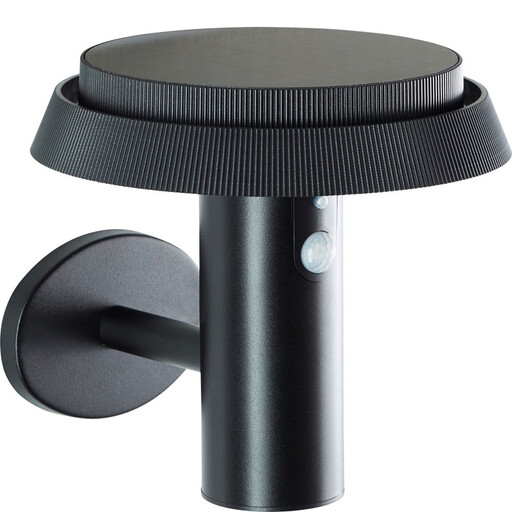
Why it suits this profile: This solar outdoor wall light is suitable for an entrance, garden path or patio where you do not want to install a power cable. The integrated battery and solar panel allow for low-voltage installation.
The specifications state 500 lumens, 3000 K and IP44. This shows that it is intended for warm orientation lighting, not for exposure to direct water jets.
Integrated LED, motion sensor, dimming function and a height of 21 cm. According to the product description, no mains wiring is required.
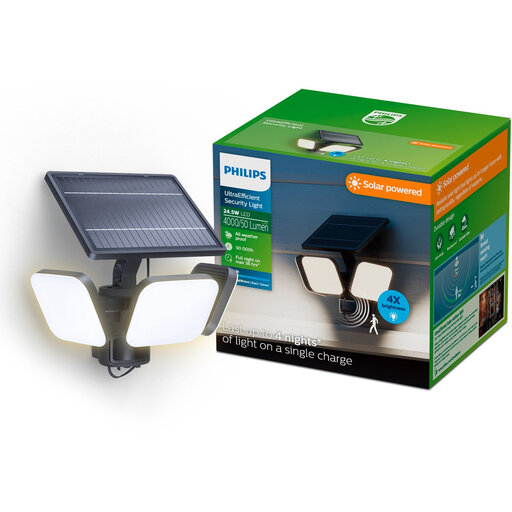
Why it suits this profile: This model is well suited to a driveway, rear garden or wide façade where a broad beam and greater protection against splashes and dust are desirable.
The product details state IP65, 4000 lumens and a detection range of 8 metres for direct approach and 16 metres for sideways approach. However, check that this powerful light output is suitable for your location.
Solar power, adjustable lamp head, two lighting modes and a stated battery life of up to four nights, according to Philips’ product description.

Why it suits this profile: This compact rechargeable light is useful for rented homes, storage areas, balconies and places where drilling or permanent wiring is not desirable.
The USB-C charging function makes the power source clear. IP44 indicates that the light is protected against splashing water, but is not intended for direct water jets.
Magnetic mounting, integrated battery, USB-C charging, 300 lumens and warm white light at 3000 K.
We have put together a complete, up-to-date list of products that fully meet these strict selection criteria and the applicable European safety regulations.
The correct height depends on the model and its detection range. A mounting position around eye level may make the sensor less reliable and make the light easier to reach. Therefore, follow the instructions and aim the sensor at the area where movement is expected.
A solar outdoor light does not use mains electricity for daily charging. The solar panel charges the internal battery. Performance depends on daylight, shade, temperature and the selected lighting mode. In winter, the light may need to be charged more often or have a shorter operating time.
The stated lifespan varies from product to product. The product details for different models may state, for example, 10,000, 20,000 or 25,000 operating hours. This is a manufacturer’s specification and not a guarantee of a particular service life in every outdoor environment. Also check whether the integrated LED and battery can be replaced.
