
Vandaag of morgen in huis

Kwaliteit gegarandeerd

Welkomstaanbiedingen ontgrendelen: GRATIS bezorging | Tot 80% korting | Gratis 30 dagen JoyPlus-proefperiode
Download de app
An outdoor wall light can make an entrance feel safer, create a more inviting atmosphere on your patio or make a dark shed easier to see. However, not every outdoor wall light is suitable for every location. A model that works perfectly under a covered area may be less suitable on a façade exposed to wind and rain.
So don’t just look at the colour and design. Check the light source, IP rating, installation requirements and controls too. That way, you can avoid finding yourself in need of an extra light, a new fitting or complicated wiring a few months later.
IP44 outdoor lighting is protected against solid objects larger than 1 millimetre and water splashes from different directions. That doesn’t mean the light is waterproof or suitable for direct water jets. It’s best to install an IP44 outdoor light under an eaves, canopy or in another sheltered spot.
A higher IP rating may be more suitable for a façade fully exposed to wind-driven rain. Always check the official product specifications and installation instructions.
With a fitting such as E27 or GU10, the light source is often not included. This gives you the freedom to choose the colour temperature and brightness, but it also means an extra purchase. Check the maximum wattage too. An outdoor light with an E27 fitting and a 60 W limit is different from a GU10 fitting with a maximum of 10 W.
With an LED outdoor wall light, the LED is often integrated. You won’t need to buy a separate bulb, but you usually won’t be able to replace the light source yourself.
A solar outdoor light needs plenty of direct daylight to charge its battery during the day. A wall beneath a deep overhang, balcony or dense tree canopy can limit how long it stays lit. So check the position of the solar panel and the cable or mounting options in advance.
An outdoor light with a motion sensor is handy by an entrance, garden path or shed, but check the detection angle and recommended mounting height. A sensor aimed at a busy pavement may switch on more often than intended.
The first two numbers or letters after “IP” indicate how well the casing is protected. IP44 is a common specification for many sheltered patios, balconies and entrances. The light must still be installed and sealed correctly. On some fittings, the IP protection is only maintained if the fitting, cover and seal are correctly positioned.
Don’t use an IP44 light as a substitute for lighting that may be submerged or cleaned directly with a high-pressure jet.
Claims about lifespan or energy savings are specific to the brand or product. For example, Philips states that certain models have a lifespan of up to 50,000 hours. This is the manufacturer’s figure, not a guarantee for every use.
A wired 230 V outdoor wall light must be connected by a qualified electrician in accordance with the product specifications. Switch off the power before installation or maintenance, and follow local installation regulations.
Solar and rechargeable models don’t need a permanent mains connection. However, check how often the battery needs charging, where the panel can be positioned and whether the light will stay on for long enough when there’s little sunlight.
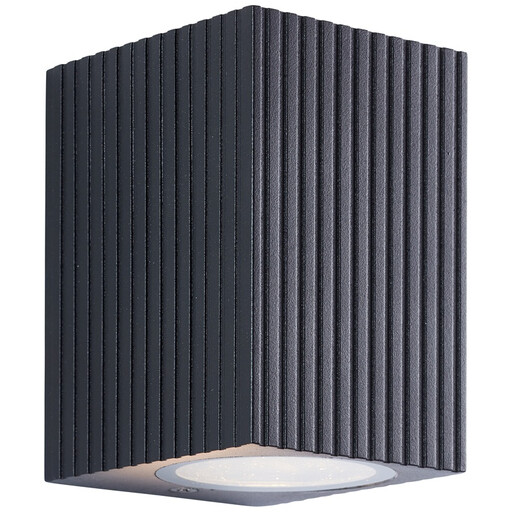
Why it suits this profile: This compact model is a good fit for a small entrance, balcony or covered patio where you want a subtle black outdoor light. The GU10 fitting lets you choose a suitable LED bulb.
The product specifications clearly state that the light source is not included and that the maximum permitted wattage is 10 W. This means you can choose a suitable GU10 LED in advance.
Aluminium construction, compact dimensions of around 10 × 6.9 × 7.8 cm and IP44 protection for sheltered outdoor locations.
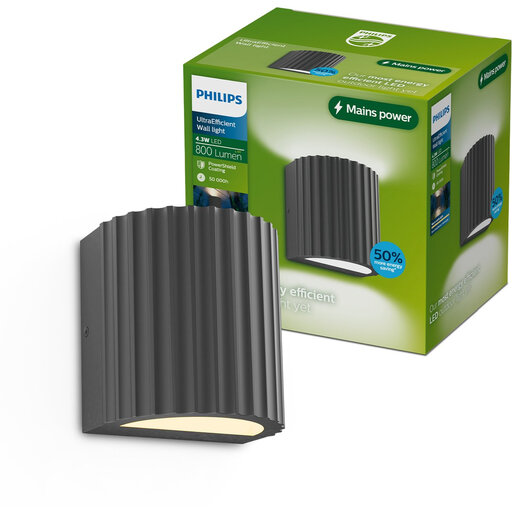
Why it suits this profile: The integrated LED and two-way light distribution make this a good choice for a modern façade or patio when you want a finished fitting with warm light.
The light source is integrated, so you won’t accidentally buy the wrong fitting or a separate bulb that’s too powerful. The IP44 rating also makes the placement limits clear: splash-resistant doesn’t mean waterproof.
800 lm, 2700 K, 4.3 W, aluminium and plastic, with light directed in two directions.

Why it suits this profile: This model is designed for an entrance, garden path or shed without access to mains power. The sensor and two lighting modes make it suitable for different needs.
No fixed wiring is needed, but the light still needs to be positioned where the solar panel gets enough daylight. The IP44 rating means it should be kept away from direct water and water jets.
1000 lm, 3000 K, integrated LED, motion sensor, dusk sensor and two operating modes.
We’ve put together a complete, up-to-date selection of products that meet these strict criteria and the applicable European safety regulations.
A fixed outdoor wall light should be attached to a stable surface. If it connects to a 230 V supply, it must be installed by a qualified electrician. Check that the cable entry and seals are correctly positioned to maintain the stated IP protection.
Clean the light with a soft, dry cloth. Don’t use harsh cleaning products or direct a garden hose or pressure washer at the fitting. Keep the panel on a solar light free of dirt and leaves. Rechargeable models need regular charging to keep the motion sensor working.
IP44 is often a practical specification for a sheltered entrance, balcony or covered area. A higher level of protection may be preferable for fully exposed locations. Consider the exact installation spot and follow the manufacturer’s instructions.
Around 180 to 400 lumens may be enough for atmospheric patio lighting. For an entrance, shed or practical garden path lighting, 800 to 1,000 lumens is a better choice. The brightness you need also depends on the mounting height, direction of the beam and distance from the surface you want to light.
A low-wattage wired LED light generally uses less electricity than a traditional higher-wattage bulb. Consumption depends on the power rating and how many hours the light is on. A solar outdoor light doesn’t use mains electricity, but its performance depends on sunlight, battery capacity and how often the sensor activates the light.
