
Vandaag of morgen in huis

Kwaliteit gegarandeerd

Welkomstaanbiedingen ontgrendelen: GRATIS bezorging | Tot 80% korting | Gratis 30 dagen JoyPlus-proefperiode
Download de app
An outdoor wall light can make an entrance, balcony, patio or garden path much clearer to see. Yet it’s easy to buy a model that disappoints in practice. A high light output, for example, doesn’t automatically mean the light is pleasant for everyday use. Similarly, a solar outdoor light won’t work equally well on every wall.
So pay particular attention to the conditions around where you’ll mount it. Does the solar panel get enough direct light? Is there a power point nearby? Do you mainly need mood lighting, or do you want to briefly illuminate a dark driveway when movement is detected? Asking these questions will help you avoid a bad purchase.
Lumens indicate how much light a lamp emits according to the product specification. A model with 4,000 lumens isn’t automatically suitable for a small front door. Bright light there can be annoying for residents or neighbours. For ambience on a balcony, warm light around 2700 K is often softer; for a functional entrance, 3000 to 4000 K can be more practical.
A weather-resistant outdoor light with IP44 is protected against solid objects larger than 1 millimetre and splashing water from any direction. That doesn’t mean the light can withstand a direct water jet or be submerged. For an open façade or a spot exposed to heavy driving rain, a higher protection rating such as IP65 may be more suitable. Also check whether the mounting location is sheltered.
A light without wiring is convenient, but the battery needs to charge during the day. Trees, an overhang, a north-facing wall and nearby buildings can limit the output. According to product information from various brands, the burn time can therefore depend on the amount of sunlight and the charge level. So don’t position the panel based on looks alone.
Also consider the direction of the light. A light with uplight and downlight creates a decorative effect, while an adjustable head directs the light more precisely towards a path or driveway.
A motion sensor outdoor light switches on when movement is detected. Check the detection angle and range. The Brilliant Magua, for example, states a detection angle of 120 degrees. According to the product information, the Philips Zyren has a range of 8 metres for direct approach and 16 metres for sideways movement.
A dusk sensor turns the light on when it gets dark. Some models combine both functions: the light stays dimmed or off and brightens as soon as someone approaches. This can save energy, but check how long the light stays on before switching off again.
A fixed LED outdoor wall light on 230 V usually needs to be connected to the mains. Have any work on the fixed wiring carried out in line with local safety regulations, if necessary by a qualified electrician.
A solar outdoor light or rechargeable wall light is easier to install, but has other points to consider:
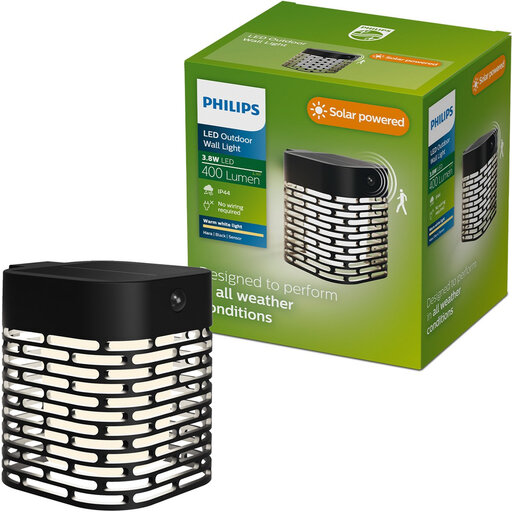
Why it fits this profile: This compact solar outdoor light works without a mains connection and offers 400 lumens, warm white light at 2700 K and two light modes. That makes it straightforward for a first purchase for a balcony, garden or entrance.
The product specification clearly states that no wiring is needed. IP44 makes the light suitable for splashing water, but not for direct water jets.
Solar powered, 400 lumens, 2700 K and a compact size of around 13 cm high.
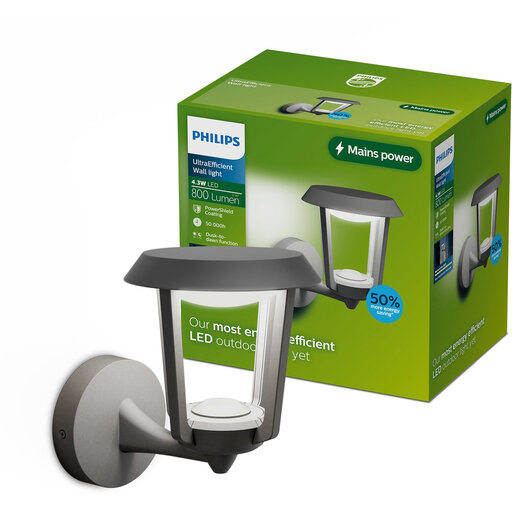
Why it fits this profile: The Nuvy combines an aluminium housing, anthracite colour and integrated LED. According to the product information, it delivers 800 lumens at 2700 K and features a dusk sensor.
The light colour and light output are clearly stated. The IP44 rating makes it clear this is splash-proof protection, not waterproof placement.
800 lumens, integrated LED, 230 V and a stated lifespan of 50,000 burning hours according to the product information.
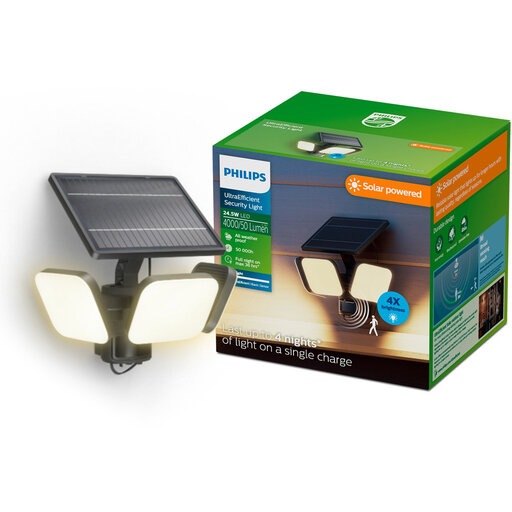
Why it fits this profile: For a driveway, wide façade or dark passageway, a high light output can be useful. The product information states 4,000 lumens, IP65, an adjustable head and a motion sensor.
The higher IP rating can be verified in the product specifications. Installation still requires a sturdy fixing and sufficient light on the solar panel.
IP65, adjustable light head, solar powered and a stated sensor range of 8 metres for direct approach and 16 metres sideways.

Why it fits this profile: This portable model uses a magnetic fixing, USB-C charging and an integrated motion sensor. That makes it usable on a balcony, patio or other spot where you don’t want to install fixed wiring.
The battery is rechargeable and the light is removable. IP44 does mean you need to protect it from splashing water and not expose it to direct water jets.
300 lumens, 3000 K, magnetic mounting and USB-C charging. The product specification mentions two 18650 batteries.
We’ve put together a full, up-to-date list of products that fully meet these strict selection criteria and comply with current European safety regulations.
For ambience and orientation, around 180 to 500 lumens is often enough. For an entrance or façade, 800 lumens can be more practical. A powerful model with 4,000 lumens is mainly suitable for a wide or dark area. Alongside lumens, also consider the light beam and the distance to windows or neighbours.
That depends on the placement. A solar panel needs enough direct light during the day. In winter or during prolonged cloud cover, the available burn time may be lower. Choose a spot without shade and clean the panel regularly. For lighting that must always be available, a fixed LED outdoor wall light on mains power is more reliable.
The lifespan varies by product. Some models state, for example, 25,000, 20,000 or 50,000 burning hours. These are stated product specifications from the manufacturer and not a guarantee of actual use. Also pay attention to the battery on solar and rechargeable lights. With an integrated LED, the whole light usually needs to be replaced when the light source reaches the end of its life.
