
Vandaag of morgen in huis

Kwaliteit gegarandeerd

Welkomstaanbiedingen ontgrendelen: GRATIS bezorging | Tot 80% korting | Gratis 30 dagen JoyPlus-proefperiode
Download de app
An outdoor wall light can make an entrance easier to see, create a more pleasant atmosphere on a patio or highlight a façade. However, not every light is suitable for every location. A model that works well under a canopy may be more exposed to rain and wind on an open façade. The wrong fitting, a small battery or a sensor with an unsuitable detection angle can also lead to disappointment.
So don’t focus only on colour and design. The key differences lie in power supply, ingress protection, light source, installation and intended use.
An IP44 outdoor light is protected against solid objects larger than 1 millimetre and water splashes from various directions. This doesn’t mean it can withstand a direct jet of water, immersion or prolonged exposure to extreme weather.
IP44 is generally suitable for a sheltered entrance, balcony, veranda or covered patio. For a fully exposed façade, take extra care to check the installation location, seals and manufacturer’s instructions.
A solar outdoor light with a sensor doesn’t need a fixed power connection, but its solar panel needs to receive enough daylight. A north-facing wall, a spot under a balcony or shade from trees can limit charging time. The light may also stay on for less time during the darker winter months.
So check the position of the panel and choose between continuous mode, sensor mode or a combination of the two. According to information from Philips, the Fyns and Swyn models include features such as an automatic mode and a motion sensor. Actual run time depends on the position, weather conditions and usage.
An E27 or GU10 outdoor light is often a fitting without a bulb. This gives you the freedom to choose the colour temperature and brightness, but it also means you’ll need to buy a suitable light source separately.
Check the maximum wattage. The Brilliant Newport has an E27 fitting with a maximum rating of 60 W. The compact Brilliant Jelani and Keola have a GU10 fitting with a maximum rating of 10 W, according to the product specifications. A fitting is not the same as a complete LED bulb.
Choose the level of protection to suit the location:
So always check the specific IP rating when considering the term weather-resistant wall light. Marketing language is less useful than a verifiable technical specification.
A 230 V mains-powered wall light generally provides a constant light source and doesn’t need charging. However, if it requires fixed wiring, installation and connection must be carried out by a qualified electrician.
Solar lighting is more flexible to position, as there’s no need to run a power cable to the wall. However, it depends on sunlight. A rechargeable wall light with a USB connection is somewhere in between: it doesn’t need fixed wiring, but you will need to charge the battery regularly.
An LED outdoor wall light with an integrated light source is ready to use straight away, but the LED often can’t be replaced by the user. With an E27 or GU10 fitting, you can choose your own LED bulb. Check the following:
A warm colour often works well on a patio or by the front door. Downward-facing light is practical along a path or beside a house number.

Why it suits this need: A wireless solar outdoor light with a sensor, ideal for a balcony, garden path or sheltered entrance where you don’t want to run a cable.
The product information lists two lighting modes, an integrated motion sensor and IP44 protection. It still needs to be installed somewhere with enough daylight.
400 lumens, integrated LED, solar-powered and no fixed wiring required.
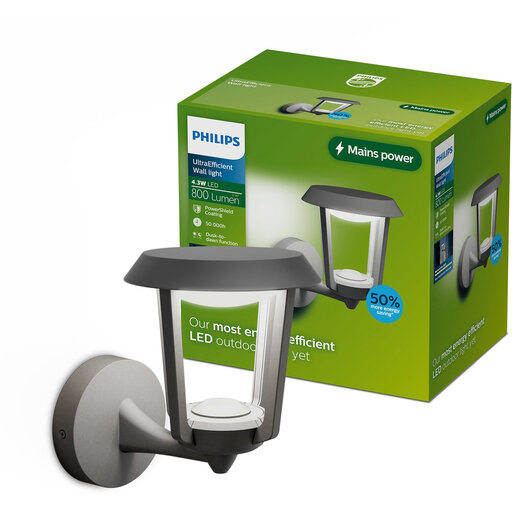
Why it suits this need: A fixed LED wall light for anyone who values a neat appearance and automatic operation by the garden, balcony or entrance.
The specifications list an integrated dusk sensor and IP44 protection. The light is designed to be connected to 230 V, so it must be installed appropriately.
800 lumens, 2700 K warm white light, integrated LED and aluminium housing, according to the product description.

Why it suits this need: For anyone looking for a bright outdoor light with a motion sensor by an entrance, shed or passageway without a mains connection.
The model has a dusk sensor, motion sensor and two lighting modes. The position of the solar panel remains key to the amount of energy available.
1000 lumens, 3000 K warm white light, integrated LED and IP44 protection, according to the product details.
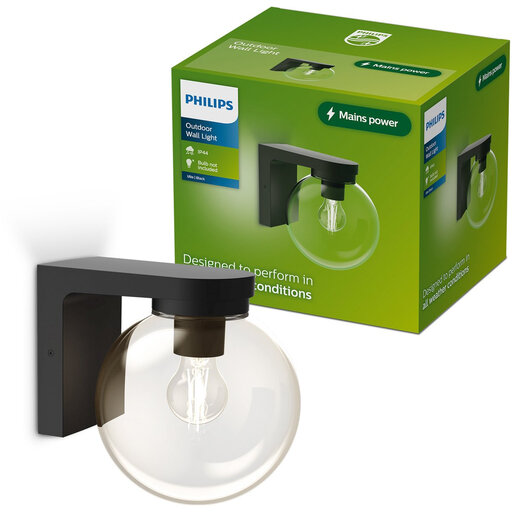
Why it suits this need: For anyone who wants to pair a black E27 outdoor light with different LED bulbs and light colours.
The fitting type and the fact that no light source is included are clearly stated. This lets you choose the lumens, colour temperature and dimmability yourself.
E27 fitting, aluminium and glass, IP44 protection and diffused light distribution, according to the product description.
We’ve put together a complete, up-to-date list of products that meet these strict selection criteria and the applicable European safety regulations.
For a sheltered location, IP44 is often a practical choice. The light is protected against water splashes, but not direct water jets or immersion. A higher level of protection may be more suitable for a fully exposed façade. Always check the installation instructions and the seals on the specific model.
A solar outdoor light doesn’t use electricity from the mains during normal operation. Its battery charges during the day via the solar panel. Light output and run time depend on sunlight, the season, panel position, battery capacity and how often the sensor is activated.
Lifespan varies by model and operating conditions. Integrated LEDs are often not designed to be replaced by the user. Manufacturers may state an expected lifespan; according to information from Philips, some models are listed as having a long LED lifespan. Treat this as a product specification and also check the warranty, installation requirements and maintenance instructions.
