
Vandaag of morgen in huis

Kwaliteit gegarandeerd

Welkomstaanbiedingen ontgrendelen: GRATIS bezorging | Tot 80% korting | Gratis 30 dagen JoyPlus-proefperiode
Download de app
An outdoor wall light can make an entrance safer, create a more pleasant atmosphere on your patio or add kerb appeal to your home. However, not every outdoor wall light is suitable for every location. A light may look sturdy in a product photo, but in practice it might not provide enough light, respond awkwardly to movement or be inadequately protected against rain.
So look out for these three common pitfalls:
IP44 outdoor lighting can be suitable for a covered balcony, a sheltered veranda or a wall beneath a canopy. The light is protected against splashing water, but it isn’t designed to be sprayed directly with a garden hose or pressure washer.
Also check that the wall light is installed correctly. For fixed 230V models, installation by a qualified electrician is advisable and may be required by local regulations. Switch off the power before installation or maintenance.
The number of lumens gives you an indication of a light’s output. For ambient lighting on a patio, a lower output may be enough. For an entrance, garage or garden path, a brighter light is more practical.
An integrated LED outdoor light doesn’t need a separate bulb. With models that use a GU10 or E27 fitting, you can choose the light source yourself and replace it later. Check whether the light is dimmable and whether you’ll need to buy a dimmer separately.
An outdoor wall light with a sensor can switch on automatically when it detects movement. A dusk sensor switches the light on when the ambient light level is low. Some models combine both features.
A solar-powered outdoor light is useful if there’s no power supply nearby. However, its performance depends on the position of the panel, the amount of direct daylight and the battery capacity. Charging may be limited on a north-facing wall or beneath a deep canopy. So don’t just look for the word ‘solar’: check the lumens, battery type and operating mode too.
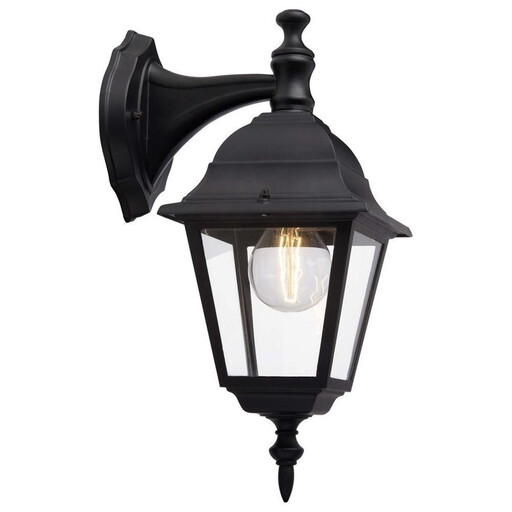
Why it suits this type of buyer: This black outdoor light has an E27 fitting, so you can choose a suitable LED bulb yourself. That lets you tailor the light colour and energy use to your budget.
The product information clearly states that the bulb isn’t included. It also specifies the maximum power of 60 W, so you can avoid overloading the fitting.
E27 fitting, black metal design and IP44 protection. It can be dimmed with a suitable dimmable bulb and dimmer.
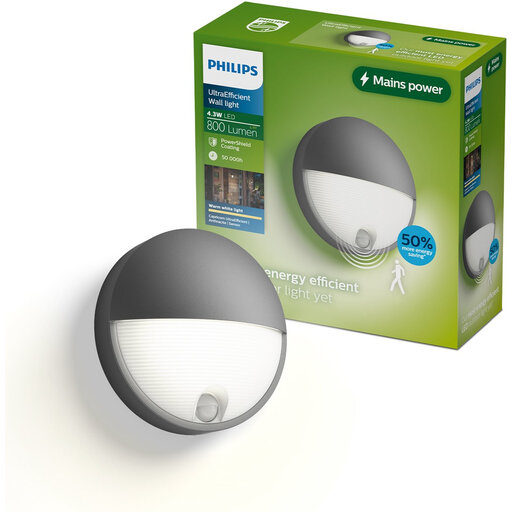
Why it suits this type of buyer: The integrated LED, motion sensor and dusk sensor make this a good choice for an entrance where you want automatic lighting without a separate bulb or switch.
The specifications list both the IP44 rating and the 4,3 W power consumption. This makes it clear upfront that the light offers splash protection and has an integrated LED, rather than a replaceable bulb.
800 lumens, 2700K warm white light, integrated LED and sensors. The housing is made of aluminium and finished in anthracite.

Why it suits this type of buyer: This solar-powered outdoor light is ideal for places without an existing power supply, such as a garden shed, balcony or garden path where running cables would be difficult.
The product information specifies the solar power supply, a built-in battery, two lighting modes and an IP44 rating. It’s still important to position the light where it will receive enough direct daylight.
1000 lumens, 3000K warm white light, motion sensor and dusk sensor. No connection to the mains is needed.
We’ve put together a complete, up-to-date list of products that meet these strict selection criteria and the applicable European safety regulations.
IP44 is often a practical rating for a sheltered exterior wall, balcony or patio. The light is protected against splashing water, but not against immersion, direct jets of water or prolonged exposure to harsh conditions. Install the light according to the instructions and check that the seals are fitted properly.
Energy use depends on the wattage and how long the light is on. A 4,3 W light switched on for a few hours each day uses considerably less energy than a traditional fitting with a much higher wattage. A motion or dusk sensor can reduce the time the light stays on. A solar-powered outdoor light isn’t connected directly to the mains, but its battery still needs to charge sufficiently.
Lifespan varies depending on the light source, housing, battery and exposure to the weather. Manufacturers may state an expected lifespan; according to Philips, some of its integrated LED models last up to 50.000 hours. This is a claim made by the brand, not a guarantee for every use case. With replaceable E27 or GU10 bulbs, you can replace the light source later without having to replace the entire fitting.
