
Vandaag of morgen in huis

Kwaliteit gegarandeerd

Welkomstaanbiedingen ontgrendelen: GRATIS bezorging | Tot 80% korting | Gratis 30 dagen JoyPlus-proefperiode
Download de app
An outdoor wall light can make an entrance feel safer, create a more inviting balcony or add character to a façade. However, models vary considerably in how they’re installed, their light source, power supply and protection against moisture. A light that looks suitable for any outdoor space in the product photo won’t necessarily be right for an exposed façade or a sunny garden wall.
So, watch out for these three common pitfalls:
A weather-resistant wall light has an IP rating. For the popular IP44 wall light, the first 4 indicates protection against solid particles larger than 1 mm. The second 4 means protection against water splashes from different directions.
IP44 is a practical choice for a sheltered façade, balcony, patio or entrance. Ideally, position the light so rainwater won’t sit in the fitting or housing for long periods. For a fully exposed location, a higher IP rating may be more suitable; always check the official product specifications.
An integrated LED is ready to use straight away and doesn’t need a separate bulb. Check the stated lumen output and colour temperature:
With a replaceable bulb, a wall light with an E27 fitting gives you more choice of wattage, colour and dimming options. A wall light with a GU10 fitting is handy if you want to choose a spotlight with a specific beam angle. Always check the maximum wattage and whether the light is supplied without a bulb.
A fixed 230V connection generally provides consistent brightness, but installation requires an electrical connection. Ensure work on mains electricity is carried out in accordance with the relevant regulations, and switch off the power during installation.
An outdoor solar wall light doesn’t need a mains cable. That’s handy for a garden path, shed or any location where running cables is difficult. Don’t just look at the lumen output: also consider the position of the solar panel, battery capacity and selected lighting mode. A motion sensor can extend the run time by preventing the light from staying on at full brightness continuously.
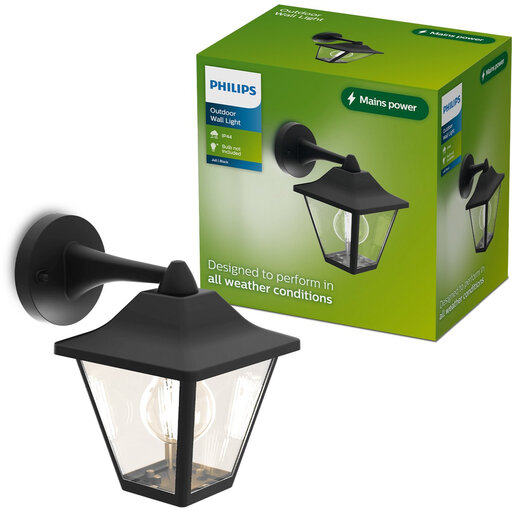
Why it suits this type of buyer: This classic black outdoor light takes a separate E27 LED bulb, so you can choose the colour and brightness to suit an entrance, balcony or sheltered façade.
The product information clearly states that the E27 bulb isn’t included. Its IP44 rating makes it suitable for outdoor use where protection against splashing water is needed.
E27 fitting, black aluminium, IP44 and dimensions of approximately 15 × 21,7 × 22,2 cm.
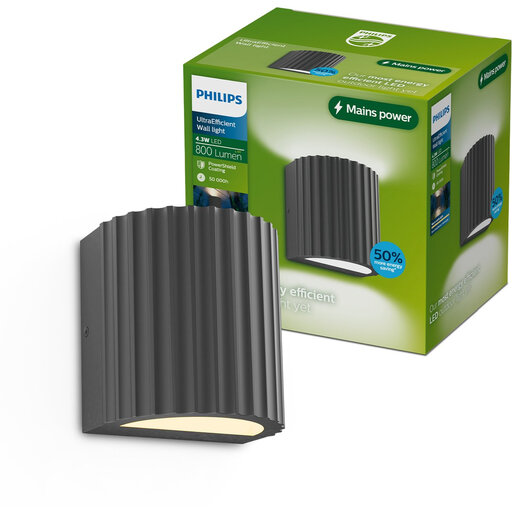
Why it suits this type of buyer: The integrated LED and light directed both upwards and downwards suit a modern façade where you want consistent, warm lighting without having to choose a separate bulb.
There’s no need to choose a separate fitting or check bulb compatibility. The product information states that the light has an integrated LED and IP44 protection.
800 lumens, 2700K warm white, 4,3 W, integrated LED and light directed upwards and downwards.

Why it suits this type of buyer: For a garden, shed or façade without a suitable power connection, this solar outdoor wall light offers a wireless solution with a motion sensor.
It doesn’t rely on a mains cable, but it still needs to be positioned where it will receive enough direct sunlight. The product information lists two lighting modes and an integrated dusk and motion sensor.
1000 lumens, 3000K, integrated LED, IP44 and installation without a mains connection.
We’ve put together a complete, up-to-date list of products that meet these strict selection criteria and the applicable European safety regulations.
For many sheltered outdoor locations, yes. An IP44 wall light is protected against water splashes, but not against submersion or direct jets of water. Also check that the seal is fitted correctly. IP protection only applies when the fitting is installed according to the instructions.
Energy consumption depends on the wattage and how long the light is on. A 4,3 W model used for a few hours each day uses less energy than a traditional bulb with a higher wattage. An outdoor solar wall light doesn’t use mains electricity, but its performance depends on sunlight, the battery and the lighting mode.
Install the light by an entrance, garage, shed or garden path, somewhere the sensor can detect movement without constantly picking up passing traffic. Check the recommended installation height and make sure the sensor isn’t pointing directly at a bright light source or busy road. When comparing options, also look for terms such as outdoor light for balconies and façades, so the size and protection rating are right for the location.
