
Vandaag of morgen in huis

Kwaliteit gegarandeerd

Welkomstaanbiedingen ontgrendelen: GRATIS bezorging | Tot 80% korting | Gratis 30 dagen JoyPlus-proefperiode
Download de app
An outdoor wall light can make an entrance feel safer, keep your patio usable in the evening and add character to your home’s exterior. But the difference between a suitable outdoor wall-mounted light and a poor buy may not become clear until a few weeks later. For example, a light may not be bright enough, may be poorly positioned or may not be adequately protected from rain.
So don’t focus only on the shape or colour. Pay particular attention to the light source, IP rating, power supply and installation requirements.
An IP44 wall light is protected against splashing water from different directions. That doesn’t mean it can withstand a direct jet of water or prolonged exposure to heavy rain. Products with IP44 are generally suitable for a sheltered exterior wall, balcony, veranda or covered patio.
For an exposed wall, a higher protection rating, such as IP65, may be more practical. Always check the installation instructions too. A suitable IP rating won’t provide full protection if the housing is fitted incorrectly or becomes damaged.
A higher lumen figure means more light, but not necessarily more comfortable lighting. A powerful light can cause glare if it’s mounted at eye level. For a front door or patio, warm white light around 2700 to 3000 K is often more relaxing than a very cool light.
Consider the light distribution too. A downlight directs light downwards, while a lantern-style light often spreads it more widely. For a driveway or large garden, a wider beam may be more useful than a compact decorative light.
A fixed 230 V outdoor light will generally need to be connected by a qualified electrician. This applies, for example, to an E27 or GU10 fitting connected to the mains. Check in advance whether there is existing wiring and whether the wall is suitable for mounting.
Many fittings don’t include a bulb. An E27 outdoor bulb or GU10 outdoor bulb gives you more choice, but comes at an extra cost. An integrated LED outdoor light is easier to use, but its light source is usually not designed to be replaced by the user.
The IP code consists of two digits. The first relates to protection against solid objects, and the second to protection against water. For IP44, the second digit means the light is protected against splashing water. IP65 offers greater protection against water jets and provides a more dust-tight housing.
It’s best to use IP44 in a sheltered location. For an exposed wall, garage or garden wall where rain falls directly on the light, consider a model with a higher IP rating.
A solar outdoor wall light works without a connection to the mains. Its solar panel needs enough direct daylight during the day, so don’t install the light beneath a deep canopy or on a north-facing wall with little extra light.
A solar light is handy for rented homes, sheds, garden paths and places without existing wiring. Bear in mind that it may stay lit for less time on dark winter days. A light with an integrated battery, motion sensor and several modes can help limit energy use.
A fixed LED light does need wiring, but it generally provides a more consistent light output. An LED outdoor wall light with 800 to 1000 lumens is a good choice when practical lighting matters more than ambience alone.
An outdoor light with a motion sensor switches on when it detects movement. Check the detection angle, range and whether you can adjust how long it stays on. A sensor is particularly useful by a front door, garage or driveway.
With a separate bulb, you can choose the light colour and brightness. An E27 fitting works with many common bulbs, while GU10 is often used for compact spotlights. Always check the fitting’s maximum wattage.
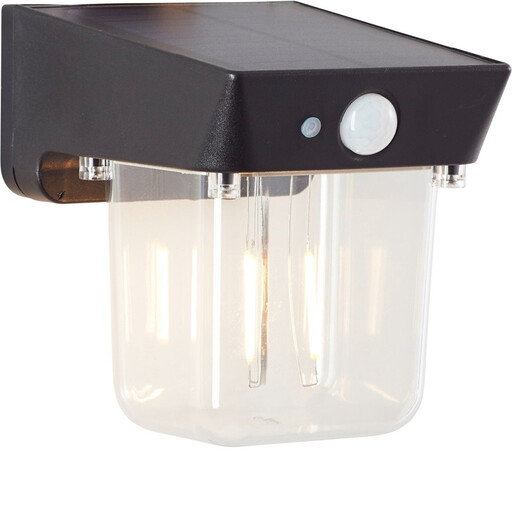
Why it suits this type of buyer: This compact solar outdoor wall light works without fixed wiring and combines integrated LED lighting with a motion sensor. It’s a good fit for an entrance, shed or balcony where you need extra light quickly.
The product specifications clearly state that it has an integrated battery, solar panel, motion sensor and IP44 protection. Bear in mind, though, that its light output is limited to 180 lumens.
Solar-powered, integrated LED, 2700 K warm white light, motion sensor and compact dimensions of 11,5 × 10 × 11 cm.

Why it suits this type of buyer: According to the product specifications, this light offers 1000 lumens, 3000 K warm white light, two modes and a built-in dusk and motion sensor.
The lumen output, colour temperature and IP44 rating are clearly specified. This light isn’t designed to be fully waterproof, so it’s still important to install it on a suitable exterior wall.
1000 lumens, solar-powered, motion sensor, choice of Auto and On modes, and dimensions of 18,6 × 11,5 × 12,5 cm.

Why it suits this type of buyer: The three adjustable heads, wide light coverage and motion detection are designed for driveways, garages, gardens and larger outdoor spaces.
The listing specifies 3000 lumens, IP65, a 180-degree detection angle and three lighting modes. This means you can check the key performance details before buying.
302 LEDs, 3000 lumens, IP65 rating, three adjustable light heads and installation without a connection to the mains.
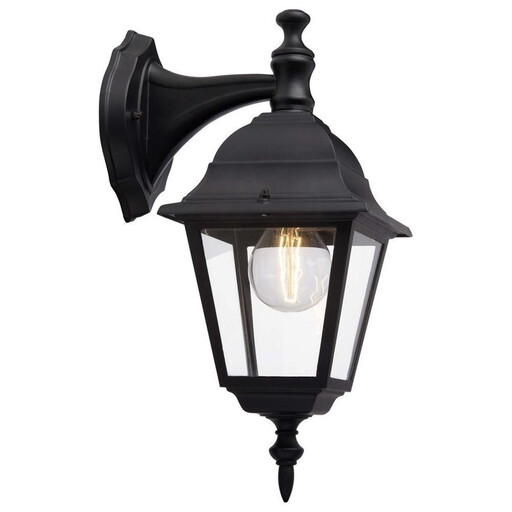
Why it suits this type of buyer: Its classic black design with glass suits an entrance, veranda or patio where appearance and choice of light source matter.
The E27 fitting and maximum 60 W output are specified. The light is supplied without a bulb and, according to the product information, has an IP44 rating for sheltered outdoor locations.
E27 fitting, black metal and glass, compatible with your choice of bulb, and dimmable when used with a suitable bulb and dimmer.
We’ve put together a complete, up-to-date list of products that meet these strict selection criteria and comply with current European safety regulations.
IP44 is suitable for splashing water and is often a good fit for a sheltered exterior wall, balcony or veranda. This rating doesn’t mean the light is waterproof. For a fully exposed location, IP65 may be a more suitable starting point. Always follow the installation instructions for the product in question.
A lower light output may be enough for a front door or small patio. You’ll need more light for practical illumination of a driveway or large garden area. As well as lumens, consider the beam, mounting height and colour temperature. For example, a 3000-lumen light may be unnecessarily bright by a small entrance.
A solar-powered light doesn’t use electricity from the mains. How long it stays lit depends on the amount of daylight, battery capacity and sensor use. In winter or on a shaded wall, it may stay lit for less time. So don’t just look for the word ‘solar’: check the battery, lighting modes and installation requirements too.
