
Vandaag of morgen in huis

Kwaliteit gegarandeerd

Welkomstaanbiedingen ontgrendelen: GRATIS bezorging | Tot 80% korting | Gratis 30 dagen JoyPlus-proefperiode
Download de app
An outdoor wall light can make an entrance, balcony, patio or exterior wall much more useful after dark. But good looks aren’t everything. A light that’s poorly positioned, doesn’t provide enough illumination or isn’t suitable for exposure to rain can quickly disappoint.
The most common mistakes when buying are:
For many sheltered exterior walls, balconies and covered entrances, an IP44 outdoor light is a practical choice. It can withstand splashing water from different directions, but don’t fit it somewhere rainwater collects or where it could be hit by a high-pressure jet.
Also consider where you’ll install it. A wall beneath an overhang is less exposed than a completely unprotected wall. If you need more protection, compare the specifications of models with a higher IP rating. Always check that the product information and installation instructions are suitable for your situation.
An integrated LED is ready to use straight away, with no separate bulb required. For example, the Philips Capricorn Wall Light has an integrated LED rated at 800 lumens and 4.3 watts, with a warm white colour temperature of 2700 K. It’s a good fit for an entrance or patio where you want a soft, even light.
With an E27 or GU10 fitting, you have more flexibility. You can choose the colour temperature, brightness and, if required, whether the bulb is dimmable. Just check:
A warm colour temperature of around 2700 to 3000 K usually creates a relaxed feel. For practical exterior lighting, a higher brightness can be useful, while accent lighting needs fewer lumens.
An outdoor wall light connected to mains power will generally provide consistent operation, but it requires fixed wiring. A light with a motion sensor can switch on only when movement is detected. A dusk sensor, on the other hand, switches the light on according to the ambient light level.
A solar outdoor light works without a connection to the mains. This makes installation easier, but the solar panel needs enough direct daylight. Also consider the battery, brightness and available lighting modes. A solar light isn’t automatically suitable for staying on all night.
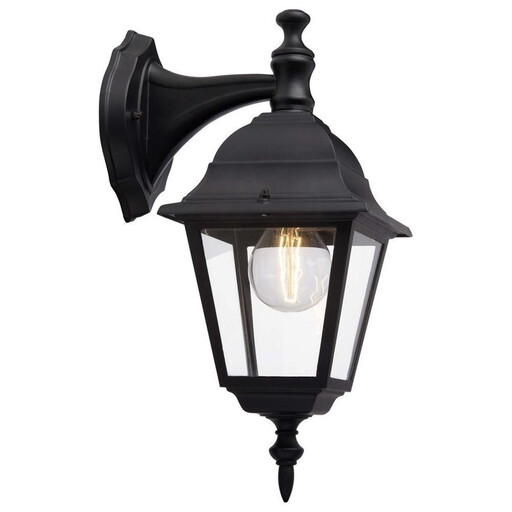
Why it suits this shopper: This model has a classic black housing, an E27 fitting and a maximum load of 60 watts. You can choose a suitable LED bulb yourself and build your purchase up step by step.
The product information clearly states that the light is supplied without a bulb. This means you can factor in the extra cost of an E27 LED bulb before buying.
E27 fitting, classic design, IP44 rating and external dimming when used with a suitable dimmable bulb and dimmer.
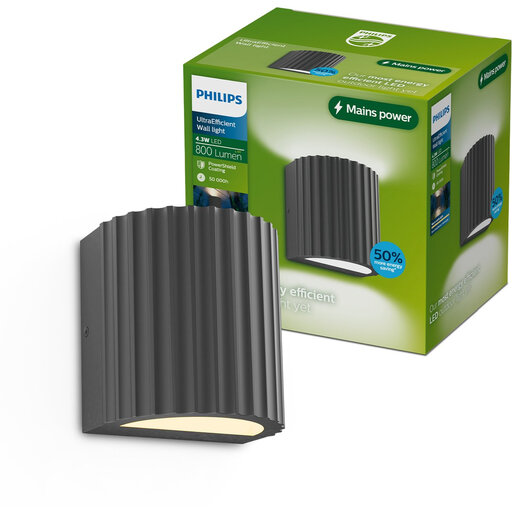
Why it suits this shopper: The integrated LED and two-way light output suit a modern exterior wall where design and a consistent light colour matter.
The specifications include the brightness, colour temperature, connection type and IP44 rating. So you won’t need to choose a separate bulb or guess what colour light to expect.
800 lumens, 2700 K warm white light, integrated LED and light in two directions. The stated lifespan is up to 50,000 hours.

Why it suits this shopper: This solar outdoor light is designed for people who don’t want to install wiring and need extra light by an entrance, shed or garden path.
The product specifications mention both a motion sensor and automatic dusk operation. It still needs to be positioned where it can receive enough direct sunlight.
1000 lumens, 3000 K, integrated LED, two lighting modes and installation without a connection to the mains.
For a fixed-wiring LED outdoor wall light, switch off the power at the consumer unit before carrying out any work. Use wall plugs and screws suited to the surface, such as brick, concrete or sheet material. For a solar light, check that the mounting surface is stable and that the panel won’t be shaded by a roof edge, tree or balcony.
Clean the housing and solar panel regularly with a soft, dry cloth. Don’t use abrasive cleaners or solvents. Also check the seals, cables and fixing points for any visible damage.
We’ve put together a complete, up-to-date list of products that meet these strict selection criteria and the applicable European safety regulations.
IP44 is suitable for many sheltered outdoor locations, such as a covered entrance, balcony or exterior wall. It protects against splashing water, but not against submersion or direct jets of water. Install the light in accordance with the fitting instructions.
Lifespan varies by model and use. Some integrated LED models state up to 50,000 hours, while other solar models state 25,000 hours. These are stated product specifications, not a guarantee of an exact operating life. With a non-replaceable LED, you’ll need to replace the entire fitting when the light source reaches the end of its lifespan.
A sensor can reduce the time the light stays on by switching it on only when movement is detected or when it’s dark. Actual energy use depends on the wattage, the set lighting duration and how often the sensor is activated. A solar outdoor light doesn’t use electricity from the mains, but its operation still depends on sunlight and battery capacity.
