
Vandaag of morgen in huis

Kwaliteit gegarandeerd

Welkomstaanbiedingen ontgrendelen: GRATIS bezorging | Tot 80% korting | Gratis 30 dagen JoyPlus-proefperiode
Download de app
An outdoor wall light can make an entrance feel safer, create a more inviting atmosphere on a balcony or brighten up a dark exterior wall. However, you may not realise the difference between a suitable outdoor wall light and a poor choice until after it’s installed. A light may look great, but be poorly positioned, not bright enough or unable to withstand the conditions around your home.
So consider more than just colour and design. These points will help you choose the right outdoor wall light.
An IP44 outdoor light is protected against solid objects larger than 1 millimetre and splashing water from different directions. This doesn’t mean it’s suitable for a direct jet of water, submersion or a completely exposed spot where rain constantly hits the housing.
So check where the light will be installed. IP44 may be suitable under a canopy or beside a sheltered front door. On an exterior wall exposed to strong winds and rain, the installation method and exact position may be especially important.
Some models have integrated LED, while others are supplied without a bulb. If the fitting is GU10 or E27, you’ll need to buy a suitable LED bulb separately. Check:
A replaceable light source gives you more choice. Integrated LED is often compact and easy to use, but the light source can’t always be replaced separately.
An outdoor wall light with a sensor won’t respond in the same way in every situation. A motion sensor detects movement, while a dusk sensor measures the amount of ambient light. Some lights combine both functions.
Pay attention to where the light is positioned, too. A sensor pointing towards a busy footpath or public road may activate more often than you’d like. With a solar outdoor wall light, the amount of sunlight also matters. In winter in the Netherlands, the operating time may be shorter if the panel receives little direct sunlight.
Lumens indicate how much light a lamp produces. Functional light is useful by an entrance or keyhole, while a softer light output may be more pleasant on a balcony or terrace. A colour temperature of 2700K gives a warm white light. At around 3000K, the light still looks warm, but slightly fresher. At around 4000K, it appears more neutral and is better suited to places where visibility matters more than ambience.
Remember that lumens and wattage aren’t the same. Wattage indicates electricity consumption, while lumens describe light output.
Aluminium is often used for exterior wall lights because it’s relatively lightweight. Glass can create a classic look and diffuse the light, but needs more care during installation and maintenance. A coating can protect the surface, but always check the product information rather than relying on general marketing claims.
Several Philips outdoor lighting models are listed as having a PowerShield coating. Its protective effect and lifespan should be treated as product specifications or information provided by the brand, not as a universal guarantee for every exterior wall.
A wired LED outdoor wall light running on 230 volts must be safely connected and properly sealed. Have work on the fixed electrical installation carried out by a qualified professional. Switch off the power before installation or maintenance, and follow the instructions.
A solar or rechargeable model doesn’t need a fixed power connection. Check that the wall is suitable for the fixings and that the solar panel will receive enough daylight. For a magnetic model, make sure the mounting plate is securely fixed and level.
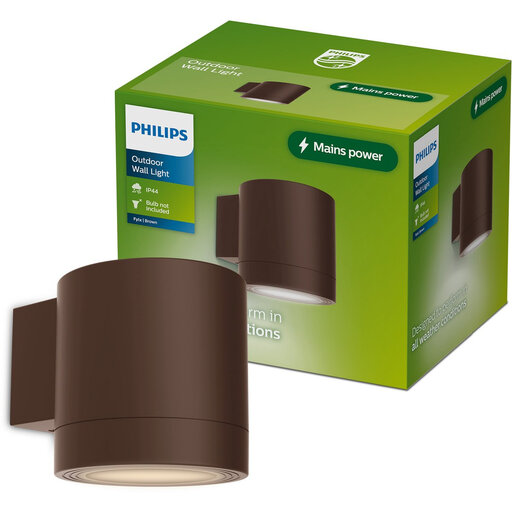
Why it suits this profile: This compact fitting has a GU10 fitting and is supplied without a light source. You can choose an LED spotlight to suit your budget and preferred light colour.
The product information clearly states that the GU10 bulb isn’t included. The IP44 rating is also shown, so you can consider the installation location in advance.
GU10 fitting, replaceable light source, aluminium housing and IP44 rating for outdoor use.
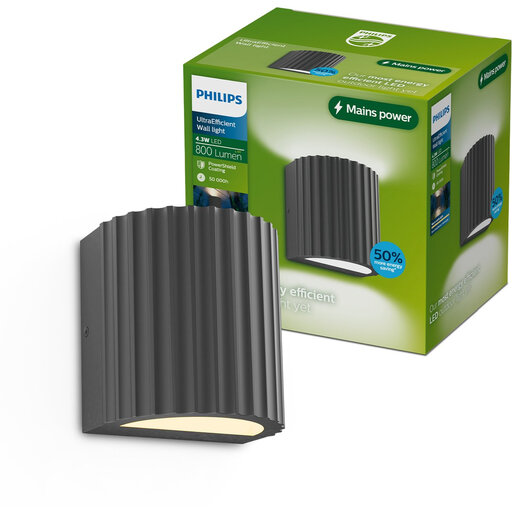
Why it suits this profile: The integrated LED shines in two directions and complements a modern exterior, entrance or balcony where you want a decorative lighting effect.
The fitting and light source are integrated, so you won’t accidentally buy the wrong bulb. The IP44 rating is listed in the product specifications.
800 lumens, 2700K warm white light, integrated LED and light in two directions.
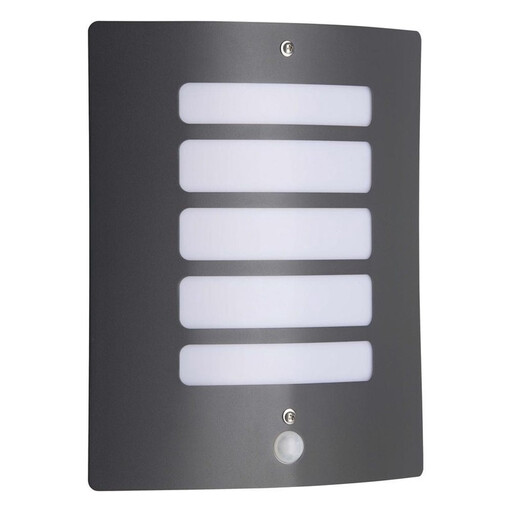
Why it suits this profile: This wired wall light is designed for entrances, exterior walls and passageways where you want the light to switch on automatically. The E27 fitting lets you choose your own LED bulb.
The motion sensor is clearly listed as a feature, and the light is supplied without a light source. This means both the sensor function and your choice of E27 LED are clear from the outset.
Integrated motion sensor, E27 fitting, maximum 60 watts and IP44 rating.
We’ve put together a full, up-to-date list of products that meet these strict selection criteria and the applicable European safety regulations.
IP44 is used for many sheltered outdoor locations, as this rating offers protection against splashing water. IP44 doesn’t mean waterproof. Consider how exposed the light is to rain, whether it’s sheltered and what the installation instructions say. For a very exposed location, a higher protection rating may be worth considering, provided it’s suitable for the fitting and installation.
It can be, as the light only switches on when movement is detected. Actual energy use depends on the wattage, how long the light stays on, how often it’s activated and the sensor’s sensitivity. Adjust the sensor so it doesn’t respond unnecessarily to traffic outside your property.
Lifespan varies by product and conditions of use. Some brands state an expected operating life, but according to the brand’s own information, this isn’t a guarantee for every real-world situation. As well as the stated lifespan, consider heat dissipation, correct installation, exposure to moisture and whether the light source can be replaced.
