
Vandaag of morgen in huis

Kwaliteit gegarandeerd

Welkomstaanbiedingen ontgrendelen: GRATIS bezorging | Tot 80% korting | Gratis 30 dagen JoyPlus-proefperiode
Download de app
An outdoor wall light might seem simple to choose: select a model, attach it to the wall and you’re done. In practice, problems often only become apparent after a few weeks. The light isn’t bright enough, the motion sensor is triggered by passing cats, or the solar panel gets hardly any direct sunlight.
For homeowners, tenants and garden lovers, there are three pitfalls in particular to watch out for:
For a covered entrance, balcony or sheltered patio, IP44 may be suitable. This rating means protection against solid objects larger than 1 millimetre and splashing water from different directions. It doesn’t guarantee that the fitting can withstand every type of weather.
Also check whether the seal is only maintained when the light is installed correctly. On models with a separate bulb holder, such as an E27 outdoor light or GU10 fitting, make sure the cover or compartment closes securely. A light under an overhang will generally get less direct rain than an exterior wall light on a completely exposed wall.
Colour temperature is measured in kelvin:
Also check the lumen rating. For example, Philips models in this selection provide 800 lumens at 4.3W, while some solar outdoor lights offer 180 to 500 lumens. A model with fewer lumens may be enough for a balcony, but less suitable for lighting a wide driveway.
Pay attention to light distribution too. A light that shines in two directions can draw attention to an exterior wall. A shielded downlight, on the other hand, directs the light more precisely and reduces upward light spill.
An integrated LED outdoor wall light is usually ready to use straight away, but the light source often can’t be replaced by the user. With an E27 or GU10 fitting, you can choose the bulb, light colour and, if required, dimmability. However, you’ll need to buy a suitable light source yourself.
A solar outdoor light doesn’t need a 230V connection. This makes installation easier, but its performance depends on its position, battery capacity and the amount of sunlight it receives. In winter, or on a north-facing wall, the operating time may differ from the product description.
For a fixed mains connection, it’s best to have the installation carried out in accordance with local regulations. Switch off the power before working on existing wiring.

Why it suits this type of user: This compact light runs on solar power and doesn’t need a fixed electrical connection. With 180 lumens, 2700K light and an integrated sensor, it’s suitable for an entrance, balcony or sheltered garden wall.
The specifications clearly state that the light output is limited to 180 lumens. So don’t expect a wide beam for lighting a driveway. The IP44 rating protects against splashing water; it doesn’t mean the light is completely waterproof.
Solar power, integrated motion sensor, 2700K light and compact dimensions of 11,5 × 10 × 11 cm.
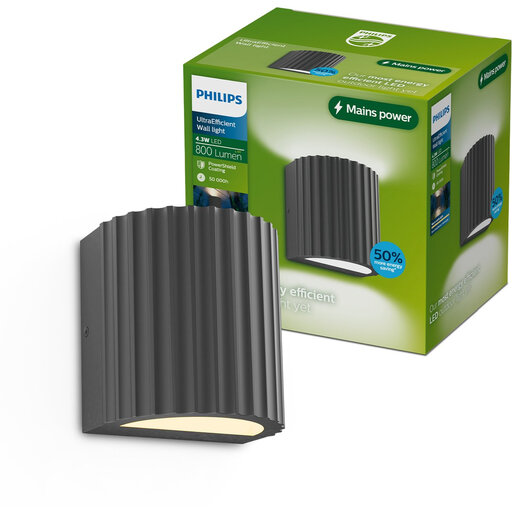
Why it suits this type of user: The integrated LED provides 800 lumens of warm white light at 2700K. Its two-way light distribution makes it a good choice for lighting an exterior wall around a front door or along a garden path.
The light colour and output are specified in advance, so you don’t need to choose a separate bulb. However, bear in mind that the LED is integrated and can’t be replaced separately.
800 lumens, 4,3W, 2700K, aluminium and plastic, plus IP44 protection for outdoor use according to the product specifications.

Why it suits this type of user: With 1000 lumens and a motion sensor, this model is designed for an entrance, garage or driveway where practical lighting matters more than ambience alone.
Its high light output makes it more suitable for practical lighting than compact ambient lights. Make sure you position the solar panel where it will receive enough direct daylight.
1000 lumens, 3000K, solar power, two lighting modes, motion sensor and IP44 protection.

Why it suits this type of user: This rechargeable light has a magnetic mount and a USB-C connection. It’s a practical choice if you don’t want to install fixed wiring or would like to move the light from time to time.
The battery needs regular recharging. The magnetic mount also requires a flat, sturdy surface. IP44 means protection against splashing water, not complete waterproofing.
300 lumens, 3000K, motion sensor, USB-C charging and wireless installation.
We’ve put together a complete, up-to-date list of products that meet these strict selection criteria and the applicable European safety regulations.
IP44 may be suitable for many sheltered exterior walls, balconies and entrances. The rating protects against splashing water, but not against immersion or direct jets of water. For a completely exposed location, carefully consider the installation position and product specifications.
Energy use depends on the wattage and how many hours the light is on. An integrated 4.3W model uses less energy when left on continuously than many older light sources. A motion sensor can reduce the amount of time the light stays on. A solar outdoor light doesn’t use electricity from the mains, but depends on sunlight and the capacity of its built-in battery.
Lifespan varies depending on the light source, battery, materials and conditions. Manufacturers may state an expected LED lifespan; Philips lists a long lifespan for some models, based on its own figures. This isn’t a guarantee for every real-world situation. With a replaceable E27 or GU10 bulb, you can change the light source later, whereas an integrated LED usually means replacing the entire fitting.
