
Vandaag of morgen in huis

Kwaliteit gegarandeerd

Welkomstaanbiedingen ontgrendelen: GRATIS bezorging | Tot 80% korting | Gratis 30 dagen JoyPlus-proefperiode
Download de app
An outdoor wall light can make an entrance feel safer, create a welcoming glow on your patio or provide practical illumination for a dark garden wall. But choosing one based on colour or appearance alone isn’t a good idea. A black fitting might look great against your façade, but without suitable protection, the right light source or proper installation, you may be disappointed with your purchase.
Look out for these common pitfalls:
Many models are listed as IP44 outdoor lights. The first 4 indicates protection against solid objects larger than 1 millimetre. The second 4 means protection against water splashes from different directions. This makes IP44 suitable for many sheltered or partially sheltered outdoor locations, such as an entrance, balcony or patio.
IP44 doesn’t mean the light can withstand a high-pressure jet, immersion or prolonged exposure to extreme weather. For an exposed façade that gets a lot of driving rain, a higher rating, such as IP65, may be more practical. Also check that the seals are fitted correctly and the fitting is properly closed.
An LED outdoor light with an integrated light source is ready to use straight away and, according to the product specifications, often uses little energy. However, the light source can’t always be replaced separately. With a model that has an E27 or GU10 fitting, you can choose the colour temperature and brightness, and opt for a dimmable bulb if you wish.
Here are the key differences:
The bulb isn’t included with a fitting such as the Brilliant Newport. This model has an E27 fitting with a maximum rating of 60 W. The Philips Fylx uses a GU10 fitting and also comes without a spotlight bulb. So check what you already have and what you still need to buy.
A wired outdoor wall light runs on mains electricity and, according to the product information, must be connected by a qualified electrician. This is worth bearing in mind if you live in rented accommodation, need a new cable entry through the façade or are installing the light on a brick wall.
A solar wall light or rechargeable light is easier to install because it doesn’t need a permanent power cable. However, how long it stays lit depends on sunlight, battery capacity and sensor use. Also consider the material:
The features below are based on the product information provided by the brands. Brand claims about lifespan, weather resistance or energy performance aren’t a guarantee for every use case.
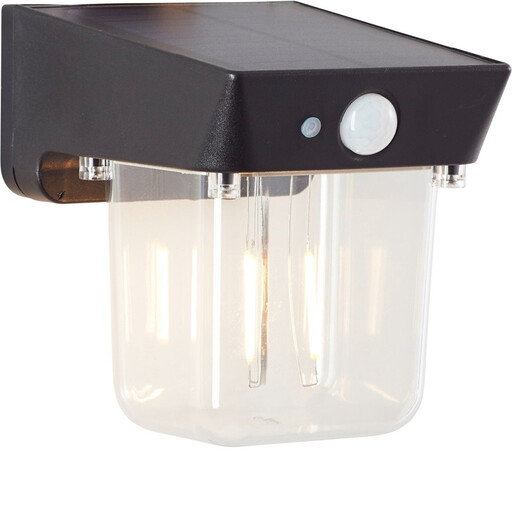
Why it suits this profile: This compact solar wall light is a good choice for an entrance, balcony or small garden without a power point. Its built-in motion sensor switches the light on when needed.
The product details list solar power, an integrated battery and IP44. That means there’s no need to plan for a separate mains connection, but make sure you place the panel somewhere with direct sunlight.
Integrated LED, 180 lm, 2700K, motion sensor and 2 W power, according to the product specifications.
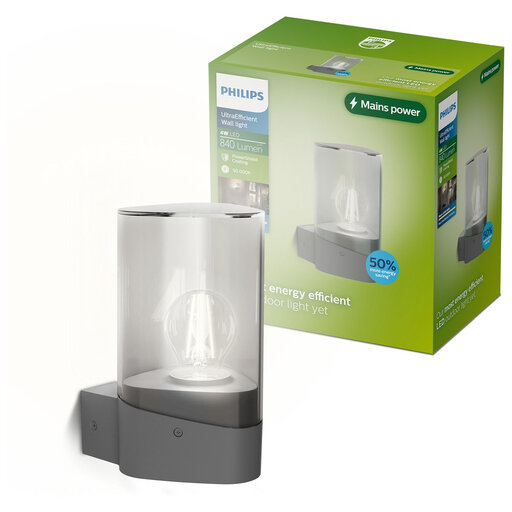
Why it suits this profile: This black outdoor light complements a modern façade and combines an E27 fitting with an included LED bulb. It’s a handy choice if you want warm light by your front door or patio straight away.
The product information lists IP44, 230 V, 4 W and an E27 fitting. Before installation, check that the fitting will be sufficiently sheltered and that the seal is positioned correctly.
840 lm, warm white light at 2700K, aluminium and plastic, plus a replaceable E27 light source according to the product details.

Why it suits this profile: A higher light output is useful for driveways, large façades or dark passageways. This solar model is designed for practical lighting and features motion and dusk sensors.
The product specifications list IP65, which may make this model more suitable for a more exposed position than an IP44 outdoor light. Make sure the solar panel gets enough daylight.
4000 lm, 3000K, integrated LED and solar power, with a detection range of 8 metres when approached directly, according to the product information.
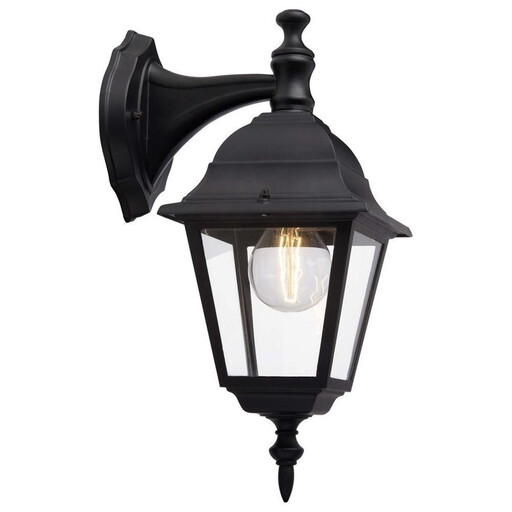
Why it suits this profile: Its hanging design and black metal finish are a good fit for a traditional veranda, garden wall or entrance where appearance matters.
The fitting, maximum load of 60 W and IP44 rating are all listed. The light isn’t waterproof, so it should be installed in a sheltered spot.
E27 fitting, externally dimmable when used with suitable components, 34 cm high and supplied without a light source.
We’ve put together a complete, up-to-date list of products that meet these strict selection criteria and the applicable European safety regulations.
An IP44 outdoor light is protected against water splashes and is suitable for many entrances, balconies and sheltered patios. Don’t install it somewhere exposed to water jets, flooding or prolonged direct rain. For an exposed façade, a model with IP65 may offer more protection.
A solar wall light uses solar energy during the day to charge its built-in battery. It doesn’t need a permanent connection to the mains. However, how well it works depends on the amount of direct sunlight, the temperature, the battery’s charge and how often the motion sensor activates the light.
Always follow the manufacturer’s installation instructions. In practice, make sure the sensor has a clear view of the approach area and won’t be triggered constantly by traffic, branches or pets. Also check that the mounting surface is secure, and have a qualified electrician connect any wired outdoor lighting.
