
Vandaag of morgen in huis

Kwaliteit gegarandeerd

Welkomstaanbiedingen ontgrendelen: GRATIS bezorging | Tot 80% korting | Gratis 30 dagen JoyPlus-proefperiode
Download de app
An outdoor wall light can make an entrance, balcony, exterior wall or patio more practical. But it’s not a good idea to choose one based on appearance or a high lumen rating alone. A light that looks great in a product photo may not provide enough light in practice, may be unsuitable for an exposed wall or could be difficult to install.
As Joybuy Product Recommendation Officer, I start by checking verifiable specifications. That way, you can avoid paying for features your outdoor space doesn’t need.
An IP44 outdoor light is protected against solid objects larger than 1 millimetre and splashing water from different directions. This doesn’t mean it can withstand direct water jets, immersion or prolonged exposure to extreme weather.
IP44 may be suitable for a covered balcony or sheltered veranda. If you’re mounting an outdoor wall light on a fully exposed exterior wall, check the installation location and the manufacturer’s instructions carefully. A higher IP rating, such as IP65, offers greater protection against dust and water according to the classification, but always check that the entire construction is designed for this.
Lumens indicate how much light a lamp emits according to its product specifications. Light distribution is just as important. A compact garden wall light with 300 lumens may be enough for a balcony or as orientation lighting. For a driveway or large patio, a higher light output may be more suitable.
Pay attention to the colour temperature too:
Don’t treat a brand’s claims about ambience, safety or energy savings as guaranteed results. According to the brands’ own product information, features such as lifespan and energy consumption can vary between models.
A solar outdoor wall light needs to receive enough direct sunlight during the day. Shade from a canopy, tree or neighbouring exterior wall can limit its charging performance. In winter or during several overcast days, its operating time may also differ from what you’d get in sunny conditions.
For a light with a motion sensor, also check the detection angle, range and available settings. A sensor aimed at a busy footpath may activate more often than you’d like.
Choose the IP rating based on where you’ll install the light, not just the product title. IP44 may be sufficient for a sheltered wall. Also check whether the light is designed for a fixed 230V connection, solar power or a rechargeable battery.
A mains-powered light, such as an LED outdoor wall light with an integrated light source, must be connected in accordance with local regulations. If in doubt, have fixed electrical work carried out by a qualified electrician.
With integrated LED lighting, the light source is built into the lamp. This allows for a compact design, but on some models the LED can’t be replaced by the user. With a fitting for an E27 or GU10 bulb, you can choose the light source yourself and often select the colour temperature too.
Check:
Measure the available wall space before ordering. A wide wall light may be awkward beside a door or on a narrow balcony. Check the direction of the light too: downward-facing light works well for a garden path, while two-way or diffuse lighting may be more suitable for illuminating an exterior wall and creating atmosphere.
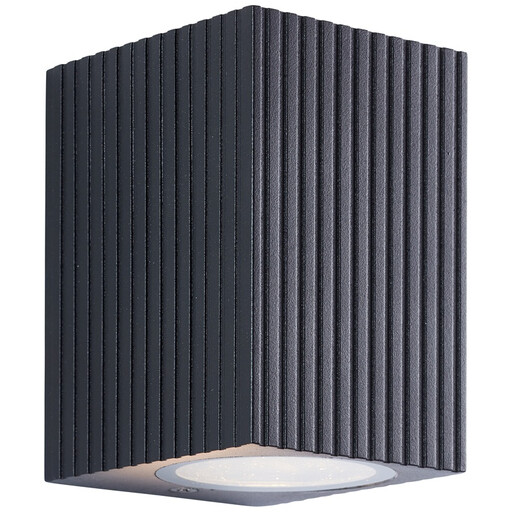
Why it suits this profile: A compact black outdoor light for anyone who wants to choose their own GU10 LED bulb for an exterior wall, patio or entrance.
The fitting is clearly specified, and the light is supplied without a bulb. This means you can choose your preferred colour temperature and brightness in advance.
GU10 fitting, aluminium/plastic/glass construction and IP44 rating. The maximum load is 10W; fixed wiring must be installed by a qualified electrician.
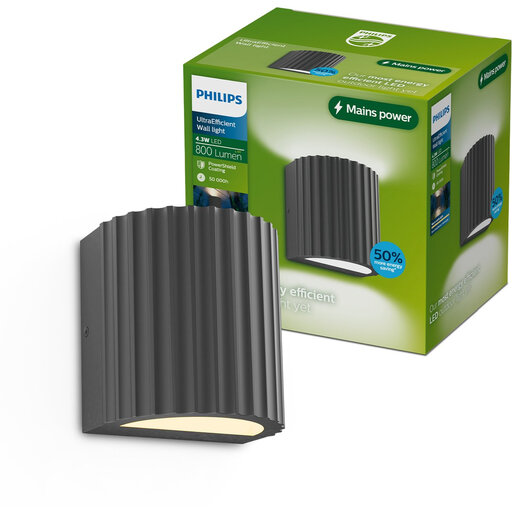
Why it suits this profile: For anyone looking for a fixed, modern outdoor wall light with warm light and an up-and-down effect for an exterior wall or patio.
The product specifications state both the light colour and the light output, so you don’t have to rely on an atmospheric product photo alone.
Integrated LED, 800 lumens, 2700K warm white light, 230V connection and IP44 rating. The product information gives a lifespan of up to 50,000 hours of use.

Why it suits this profile: For large gardens, driveways, garages or patios where broad light coverage and motion detection are important.
The product specifications clearly state the detection range, viewing angle, three lighting modes and IP65 rating. Do check that the installation spot receives enough direct sunlight.
Solar-powered, with three adjustable light heads, 3000 lumens, a stated detection range of 60 feet and a 180-degree detection angle.
We’ve put together a complete, up-to-date list of products that meet these strict selection criteria and the applicable European safety regulations.
Compact models with IP44, warm white light and a modest light output are often a practical choice for a balcony. A solar outdoor wall light can be useful if there’s no power connection, but place the solar panel somewhere it will receive enough direct daylight. Measure the available wall space beforehand.
Lifespan varies by model and operating conditions. Manufacturers sometimes state a figure such as 20,000 or 50,000 hours of use. This is a product specification, not a guarantee that the light will work for exactly that long. With integrated LED lighting, it’s often not possible to replace just the light source; with an E27 or GU10 fitting, you can usually replace the bulb.
A solar outdoor light doesn’t use mains electricity, but it depends on sunlight and an internal battery. For a 230V model, energy consumption depends on the wattage and the number of hours it’s on. For example, a 4.3W light uses less electricity per hour of use than a 20W model. Before choosing, compare the wattage, operating time and how the sensor is activated.
